Last updated: August 14, 2026
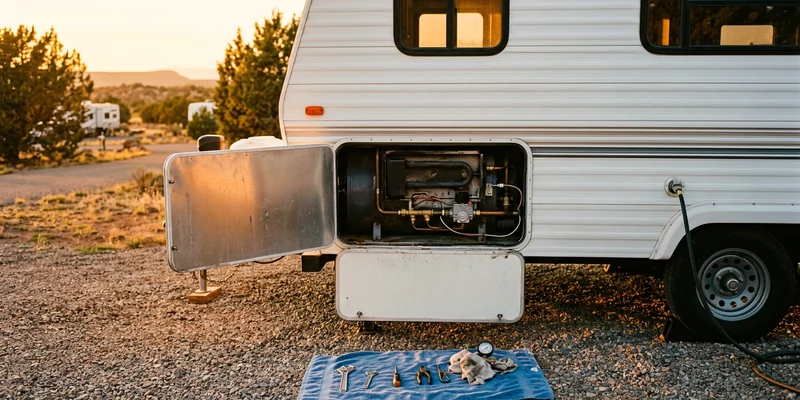
Almost every hot water problem in a camper traces back to one question that owners cannot answer about their own rig: what kind of RV water heater is behind that little outside access door? A steel tank with an anode rod behaves nothing like an aluminum tank without one. A gas only unit fails in different ways than a gas plus electric unit. And a tankless unit shares almost none of its failure points with either. Buying the wrong part, or chasing the wrong symptom, usually starts right there.
So this guide is the map. It covers the two tank families and how to tell them apart in about thirty seconds, what the gas side and the electric side each contribute, how tankless actually differs once it is installed, what size and recovery rate mean in practice, and the maintenance that decides whether your heater lasts five years or fifteen. Where a specific fault needs its own walkthrough, we link straight to it.
This article contains affiliate links. If you buy through them, we may earn a commission at no extra cost to you. Learn more.
Quick Answer
What is the difference between a tank and a tankless RV water heater?
- A tank heater stores a fixed volume, commonly 6 or 10 gallons, and heats it in advance. You get instant hot water until the tank runs out, then you wait for it to recover.
- A tankless heater has no storage at all. It fires only while water flows, so hot water is effectively unlimited, but it needs a minimum flow to trigger and it demands a steady water supply.
- Within tanks there are two families: steel tanks with a sacrificial anode rod, and aluminum tanks that never had one. Knowing which you own decides your maintenance and your parts list.
- Anything involving the gas line, the regulator, the gas valve, the burner tube or the orifice belongs to a certified RV technician. We do not publish those procedures.
RV Water Heater Types at a Glance
Find your setup in the left column. The rest of the row tells you how it makes hot water, who it suits, and the specific thing that catches owners out with that type.
| Type | How it heats water | Suits | Watch out for |
|---|---|---|---|
| Steel tank, gas only | Propane burner heats a stored 6 or 10 gallons | Boondockers and older trailers | Needs an anode rod, and it needs 12V power even to light |
| Steel tank, gas plus electric | Same burner, plus a screw in 120V element | Owners who move between hookups and dry camping | Two heat sources means two separate fault paths |
| Aluminum tank (Atwood, now Dometic) | Burner heats an aluminum tank clad in steel | Owners who want less maintenance | No anode rod, plastic drain plug, do not add a rod |
| Propane tankless | Fires a burner only while water is flowing | Long showers, larger families, full timers | Needs adequate propane supply and a minimum flow rate |
| Electric tankless | Heats flowing water with electric elements | Rigs that live on 50 amp shore power | Heavy current draw, unrealistic on a generator or battery |
| Motoraid style tank | Adds engine coolant heat while driving | Motorhomes on travel days | Only useful while the engine is running and warm |
| Hybrid tank plus tankless | Small buffer tank with on demand firing | Owners wanting steady temperature | More electronics, more to go wrong |
If yours is simply not making hot water right now, start at RV water heater not working, which routes you by symptom. If you are shopping rather than fixing, the honest side by side is in tankless versus tank.
The Two Tank Families, and How to Tell Them Apart
This is the single most useful thing to know about your rig, and it takes half a minute. Open the outside access door and look at the drain point at the bottom of the tank face. A metal hex plug that also serves as the anode rod means a steel tank, almost always Suburban. A white or grey plastic plug means an aluminum tank, almost always Atwood, a brand now sold under Dometic.
Steel tanks are porcelain lined and protected by a sacrificial anode rod, a bar of reactive metal that corrodes instead of the tank. That rod is a consumable and it is the main reason steel tanks need annual attention. Aluminum tanks were designed without one, because the aluminum forms its own protective layer, so the maintenance is mostly flushing sediment out.
Why fitting a rod to an aluminum tank is not an upgrade
Owners see anode rods sold for water heaters and assume every tank should have one. On an aluminum tank it is not a missing part, it is a design difference, and adding reactive metal to a tank that does not need it can create the exact sulfur smell you were trying to avoid. Check the label on the access door or the model number in your manual before you buy anything. Our guides on the RV water heater anode rod and Suburban anode rod sizing cover which rod fits what, and the replacement walkthrough covers the job itself.
🔩 The consumable part on a steel tank
An anode rod in the standard 3/4 inch NPT thread used by Suburban tanks, available in magnesium for maximum protection or aluminum zinc alloy, which owners with recurring sulfur odor commonly prefer. Confirm your thread size and rod length before ordering, and buy two so the spare travels with you.
How the Gas Side Works, and Where It Stops Being Yours
On a modern RV water heater, propane ignition is electronic. You flip a switch inside, a control board opens a valve and sparks an electrode, a sensor confirms flame, and the burner stays lit until the thermostat is satisfied. That whole sequence needs 12 volt power, which is why a gas heater with a dead 12V circuit will not light at all even though the propane is fine.
Older units instead use a standing pilot that you light by hand and hold in with a knob until a thermocouple warms up. Those still exist and they are simple, but they blow out in wind and they cannot be switched on from inside.
The line we do not cross
You are welcome to light your own heater following your manual, clean the igniter electrode and its ground contact, clear the exterior vent of debris and insects, check that your propane tanks actually have gas and that the valves are open, and read the fault codes your board gives you. We do not publish instructions for gas lines, regulators, gas valves, burner tubes, orifices, burner adjustment or thermocouple adjustment, because getting any of those wrong produces carbon monoxide or a leak, and neither announces itself politely. Those are certified RV technician jobs, without exception.
Stop immediately and get everyone outside if you smell gas, if a carbon monoxide alarm sounds, if you see soot around the vent, if the flame is yellow or lifting off the burner, or if there are scorch marks on the access door. Shut the appliance off, close the valve at the propane tank, ventilate, and call a technician before using it again.
🚨 The detector that has an expiry date on it
A combination propane and carbon monoxide alarm rated for RV use. These have a service life printed on the back, commonly five to ten years from the date of manufacture, and an alarm past that date is decoration. Check yours today; if the sticker is faded or missing, replace it.

The Electric Side and What It Actually Adds
A gas plus electric tank has a screw in 120 volt element in the side of the tank, commonly rated around 1400 watts, with its own switch. On shore power that lets you keep hot water without touching your propane, which over a season at a full hookup site is a meaningful saving in refills and in trips to the exchange cage.
What it does not do is heat quickly. A single element of that size takes far longer to bring a cold tank up than the burner does, which is why many owners run both together on the first morning of a trip and then leave it on electric alone. It is also the reason a heater can be dead on electric and perfectly healthy on gas, or the reverse, and why those two symptoms lead to completely different checks. See not heating on electric and will not light on propane for each path.
The one rule that kills elements
Never switch the electric element on with an empty or partly drained tank. An element that fires in air burns out in seconds, and this is by far the most common way owners destroy a healthy heater, usually on the first trip after winterizing. Fill the tank, run a hot tap until the flow is steady and free of air, and only then turn the element on.
How Tankless Is Genuinely Different
A tankless unit stores nothing. Water flows through a heat exchanger and a burner fires for exactly as long as the tap is open, so you cannot run out of hot water and you are not carrying 80 pounds of water around when the tank is full. That is the appeal, and for full timers and families it is a real one.
The trade offs are just as real. A tankless unit needs a minimum flow to trigger, commonly somewhere around half a gallon per minute, so a barely open tap can leave you standing in cold water. It is more sensitive to inconsistent supply pressure, which is why owners with a marginal water pump often notice temperature swings. Propane models are typically rated in the 40,000 to 65,000 BTU range and want a healthy propane supply to reach that. And scale builds inside the heat exchanger on hard water, which is why descaling is a routine job rather than an emergency one.
If you are considering the switch, start with the honest comparison, then what installation involves. For shopping, we cover the best RV tankless water heaters overall, plus separate roundups for propane models and electric models. When one misbehaves, tankless repair covers what actually fails.
Size and Recovery: What You Really Get
Tank size tells you how much hot water you start with, not how much you get. Because cold water enters as hot water leaves, the usable hot water from a tank is meaningfully less than its rated volume, and a 6 gallon tank realistically supports one short shower or a round of dishes before it fades.
Recovery is the number that matters more. On gas, a typical RV tank reheats in well under an hour; on the electric element alone it takes considerably longer. That is the whole argument for tankless in a busy rig, and the whole argument against upsizing a tank you cannot recover quickly.
| Your usage | Sensible choice | Why |
|---|---|---|
| Weekend couple, campground hookups | 6 gallon tank, gas plus electric | Cheap to run on shore power, simple to service |
| Family of four, back to back showers | 10 gallon tank or propane tankless | Recovery, not capacity, is the constraint |
| Full timers with hard water | Tank, or tankless with a descaling routine | Scale is the main tankless maintenance item |
| Boondocking on limited propane | Tank, gas mode | Predictable propane use and no minimum flow issue |
| Rig always on 50 amp shore power | Electric tankless is viable | Current draw is the limiting factor everywhere else |
| Cold climate camping | Tank with a proper winterizing routine | Fewer small passages to freeze and split |
The Maintenance That Decides Its Lifespan
Water heaters rarely die suddenly. They die from sediment, from a spent anode rod, and from freezing, and all three are preventable with an afternoon a year.
Drain and flush the tank at least once a season, more often on hard water. Sediment insulates the bottom of the tank so the burner works harder for less result, and on a gas plus electric unit it packs around the element and cooks it. A rinse wand through the drain opening removes what gravity leaves behind, and the difference in what comes out is usually startling.
Rod, relief valve, vent, and winter
On a steel tank, inspect the anode rod every year and replace it when it is heavily pitted or thinned toward its core wire. Exercise the pressure relief valve occasionally so it does not seize, and expect it to weep a little as the tank heats, which is normal expansion rather than a fault. Keep the exterior vent clear of insect nests and road debris. And winterize properly: bypass the heater, drain it fully, and never leave water in a tank through a hard freeze. Our guides on keeping RV pipes from freezing and winterizing a tankless unit cover both routines, and tankless maintenance handles the descaling schedule.
🚿 What makes a flush actually work
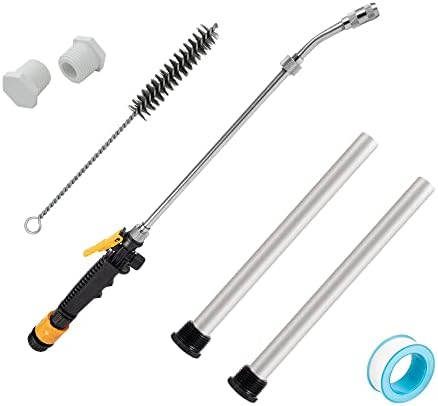
A water heater tank rinse wand that reaches through the drain opening and sprays in every direction. Gravity draining alone leaves most of the sediment sitting on the bottom of the tank, which is why owners who flush every year still find grit the first time they use a wand.

If your hot water smells of rotten eggs rather than failing to arrive, that is a separate and very solvable problem, covered in why RV hot water smells like sulfur.
🐝 The cheapest insurance on the gas side
A stainless insect screen sized for your water heater’s exterior vent. Mud daubers and spiders build in the warm airflow of the burner area, and a blocked vent is one of the most common reasons a heater will not stay lit. The screen goes on the outside of the vent, which keeps it firmly in owner territory.

Where This Stops Being a DIY Job
The owner side of a water heater is generous: switches, fuses, 12 volt readings, the anode rod, the drain, the vent exterior, the igniter electrode, and choosing a replacement unit. These are not yours.
- Anything on the propane side. Gas lines, regulators, gas valves, burner tubes, orifices, burner adjustment and thermocouple adjustment go to a certified RV technician. We deliberately do not publish those steps.
- Anything on the 120 volt side. Element wiring, thermostat wiring and breaker work belong to a certified RV technician or licensed electrician.
- A hot or pressurized tank. Never open a drain, an anode rod or a relief valve on a warm tank. Switch everything off, let it cool for several hours, kill the water supply, open a hot tap, and lift the relief valve lever first.
- Soot, yellow flame, gas smell, or a CO alarm. Shut it down, close the propane at the tank, ventilate, get out, and call a technician.
- Water inside the structure. Soft floors, stained ceilings or a musty smell mean water has been in the framing. That gets assessed properly, because subfloor rot has a deadline.
Common Mistakes to Avoid
- Turning the element on before the tank is full. The single most common self inflicted failure, and it happens in seconds.
- Leaving the heater bypassed after winterizing. The heater then works perfectly while delivering no hot water to any tap, which sends people chasing a fault that does not exist.
- Adding an anode rod to an aluminum tank. It was never missing. Check which tank you have first.
- Ignoring a weeping relief valve. A little drip on heat up is normal expansion; a constant stream is not, and a valve that has never been exercised can seize.
- Skipping the annual flush. Sediment is what turns a fifteen year heater into a six year heater.
- Treating a blocked vent as cosmetic. Insect nests in the burner area are a real safety issue, not a nuisance.
Where to Go From Here
If nothing is happening at all, work through RV water heater not working first, then branch by what is dead: dead on gas and electric, electric only, or propane only.
If your unit is brand specific and behaving oddly, we cover Suburban water heaters and Dometic and Atwood water heaters separately, because the tank material and the reset locations differ. And if the fault turns out to be water delivery rather than heat, start at RV water pump repair instead.
Frequently Asked Questions
How long does an RV water heater take to heat up? On propane, a typical 6 gallon RV tank reaches temperature in well under an hour. On the 120 volt element alone it commonly takes several times longer, which is why many owners run both together on the first morning of a trip.
Can I run an RV water heater on gas and electric at the same time? On gas plus electric models, yes, and it is the fastest way to recover a cold tank. Check your own manual, since a few units specify otherwise.
Does an RV water heater need 12 volt power to run on propane? On electronic ignition models, yes. The board, the spark and the gas valve all run on 12 volts, so a dead fuse or a flat battery stops the burner even with full propane tanks.
How do I know whether my tank is steel or aluminum? Look at the drain point behind the outside access door. A metal hex plug that doubles as the anode rod means a steel Suburban style tank. A plastic plug means an aluminum Atwood or Dometic tank with no rod.
Is tankless worth it in an RV? It is if you run out of hot water regularly, camp with hookups or a strong propane supply, and can live with a minimum flow rate. It is a poor fit if your water pump struggles or you camp mostly in freezing weather.
Why is water dripping from my pressure relief valve? A small weep as the tank heats is normal thermal expansion. A steady flow, or dripping when the heater is cold, points at a valve that needs replacing or a tank running too hot, which is worth having looked at.
The Bottom Line
Identify your tank first: steel with an anode rod, aluminum without one, or tankless with no tank at all. That one fact decides your maintenance, your parts and your troubleshooting path. Flush the tank yearly, replace the rod when it is spent, keep the vent clear, never fire the element into an empty tank, and winterize properly. Keep the 12 volt work and the housekeeping for yourself, and hand every gas component and every 120 volt connection to a certified RV technician.