Last updated: August 14, 2026
An electric RV tankless water heater removes the propane, the venting, the ignition faults and the relighting, and replaces all of it with one problem: electricity, in quantity, for as long as the tap is open. Heating water is one of the most power hungry things you can ask a rig to do, and unlike an air conditioner it cannot be staged or cycled. The element is either on and drawing its full rating or off and giving you cold water.
That is why this format only makes sense for a particular kind of camping. If you are on a fifty amp site, in a seasonal spot, or parked at a house with a proper feed, an electric on demand unit is genuinely pleasant to live with. If you are on a thirty amp pedestal, it is a real trade against your air conditioner, and if you are off grid it is not a candidate at all. This guide covers the power math honestly first, then the units worth considering for each case.
This article contains affiliate links. If you buy through them, we may earn a commission at no extra cost to you. Learn more.
Quick Answer
Should you fit an electric RV tankless water heater?
- Only if you are on shore power essentially all the time. These units cannot run from a battery bank or an inverter in any practical sense, and a portable generator large enough is a poor fit for the job.
- On a thirty amp pedestal, expect to choose between hot water and the air conditioner. That is not a fault, it is the arithmetic of a single thirty amp feed.
- Read the flow figure with the temperature rise it was quoted at. Electric units lose more than owners expect when the incoming water is cold.
- Any 120 volt wiring, dedicated circuit or breaker work is a job for a certified RV technician. Owner installed heating circuits are how rigs catch fire.
What to Check Before You Buy
Electric units are compared on different points than propane ones, and half the list is about your rig’s power rather than the heater. Work down these in order, because the first two rule out most of the market for most owners.
| What to check | Why it matters | What to look for |
|---|---|---|
| Amp draw at full output | This is the number that decides whether the unit works on your site at all | The rated amps on the listing, compared against your service and what else runs at the same time |
| Voltage required | Some units are standard 120 volt, others expect a heavier supply an RV does not have | Confirm 120 volt operation unless you are on a fifty amp service and a technician has confirmed the circuit |
| Temperature rise at rated flow | The honest measure of output, and where electric units are weakest | Flow quoted together with the rise, plus a stated minimum inlet temperature if there is one |
| Minimum activation flow | Decides whether the unit switches on at a low shower setting | A low threshold, since RV pumps and low flow fixtures sit near it |
| Mounting format | Wall replacement units and point of use units are different products | A wall unit if you are replacing a tank heater, a point of use unit if you are feeding one fixture |
| Dedicated circuit | Most units want a circuit of their own rather than sharing | Whether the manual calls for a dedicated breaker, and what size |
| Controls and display | An outlet temperature readout tells you what the unit is actually doing | A digital setpoint rather than a fixed thermostat, ideally with a temperature display |
| Freeze protection | Passages are small and an unheated bay is cold | A documented drain and winterizing procedure from the manufacturer |
Before you buy anything, look at what your pedestal actually delivers. Our explainer on thirty amp versus fifty amp RV service is the piece of background that makes the rest of this guide make sense, because the two services are not a small step apart.
The Power Math Nobody Puts on the Box
A thirty amp RV service is a single 120 volt circuit, shared by everything in the rig and nothing like a house supply. An air conditioner takes a large share on its own, the converter takes some, and the microwave takes most of what is left while it runs. An electric tankless heater is comparable to the air conditioner, and two loads of that size on one thirty amp feed is not something you can schedule your way out of.
In practice that means you can have hot water or air conditioning, and switching between them by hand is the reality of living with the unit. Workable in spring and fall, irritating in August. On fifty amps you have two 120 volt legs and considerably more headroom, and a technician can put the heater on its own circuit on the leg that is not carrying the air conditioner. That is where these units stop being a compromise.
If breakers trip, do not just reset them
A heating load that trips a pedestal breaker repeatedly is telling you something about the supply, the circuit or the unit, and the fix is not a bigger breaker. Our guide to why RV breakers trip at a campground pedestal covers what to check and where the line is, and a heating circuit that trips belongs to a certified RV technician rather than to trial and error.
Temperature Rise Is the Real Limit
Every tankless heater is rated to raise incoming water by a certain number of degrees at a certain flow, and those two figures move against each other. Open the tap wider and the rise drops. That is physics rather than a design flaw, but electric units feel it more sharply because the power available to them is capped by your pedestal, and no amount of shopping raises that cap.
The consequence is seasonal. In summer, with water arriving from a hose lying in the sun, the rise needed for a shower is small and a modest unit copes easily. In spring, or in a northern park where the supply is genuinely cold, the same unit works far harder and shows it by delivering less flow at temperature. Owners who call a heater fine in July and useless in April are describing correct behavior at a different inlet temperature.
Our Top Picks at a Glance
How we chose: we compared available electric on demand units on rated amp draw, voltage, flow relative to the quoted temperature rise, minimum activation flow, mounting format, and the patterns that repeat in owner feedback. Our assessment is based on published specifications and that feedback rather than on any trial of our own. The first pick suits far more rigs than its size suggests, and the second is only sensible on a fifty amp site.
🏆 Best for Thirty Amp Hookups
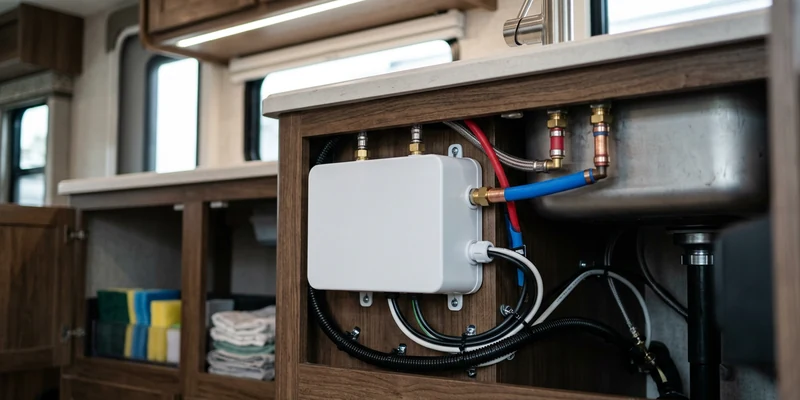
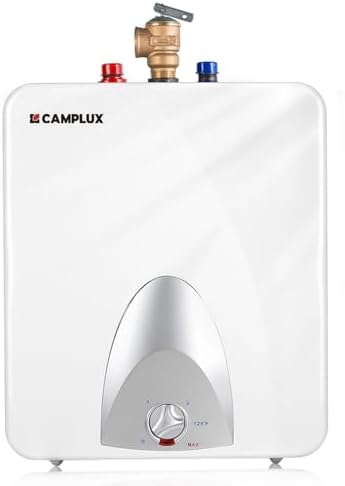
A compact 120 volt point of use electric tankless heater sized for a single fixture, fitted close to the shower or the galley. Keeping the unit small keeps the amp draw within what a thirty amp pedestal can spare, and mounting it near the outlet cuts the wait and the water wasted. It will not serve two fixtures at once, but for one person showering in a small rig it is the version of this idea that fits the power available. Confirm the amp rating against your service before ordering.
⬆️ Best for Fifty Amp and Seasonal Sites
A larger electric tankless unit with a digital temperature setpoint, for rigs on a fifty amp service or parked at a house with a proper supply. The extra capacity is what holds shower temperature when the incoming water is cold, which is exactly where small units run out. It needs a dedicated circuit and a technician to install and confirm it, so budget for the labor too.

🔥 Honestly, Most People Should Buy This Instead
A propane RV tankless unit, if there is any chance of camping without a pedestal. It is the more flexible appliance in nearly every scenario: it works off grid, it does not compete with the air conditioner, and its output does not fall away because the site wiring is tired. The trade is combustion, venting and a gas connection a technician has to make. Our propane RV tankless guide covers that side.

Where Electric Makes Sense and Where It Does Not
The decision comes down to how much of your camping happens with a cord plugged in, and secondarily to how cold the water arrives. These four cases cover almost everyone.
- Seasonal site or long stay park on fifty amps. The case electric was made for. No propane to run out of, nothing to relight, no venting, and enough supply to run the heater and the air conditioner together.
- Thirty amp site, one or two people. Workable with a small point of use unit and the habit of switching the air conditioner off before showering. Fine in mild weather, tiresome in a heat wave.
- Touring with mixed hookups. Choose propane. Half the appeal of a tankless heater is a hot shower whenever you want one, and an electric unit hands that back every time you park without power.
- Off grid or boondocking. Not a candidate. Heating water electrically drains a battery bank faster than almost anything else, and running a generator for the length of a shower is an expensive way to do what propane does quietly.
Buy These at the Same Time
Two items matter more on an electric installation than a propane one, because both of your risks now come from the pedestal rather than a flame.
⚡ The One That Protects the Unit
A surge protector with an electrical management system showing voltage and current on the display. Park wiring sags under load, and a heating element pulling hard on a tired pedestal is exactly where low voltage does damage. The current readout also shows what the heater draws in practice, which is the fastest way to learn what your rig can run at once. Our surge protector guide covers the difference between a basic protector and a full management system.

🧪 The Maintenance Item for Hard Water
A descaling kit with a small circulation pump, hoses and a food safe solution. Elements and narrow heat exchanger passages scale up on hard water, which shows first as reduced flow and unstable temperature, then as a unit that will not reach its setpoint. A seasonal descale is the cheapest thing that keeps performance where it started, and the procedure is in our descaling guide.

Installation, and Where It Stops Being Your Job
The plumbing side is owner work. Isolating and draining the system, removing the old appliance, mounting the new unit and connecting the cold inlet and hot outlet with the correct fittings are normal tasks, and the manual specifies the connection sizes.
The electrical side is not. We do not publish instructions for 120 volt wiring, dedicated circuits or breaker work, because a heating load is one of the largest continuous currents in the rig and an undersized conductor or a loose termination heats up quietly behind a wall until it does not. A certified RV technician or a licensed electrician should size and install the circuit, confirm the breaker, and check the terminations under load. If the unit has a propane or hybrid element, everything on the gas side, the lines, regulators, valves, burner tubes and orifices, belongs to a certified RV technician too, and any rig with a combustion appliance needs a carbon monoxide alarm that is still within the expiry date on its back.
Stop immediately if
You smell burning or hot plastic, a breaker or the pedestal breaker trips more than once, a connection is discolored or a cover is warm to the touch, or the unit runs with the water off. Switch it off at the breaker, unplug from shore power, and get a technician to look at it before using it again.
Common Mistakes to Avoid
- Buying for the flow rating rather than the amp draw. The pedestal sets your ceiling. A unit needing more than your service can give will simply trip out.
- Assuming an inverter can run it. Heating water is a continuous load of a different order than the electronics people usually inverter. It drains a bank quickly and shortens its life.
- Ignoring the inlet temperature. A unit that impressed you in August can be genuinely inadequate in April, with nothing broken.
- Sharing a circuit to avoid the electrician. A heating load on a shared circuit is the classic cause of nuisance tripping and, worse, of warm terminations.
- Skipping winterizing because there is no tank. Small passages freeze fastest. Follow our winterizing guide, and protect the plumbing behind it as covered in keeping RV pipes from freezing.
- Fitting one because propane annoys you. An ignition fault is usually a repair rather than a reason to change fuel. Start with what to check first.
Where to Go From Here
If the power arithmetic has talked you out of electric, that was the honest outcome. Our main RV tankless buying guide works through fitment and fuel choice together, and tank versus tankless explained is worth reading before spending anything.
If you are going ahead, read what an RV tankless installation involves so you can separate your tasks from the technician’s before booking, and keep the repair guide handy for the first season.
Frequently Asked Questions
Can an electric tankless water heater run on thirty amp RV service? A small point of use unit can, provided you accept that it competes with the air conditioner. Larger units want a fifty amp service and a dedicated circuit installed by a technician.
Can I run one from batteries and an inverter? Not practically. Heating water electrically is a continuous load of a size that drains a battery bank quickly, and it is one of the poorest uses of stored energy in a rig.
Why does the water get cooler in spring than in summer? The incoming water is colder, so the heater has to raise it further. Output at temperature drops as a result, and nothing has failed.
Does an electric unit need venting? No, there is no combustion, which is one of its genuine advantages. It does need a dedicated electrical circuit and, in most cases, a technician to install it.
Is electric cheaper to run than propane? It depends entirely on what you pay for each, and at a site with power included in the nightly rate the answer is usually yes. That is a site question rather than an appliance question.
Do I still need a carbon monoxide alarm? If any appliance in the rig burns propane, including the furnace, the stove or the fridge, then yes, and check the expiry date printed on the back of the alarm.
The Bottom Line
An electric RV tankless heater is an excellent appliance in one situation and a poor one in every other. On a fifty amp seasonal site it removes propane, venting and ignition faults from your life entirely. On thirty amps a small point of use unit works if you are willing to trade the air conditioner for a shower. Off grid it is not a realistic option at all, and propane is the better answer. Whichever you choose, read the flow rating alongside the temperature rise, protect the unit with a proper electrical management system, and have a certified RV technician size and install the circuit rather than sharing an existing one.