Last updated: August 14, 2026
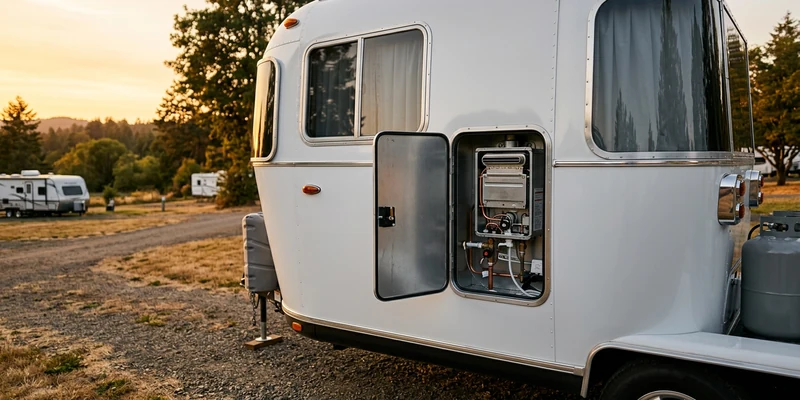
The best RV tankless water heater for your rig is decided by the opening in your sidewall long before it is decided by anything on the spec sheet. A tankless unit replaces a tank heater by going into the same hole in the wall, and if the new unit does not match that opening you are no longer swapping an appliance, you are cutting and reframing a wall on a vehicle that flexes. Owners who measure first have a two hour job. Owners who buy on flow rating first have a project.
After the opening, two questions decide the rest. How much hot water do you need at once, expressed as gallons per minute at a stated temperature rise, and are you usually plugged into a pedestal or usually running on propane. Those three points, opening, flow, and fuel, sort almost every buyer into one of three answers. This guide walks through each of them, names the picks that suit each case, and is honest about the parts of the job that belong to a certified RV technician rather than to you.
This article contains affiliate links. If you buy through them, we may earn a commission at no extra cost to you. Learn more.
Quick Answer
Which RV tankless water heater should you buy?
- Measure the existing water heater opening first, height, width and depth, then shop only units whose published dimensions fit it. This single step eliminates most of the market for you.
- Choose propane if you camp off grid or move between hookups. Choose electric only if you are almost always on shore power and understand what it does to your amp budget.
- Read the flow rating together with the temperature rise it was measured at. A gallons per minute figure on its own tells you nothing about how the shower will feel in cold weather.
- The gas connection and any 120 volt wiring are work for a certified RV technician. Fit a working carbon monoxide alarm and check the expiry date printed on the back.
What to Check Before You Buy
These eight points decide whether a unit fits your rig and behaves the way you want. The first three eliminate most of the shortlist on their own, and the rest are the ones that turn a clean swap into a weekend of adapters and second orders.
| What to check | Why it matters | What to look for |
|---|---|---|
| Opening size | Decides whether this is an appliance swap or bodywork on a sidewall | Measure the existing door opening height, width and depth, then compare against the dimensions published on the listing |
| Fuel type | Propane works anywhere, electric only works where there is enough power | Propane for mixed or off grid use, electric only for near permanent shore power |
| Flow rating | Sets how much hot water you get at once, but only at a stated temperature rise | A gallons per minute figure paired with the rise it was measured at, not a bare number |
| Minimum activation flow | Decides whether the unit fires at all on a low shower setting | A low activation threshold, since this causes more complaints than maximum output ever does |
| 12 volt draw | Even propane units need battery power for controls, fan and ignition | The published amp figure and whether it suits your existing fuse and wiring |
| Freeze and winterizing path | Tankless units hold little water but the small passages are what split | A documented drain point and a manufacturer described winterizing procedure |
| Controls | An indoor panel is far more usable than a knob behind an outside door | An interior temperature control if you plan to change the setting often |
| Parts and support | Flow sensors and control boards are the parts that fail on these units | A brand that publishes a manual and sells service parts rather than whole units only |
If your current heater is misbehaving rather than finished, replacing it may not be the answer at all. Ignition faults, a dirty electrode and a tripped reset account for a large share of complaints, and our guide to an RV water heater that is not working covers the free checks in the order worth doing them.
Start With the Hole in the Wall
Tankless RV heaters are sold as replacements for specific tank sizes, and the fit is about the opening rather than the appliance. Manufacturers design around the common tank footprints found in most trailers and motorhomes, so a unit meant to replace a six gallon heater will not slide into an opening cut for a ten gallon one, and the reverse leaves you a gap to trim.
Measure three dimensions before you look at a single product page: the height and width of the finished opening taken at the frame rather than the door, and the depth available behind the wall to the nearest obstruction. Photograph the mounting flange and the plumbing stubs while you are there. If a listing does not publish those numbers clearly, treat that as information about the seller.
Depth is the dimension people forget
Height and width are obvious because you can see them. Depth is where swaps go wrong, because a tankless unit carries its heat exchanger, fan and burner assembly behind the face, and behind your opening there may be a wheel well, a frame member, cabinetry or a slide mechanism. Check what is inside that wall before ordering, not after the box arrives.
Our Top Picks at a Glance
How we chose: we compared widely available RV tankless units on published dimensions and fitment, flow rating relative to the temperature rise quoted, minimum activation flow, 12 volt draw, controls, and the complaints and compliments that repeat across owner feedback. Our assessment rests on manufacturer information and that feedback rather than on any trial of our own. Most owners are choosing between the first two, and the third exists for a specific and fairly narrow situation.
🏆 Best Overall
A propane on demand RV water heater built as a direct replacement for a common tank opening, with an interior control panel and a matching exterior door. This is the format most owners should buy: it works whether or not there is a pedestal, the door and flange close the hole the old heater left, and the indoor panel means changing the temperature without going outside in the rain. Confirm the opening dimensions on the listing against your own measurements, since the same model is often sold in more than one size.

📐 Best for Tight Openings and Vans
A compact propane tankless unit for camper vans, truck campers and smaller trailers where the opening or the depth behind it rules out a full size unit. You give up some maximum flow, which matters less than owners expect, because a single bathroom rig rarely draws more than one hot fixture at a time. Check the depth clearance carefully, since compact units win on face area and are not always shallower.

🔌 Best If You Live on Shore Power
An electric RV tankless heater for rigs parked and plugged in nearly all the time, in a seasonal site or a long stay park. No propane, no combustion, no venting, nothing to relight. The catch is the amp draw, which on a thirty amp pedestal competes directly with your air conditioner. We work through the power side in our guide to electric RV tankless water heaters.

Matching the Unit to How You Camp
Four situations cover most owners, and the right answer differs between them. Work out which one describes you before comparing any two products.
- Weekend and touring, mixed hookups. Propane, direct replacement size, interior control. You want a unit that does not care whether there is a pedestal.
- Boondocking and dry camping. Propane, and watch the 12 volt draw for the fan and controls. Weigh consumption honestly, because unlimited hot water plus a limited cylinder catches people out on long trips.
- Seasonal site, plugged in permanently. Electric becomes reasonable, provided the site is fifty amp or you accept scheduling showers around the air conditioner. See thirty amp versus fifty amp service.
- Two bathrooms or a family showering back to back. Prioritize flow at a realistic temperature rise over everything except fitment, since that is exactly where an undersized unit disappoints.
Do not skip the water supply side
A tankless unit is far more sensitive to what your water system does than a tank heater was. It needs a certain flow to fire and a steady supply to hold temperature, so a pump that cycles or an air leak on the suction side becomes a shower that swings hot and cold. If your pump already misbehaves, sort that out first with our water pump repair guide.
Buy These at the Same Time
Three items do more for how a tankless installation behaves than the choice between two decent units. The first one is not optional in any rig with a combustion appliance, and the other two prevent the two most common long term complaints.
🚨 Not Optional
An RV carbon monoxide alarm with a visible expiry date on the back. Every alarm has a sensor life measured in years and a date printed on the housing, and a large share of the units in older rigs are past it. Any appliance that burns propane belongs in a rig with a working alarm. Check the date the day it arrives, not the day you fit it.

🧪 The Maintenance Item Nobody Buys Until Too Late
A descaling kit with a small pump, a bucket, hoses and a food safe descaling solution. Tankless heat exchangers are narrow passages, and hard water leaves scale that shows up first as reduced flow and temperature swing, then as a unit that will not hold a setting. Our guide to descaling an RV tankless water heater covers the procedure and the interval.

🛡️ Protects the Whole Plumbing System
An adjustable brass water pressure regulator with a gauge, fitted at the spigot. Campground pedestals vary far more than owners assume, and a tankless unit adds fittings and a heat exchanger to the list of things high pressure can find. It also steadies the supply, which is exactly what these heaters want.

Installation, and Where It Stops Being Your Job
Owners can and do handle the mechanical part of a tankless swap. Draining the old unit, removing the door and flange, unbolting the old heater, sealing in the new one and connecting the fresh water lines are all normal tasks with basic tools.
The gas connection is not. We do not publish instructions for gas lines, regulators, gas valves, burner tubes, orifices, burner adjustment or thermocouple setting, because a joint that looks fine and leaks slowly is a fire and asphyxiation risk inside a sealed metal box that people sleep in, and because leak testing that connection properly needs equipment and training. The same applies to any 120 volt wiring or breaker work on an electric unit. Book a certified RV technician for those steps, tell them the model, and have them pressure test the gas system before you use it. Our walkthrough of what an RV tankless installation involves sets out which steps are yours and which are theirs.
Stop and get out if you see any of these
A smell of gas, a carbon monoxide alarm sounding, soot around the vent, a yellow or lifting flame, or scorch marks near the appliance. In any of those cases, switch the appliance off, close the valve at the propane cylinder, ventilate the rig, get everyone outside, and call a certified RV technician. Do not relight it to see whether it does it again.
Common Mistakes to Avoid
- Buying on gallons per minute alone. That figure is quoted at a temperature rise. In cold country the incoming water is colder, the rise needed is bigger, and the real flow is lower than the headline.
- Not measuring the depth behind the wall. Height and width are the easy dimensions. Depth is what turns a swap into a rebuild.
- Assuming propane use goes down. On demand heating is efficient per gallon, but people take longer showers because they can, and total consumption often goes up.
- Ignoring the minimum activation flow. A unit that will not fire on a low shower setting is the complaint owners actually live with, and it is not the same number as maximum output.
- Skipping winterizing because there is no tank. A tankless unit holds little water, and that is exactly why the narrow passages freeze fast. Follow the manufacturer procedure, as covered in winterizing an RV tankless water heater.
- Doing the gas connection yourself to save an afternoon. This is the one step where the downside is not a leaky fitting and a wet floor.
Where to Go From Here
Still deciding whether tankless is right at all? Start with RV water heaters explained, tank versus tankless, and with our honest comparison, which is blunt about where a tank heater is still the better appliance.
Narrowed it to a fuel type? Propane RV tankless water heaters covers consumption, low flow ignition and altitude, and electric RV tankless water heaters works through the amp budget honestly. Once a unit is in, RV tankless maintenance is the short list that keeps it out of the repair guide.
Frequently Asked Questions
Will a tankless water heater fit my existing opening? Often yes, because manufacturers design them around the common tank footprints, but only if you measure. Take the height, width and depth of the finished opening and compare against the dimensions published on the listing.
Do I still need 12 volt power for a propane tankless unit? Yes. The controls, the ignition and the combustion fan run on the rig’s 12 volt system, so a propane unit will not work with a flat battery any more than an electric one works without a pedestal.
Does a tankless heater really give unlimited hot water? It gives continuous hot water at its rated flow, which is not the same thing. Exceed the flow it can heat and the temperature drops, and on propane the limit becomes your cylinder rather than a tank.
Why does the water go hot and cold? Usually flow rather than the heater. A pump that cycles, an air leak on the suction side, or a shower setting near the minimum activation flow all produce that swing. The flow sensor itself is the next suspect, covered in flow sensor problems.
Can I install one myself? The mechanical fit and the fresh water connections are normal owner work. The gas connection and any 120 volt wiring are jobs for a certified RV technician, and the gas system should be leak tested before use.
Is a tankless unit worth it in a rig I only use a few weekends a year? Often not. The benefit is back to back showers and the removal of a tank, and a working tank heater that suits your use is rarely worth replacing on principle.
The Bottom Line
Measure the opening first, in three dimensions, and let that eliminate most of the market before you compare anything else. Then pick propane if your camping varies at all, and electric only if you are effectively parked on a pedestal. Read every flow figure alongside the temperature rise it was quoted at, check the minimum activation flow, and budget for a carbon monoxide alarm, a descaling kit and a pressure regulator at the same time as the heater. Do the mechanical work yourself if you are comfortable with it, and hand the gas connection and any 120 volt work to a certified RV technician, because that is the part where getting it nearly right is not good enough.