Last updated: August 14, 2026
If the burner still lights and the tank still gets hot on propane, but flipping the electric switch achieves nothing, the fault is confined to a short chain of parts on the 120 volt side. In practice, an RV water heater not working on electric comes down to four suspects in a predictable order: the breaker or shore power feed, the electric switch, the thermostat and cutout on that side, and the heating element itself. Everything the gas side uses is provably fine, because the gas side is working.
The element is the one that fails most, and it usually fails for one avoidable reason: it was switched on while the tank was empty. An element designed to sit in water burns out in seconds in air, which is why so many of these faults appear on the first trip after winterizing. This guide runs the chain from free to expensive, and it is explicit about which parts of it are yours and which belong to a certified technician, because 120 volts is where we stop.
This article contains affiliate links. If you buy through them, we may earn a commission at no extra cost to you. Learn more.
Quick Answer
Why is my RV water heater not working on electric but fine on gas?
- Because the electric side is a separate circuit. Check the breaker, confirm you are genuinely on shore power, check the electric switch, then look at the thermostat and cutout on that side.
- The most common failed part is the heating element itself, and the most common reason it failed is being switched on with an empty tank.
- Give it time before condemning anything. A single element commonly rated around 1400 watts takes hours to heat a cold tank, not minutes.
- Element wiring, thermostat wiring and breaker work are certified technician jobs. We do not publish 120 volt procedures.
What You See, What It Means, and Who Does It
Find your observation on the left. The right column is the part of this article that matters most, because it tells you whether this is an afternoon in the driveway or a phone call.
| What you observe | Likely cause | You or a technician |
|---|---|---|
| Nothing at all on electric, gas normal | Breaker off, no shore power, or the electric switch | You, all three are visual checks |
| Water warms very slowly but does warm | Normal element behavior, or heavy scale on the element | You, flush the tank and give it time |
| Stopped working right after winterizing | Element fired into an empty tank and burnt out | Part is yours to buy, wiring is a technician job |
| Breaker trips as soon as electric is switched on | Failed element or a fault in the 120V circuit | Technician, stop resetting the breaker |
| Worked at one campground, not at another | Pedestal supply, an adapter, or a weak circuit | You can compare sites, a technician confirms the rig |
| Electric worked until the tank overheated once | High limit cutout tripped on the electric thermostat | You may reset once; repeat trips go to a technician |
| Never had electric heat since you bought the rig | Gas only model with no element fitted | You, check the model label on the access door |
| Water is scalding on gas, cold on electric | Electric thermostat failed open | Technician for the wiring, part is straightforward |
If the gas side is misbehaving too, you are in the wrong article. Start at where to start, or go directly to dead on gas and electric.
First, Confirm You Even Have an Element
Not every RV water heater has electric heating. Plenty of tanks left the factory as gas only, and owners who bought the rig used sometimes spend a weekend troubleshooting a circuit that was never installed. The model label on the outside access door tells you: gas plus electric units are commonly identified by a suffix in the model number, and the giveaway inside is a dedicated electric switch on the panel.
If there is no electric switch and no breaker labeled for the water heater, that is your answer. Adding an element to a tank that never had one is not a bolt on job, and it is a certified technician conversation rather than a weekend project. Our RV water heater guide covers which types have what.
The Free Checks on the 120 Volt Side
Four things, none of which cost anything, and between them they explain a large share of these complaints. Work through them before you assume a part has failed.
- The breaker. Look at the panel and confirm the water heater breaker is fully on, not sitting in the tripped middle position where it can still look closed. Push it firmly off, then on.
- Your actual power source. An electric element draws real current, commonly around 12 amps at 120 volts. It will not run on an inverter powered by house batteries in most rigs, and a small generator may not carry it alongside an air conditioner. If you are not on shore power, that alone can explain everything.
- The electric switch. There is usually a dedicated switch inside, and on some units a second switch at the appliance. Both have to be on. Indicator lamps in RV panels fail regularly, so a dark lamp does not prove a dead circuit and a lit lamp does not prove a live one.
- Patience. This matters more than owners expect. A single element commonly rated around 1400 watts takes hours to lift a cold tank to temperature, where the burner does it in well under one. Give it a full afternoon before you conclude it is not working.
If the breaker trips the moment you switch electric on, stop. That is a fault reporting itself, not a nuisance, and repeatedly resetting a breaker into a short is how wiring gets damaged. Campground pedestals are their own subject, covered in why RV breakers trip at a campground pedestal.
The Element: Why It Burns Out
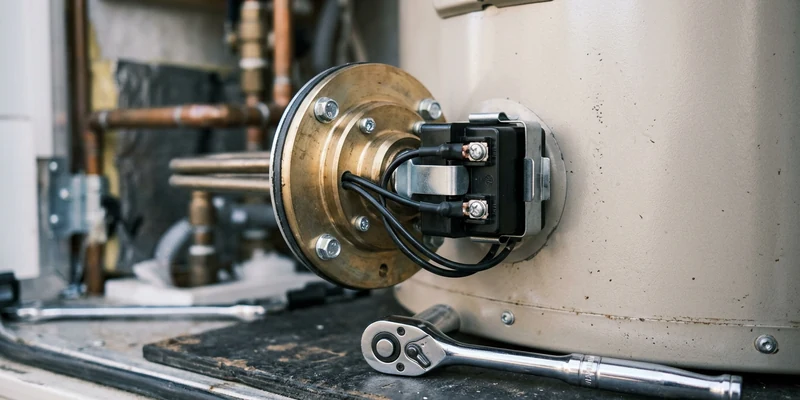
The heating element is a metal loop that screws into the side of the tank and heats the water it is immersed in. It fails in two ways, and the difference matters for what happens next.
The sudden death is dry firing. Switch the element on with the tank empty or partly drained and it glows in air, oxidizes and opens the circuit within seconds. This is overwhelmingly the most common cause, it happens most often on the first trip after storage, and it is entirely preventable: fill the tank, open a hot tap until the flow is steady with no spitting, and only then turn the element on.
The slow death is scale
The other failure mode is gradual. On hard water, mineral scale bakes onto the element and forms an insulating crust. The element then runs hotter than it should to move the same heat into the water, which shortens its life, and you notice the tank taking longer and longer. This is why an annual flush is not optional on a gas plus electric unit; sediment collects exactly where the element sits. If the tank has never been flushed, do that before you condemn anything.
🚿 The flush that gets the scale off
A water heater tank rinse wand that reaches through the drain opening and sprays sideways. Gravity draining leaves the sediment layer in place, and that layer is what packs around the element. Always do this with the heater off and fully cooled, the water supply shut off, a hot tap open and the relief valve lifted.

Replacing an Element, and Where We Stop
Elements are standard service parts, sold with a gasket, and matching one to your heater is a question of thread size, wattage and tank family rather than of brand loyalty. Buying the right part is entirely yours to do.
The installation is not something we write instructions for. The element sits on a live 120 volt circuit, and the connections at its terminals, the thermostat wiring beside it and anything at the breaker are the work of a certified RV technician or a licensed electrician. Plenty of owners buy the element and the gasket, then hand the appliance to a mobile tech for an hour, which is a reasonable split of the job and the cost. What we will say plainly: never work on that circuit yourself on the assumption the breaker is off, and never refill and energize a tank in the wrong order.
⚡ The part itself, matched properly
A screw in 120 volt water heater element with its gasket, in the wattage and thread your tank uses. RV tank elements are commonly rated around 1400 watts, but confirm against your own appliance label rather than assuming. Have a certified technician make the electrical connections.

🔧 The socket that makes it a ten minute job
A water heater element wrench, the deep thin walled socket sized for standard screw in elements. A regular socket will not clear the terminals and an adjustable wrench rounds the flats, which turns a simple swap into a damaged tank port.

The Thermostat and Cutout on the Electric Side
Gas plus electric tanks generally have separate temperature control for each heat source, so the electric side has its own thermostat and its own high limit cutout mounted against the tank face behind the access door. When that thermostat fails open, the element never gets the call, and you get exactly this symptom: fine on gas, cold on electric.
The high limit is a manual reset device with a small button. Pressing it once, with the appliance switched off, is a legitimate owner check. If the heater then works normally, note the date. If it trips again within a few days, the tank is genuinely overheating and that needs a proper diagnosis rather than another press. The wiring around both parts is 120 volt work and goes to a technician.
Where This Stops Being a DIY Job
The dividing line on this fault is unusually clean, which makes it easy to respect.
- Any 120 volt wiring. Element terminals, thermostat wiring, junction boxes and breaker work belong to a certified RV technician or licensed electrician. We do not publish those procedures.
- A breaker that trips on switch on. That is a short or a failed element, and resetting it repeatedly risks the wiring rather than proving anything.
- A hot or pressurized tank. Never open a drain, an anode rod or a relief valve on a warm tank. Switch off, cool for several hours, shut the water supply, open a hot tap, then lift the relief lever.
- Anything on the gas side. Gas lines, regulators, gas valves, burner tubes and orifices are technician work even though your gas side is currently the healthy half.
- Gas smell, a CO alarm, soot or a yellow flame. Shut down, close the propane valve at the tank, ventilate, get out, call a technician. Fit a combination propane and carbon monoxide alarm and check the expiry date printed on the back of the one you already have.
Common Mistakes to Avoid
- Switching the element on before the tank is full. The single biggest cause of this fault, and it takes seconds.
- Expecting gas speed from an element. Hours, not minutes. Impatience condemns a lot of healthy elements.
- Trying to run electric heat off an inverter. The draw is far beyond what most RV inverter setups deliver sensibly.
- Trusting the indicator lamp. Panel lamps fail on their own and prove nothing in either direction.
- Skipping the annual flush. Scale insulates the element and quietly shortens its life every season.
- Doing the 120 volt work yourself to save an hour of labor. This is the one circuit in the appliance that does not forgive a mistake.
Where to Go From Here
If the gas side starts misbehaving too, the fault has moved into shared territory and dead on gas and electric is the right walkthrough. If gas is the half that fails and electric is fine, go to will not light on propane.
Brand layouts differ enough to be worth checking: see Suburban water heater not working or Dometic water heater not working. And if the tank itself is at the end of its life, an electric tankless unit is one alternative worth understanding before you replace like for like.
Frequently Asked Questions
Why does my RV water heater work on gas but not on electric? The electric side is a separate 120 volt circuit with its own breaker, switch, thermostat and element. A failure anywhere in that chain leaves the gas side working perfectly, and a burnt out element is the most common single cause.
How long should an RV water heater take on electric? Hours rather than minutes. A single element commonly rated around 1400 watts heats a cold tank far more slowly than the burner does, which is why many owners run both together on the first morning of a trip.
What burns out an RV water heater element? Running it with an empty or partly drained tank, which destroys it in seconds. Scale buildup on hard water is the slower cause, because the crust insulates the element and makes it run hotter than intended.
Can I replace the heating element myself? Buying the correct element and gasket is straightforward. The electrical connections at the element and anything at the breaker are 120 volt work and belong to a certified RV technician or licensed electrician.
Can I run the electric element off my inverter? In most rigs, no. An element commonly draws around 12 amps at 120 volts, which is far more than a typical RV inverter and battery bank will supply for the hours the element needs.
Why does the breaker trip when I switch the water heater to electric? Usually a failed element shorting, or a fault in the 120 volt circuit. Stop resetting it and have a certified technician diagnose it, because repeated resets stress the wiring rather than the fault.
The Bottom Line
Work the electric chain in order: breaker fully on, genuine shore power, the electric switch, then time. If the tank still stays cold, look at the thermostat and cutout on the electric side and then at the element, which usually failed because it was fired into an empty tank. Flush the sediment out while you are there. Buy the element and the gasket yourself, and hand every 120 volt connection to a certified RV technician.