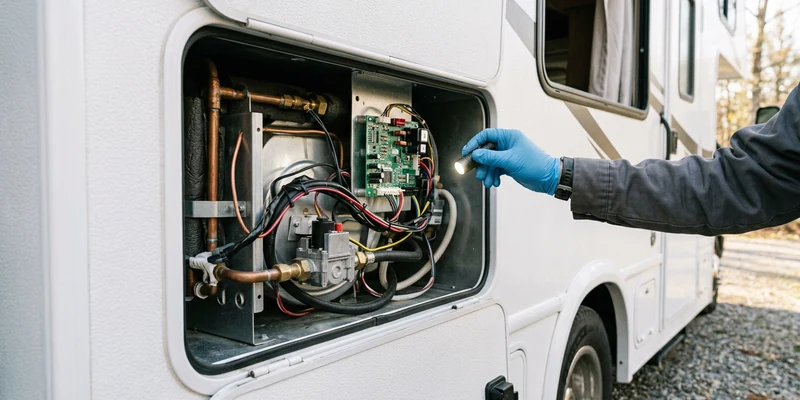
Last updated: August 14, 2026
When you have an RV water heater not working, the fastest route to an answer is not a checklist of every possible fault. It is one question: which heat source is dead? A unit that has quit on both propane and electric is telling you something completely different from one that still lights on gas but ignores the electric switch, and each of those points at a different set of parts. Answer that question first and you skip most of the guesswork.
There is also a trap worth clearing before you touch anything. A heater can be running perfectly and still deliver cold water at every tap, because the winterizing bypass valves are still set to bypass. That accounts for a large share of no hot water complaints every spring, and it costs nothing to rule out. This guide starts there, then routes you by symptom to the specific walkthrough for your fault.
This article contains affiliate links. If you buy through them, we may earn a commission at no extra cost to you. Learn more.
Quick Answer
Why is my RV water heater not working?
- First rule out the bypass. If the winterizing valves are still set to bypass, the heater heats an isolated tank and every tap stays cold.
- Then establish which mode failed. Dead on both usually means 12 volt control power, the switch, or a tripped high limit. Electric only points at the element, its thermostat or the breaker. Gas only points at propane supply, ignition or a blocked vent.
- Free checks first: tank full of water, 12V fuse and switch, propane valve open, breaker on, exterior vent clear, rig reasonably level.
- Gas lines, regulators, gas valves, burner tubes and orifices are certified technician work. We do not publish those procedures.
Symptoms, Causes, and Where to Go Next
Find the behavior you are seeing. The middle column is what it usually means, and the right column is the article that walks that specific fault through in detail.
| What you are seeing | What it usually means | Where to go next |
|---|---|---|
| No hot water anywhere, heater seems to run normally | Bypass valves still set to bypass, or a failed mixing valve | Set the valves to normal operation and run a hot tap |
| Nothing happens on gas or on electric | 12V control power, the switch, or a tripped high limit | Dead on gas and electric |
| Lights on gas, does nothing on electric | Burnt element, electric thermostat, or breaker | Not heating on electric |
| Heats on electric, will not light on gas | Propane supply, ignition, or a blocked vent | Will not light on propane |
| Water is warm but never hot | Running on one heat source, heavy sediment, or a drifting thermostat | Flush the tank, then compare both modes |
| Hot water runs out in a couple of minutes | Normal for a 6 gallon tank, or sediment stealing volume | Flush the tank, or consider a larger or tankless unit |
| Heater lights then shuts down after a minute | Flame sensing, airflow, or a high limit cutting in | The propane walkthrough, then a technician |
| Water dripping from the relief valve | Normal expansion on heat up, or a tired valve | Watch it cold; constant flow means replace the valve |
| Hot water smells of rotten eggs | Anode reacting with bacteria in the tank | Why RV hot water smells like sulfur |
| Water at the tap sputters and runs cold | Water delivery problem, not a heating problem | RV water pump repair |
| Leaking from the tank body | Corroded steel tank or freeze damage | Replacement, not repair; a leaking tank is finished |
| Soot, yellow flame, or a gas smell | Combustion fault | Shut it down, close the propane valve, call a technician |
Rule Out the Bypass Before Anything Else
The bypass is a small set of valves, usually behind an interior panel near the heater, that isolates the tank so you can pump antifreeze through the plumbing without filling the heater. If those valves are left in the winter position, the heater warms an isolated tank and none of it reaches a faucet. The symptom is indistinguishable from a dead heater.
Layouts vary. Some rigs use three valves, some use a single handle, and some use a combination. Set them so water flows into and out of the tank rather than looping around it, then run a hot tap for a minute. Air will burp out first and the flow will settle. If hot water appears, you were never broken.
The related trap: a dry tank
The other spring classic is a heater that was drained for storage and never refilled. Firing the electric element into an empty tank destroys it in seconds, and running the burner on a dry tank is not much kinder. Before you switch anything on, open a hot tap and confirm water flows steadily with no spitting. Our guide on winterizing without a blowout kit covers the drain and refill sequence in both directions.
The Free Checks, in Order
These six take about fifteen minutes with a flashlight and solve a large share of complaints before any part is bought. Do them in this order, because each one rules out the ones after it.
- Water in the tank. Confirm at a hot tap, not on a monitor panel. A tank that is empty or airlocked cannot heat anything.
- Every switch. Most rigs have a gas switch and an electric switch inside, and some have a second switch at the heater itself. All the ones you intend to use have to be on, and the indicator lamp does not always prove the circuit.
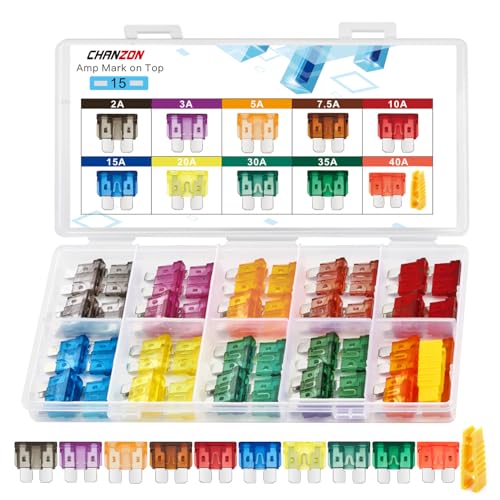
- The 12 volt fuse. Even in gas mode, the control board needs 12 volts. Pull the fuse and look at the element rather than glancing through the plastic. Water heater circuits commonly use a small blade fuse in the 5 to 15 amp range.
- Battery voltage. A healthy 12 volt battery at rest usually reads somewhere around 12.6 to 12.8 volts. A board fed by a tired battery can spark weakly and lock out even though everything else is fine.
- The 120 volt breaker. For the electric side, confirm the breaker is fully on rather than sitting in the tripped middle position, and that you are actually connected to shore power rather than running on inverter.
- Propane and the vent. Confirm the tank valve is open and there is gas in the bottle, then look at the exterior vent for insect nests, mud, leaves or a bird’s nest in the burner area.
🔧 The tool that turns guessing into diagnosis
A basic digital multimeter that reads DC volts and continuity. Every 12 volt check in this article, from the fuse to the switch to the board supply, comes down to a reading you can take yourself in under a minute. Buy one with clear leads and an audible continuity beep rather than the cheapest available.

🔌 What a blown water heater fuse costs you
An assorted blade fuse kit covering the common RV values with a puller, kept in the rig rather than at home. A heater that will not light because of a dead fuse is a two minute fix if you have the fuse and a lost evening if you do not.
Reading the Fault by Which Mode Failed
Once the free checks are clear, the split by heat source does the rest of the work for you. Try both modes deliberately, one at a time, and give each one long enough to prove itself.
Switch to electric alone and leave it for a couple of hours, then feel the hot tap. Then switch to gas alone and listen at the outside access door for the ignition sequence. What each mode does, or fails to do, tells you which family of parts to look at, because the two sides share only the tank, the 12 volt supply and the safety cutout.
The three branches
Nothing on either mode points at the shared components: the 12 volt supply, the switch, the ground, the control board or a tripped high limit cutout. Follow dead on gas and electric. Gas works but electric does not points at the element, its thermostat, the breaker or the shore power supply, covered in not heating on electric. Electric works but gas does not points at propane supply, ignition or venting, covered in will not light on propane.
Brand Differences That Matter
Two families cover most RVs, and they fail differently enough that it is worth knowing which you own before you start ordering parts. Look at the drain point behind the outside access door.
A metal hex plug that doubles as the anode rod means a Suburban steel tank. Those need an anode and they accumulate sediment, so heating complaints on a Suburban are often really sediment complaints. A plastic drain plug means an Atwood aluminum tank, now sold under Dometic, with no anode rod at all. Reset button locations and thermostat layouts also differ between the two. We cover each separately in Suburban water heater not working and Dometic water heater not working, and the type overview lives in our RV water heater guide.
Safety Limits You Do Not Cross
Most of a water heater is friendly territory. A short list of it is not, and this is the part of the job where being honest matters more than being helpful.
- Gas components. Gas lines, regulators, gas valves, burner tubes, orifices, burner adjustment and thermocouple adjustment are certified RV technician work. We do not publish instructions for them, because an error there produces carbon monoxide or a leak and neither gives you a warning.
- 120 volt work. Element wiring, thermostat wiring and breaker work belong to a certified technician or licensed electrician. Confirming a breaker position is yours; anything behind it is not.
- A warm or pressurized tank. Never open the drain, the anode rod or the relief valve while the tank is hot or under pressure. Switch it off, let it cool for several hours, shut off the water supply, open a hot tap, then lift the relief valve lever.
- Stop signs. Gas smell, a carbon monoxide alarm, soot around the vent, a yellow or lifting flame, or scorch marks. Shut the appliance down, close the valve at the propane tank, ventilate, get everyone outside, and call a technician before it is used again.
🚨 Check the date on the back of yours today
A combination propane and carbon monoxide alarm built for RV use. These have a service life printed on the housing, commonly five to ten years from manufacture, and an expired alarm gives you nothing while looking exactly like a working one. If you cannot read the date, replace it.

Common Mistakes to Avoid
- Replacing parts before establishing which mode is dead. The single split between gas and electric eliminates most of the parts catalog for free.
- Firing the element into an empty tank. Seconds is all it takes, and it happens most often on the first trip of the season.
- Forgetting the bypass valves. A perfectly healthy heater with the valves in the winter position looks completely dead from the sink.
- Assuming gas mode does not need 12 volts. On electronic ignition models the board, the spark and the valve all run on the battery.
- Resetting a high limit over and over. A cutout that keeps tripping is reporting a real fault, and repeated resets hide it.
- Ignoring a blocked exterior vent. Insect nests in the burner area are a combustion safety issue, not a cosmetic one.
When Replacement Beats Repair
Some faults end the conversation. A tank that leaks from the body is finished, whether it corroded from inside on a neglected anode or split in a freeze, and no sealant holds on a pressurized tank. A heater that has repeatedly tripped its high limit, or that shows heat damage around the burner area, is also a replacement conversation rather than a parts conversation.
That is also the moment many owners look at going tankless instead of like for like, since the swap is happening anyway. The trade offs are real in both directions and we lay them out in tankless versus tank, with the shopping side in best RV tankless water heaters and the practical side in what installation involves.
Frequently Asked Questions
Why is my RV water heater not producing hot water at the taps? The most common cause is winterizing bypass valves left in the bypass position, so the tank heats water that never reaches a faucet. Set the valves to normal operation and run a hot tap before assuming a fault.
Does an RV water heater need battery power to work on propane? On electronic ignition models, yes. The control board, spark and gas valve all run on 12 volts, so a blown fuse or a flat battery stops the burner even with full propane tanks.
Where is the reset button on an RV water heater? Most units have a high limit cutout with a reset button behind the outside access door, commonly on the thermostat mounted against the tank face. Locations differ between Suburban and Atwood or Dometic units, so check your manual.
Why does my water heater only make lukewarm water? Usually one of three things: it is running on one heat source rather than both, sediment has built up in the tank, or the thermostat has drifted. Flush the tank first, then compare gas and electric separately.
Can I fix an RV water heater myself? The 12 volt side, switches, fuses, the anode rod, the drain, the exterior vent and the igniter electrode are all owner territory. Gas lines, regulators, gas valves, burners and 120 volt wiring are not, and belong to a certified RV technician.
How long should hot water last in an RV? A 6 gallon tank realistically supports one short shower or a round of dishes before it fades, because cold water enters as hot water leaves. If yours fades much faster than that, flush the sediment out.
The Bottom Line
Rule out the bypass valves and an empty tank first, then run the free checks: switches, the 12 volt fuse, battery voltage, the breaker, the propane valve and the exterior vent. Once those are clear, split the problem by which heat source failed, because dead on both, dead on electric and dead on gas each lead to a different set of parts. Keep the 12 volt work and the housekeeping, and hand every gas component and 120 volt connection to a certified RV technician.