Last updated: August 14, 2026
When trailer brakes are not working the way they should, the cause is far more often electrical than mechanical. A corroded pin in the seven way connector, a rusty ground strap on the trailer frame, or a brake controller that lost its settings will produce grabby brakes, weak brakes, or no brakes at all, and none of those require pulling a drum to find.
The two complaints sit at opposite ends of the same system. Brakes that lock up are usually getting too much current or have a mechanical fault at one wheel, while brakes that do not engage are usually getting too little current or none at all. This guide works through the free checks first, then the parts that genuinely wear out, and it is clear about where the job stops being a driveway job. Brakes are the one system where an optimistic guess is not worth making.
This article contains affiliate links. If you buy through them, we may earn a commission at no extra cost to you. Learn more.
Quick Answer
Why do RV trailer brakes lock up or fail to engage?
- Start with the connection: a dirty or damaged seven way plug and a poor frame ground cause most no brake and weak brake complaints, and they cost nothing to check.
- Grabby brakes usually mean controller gain set too high, an out of level rig confusing a pendulum style controller, or contamination and wear at one wheel.
- Adjusting the brake controller is owner territory. Drums, shoes, magnets, and wheel bearings belong with a qualified trailer technician, and so does any brake that pulls to one side.
Symptom, Likely Cause, First Action
Match what you feel from the driver’s seat to the row below, then work the action column in order. Everything in the first four rows is free to check.
| Symptom | Likely cause | What to do first |
|---|---|---|
| No trailer braking at all | Connector fault, blown circuit, controller not detecting the trailer | Inspect and clean the seven way plug, check the tow vehicle trailer brake fuse, confirm the controller powers up and shows a trailer connection |
| Weak or fading braking | Low gain setting, poor ground, worn shoes, weak magnets | Raise gain in small steps on a quiet road, then check the ground connection at the trailer frame |
| Brakes grab or lock up | Gain set too high, pendulum controller out of level, contaminated shoes | Lower gain, confirm the controller is mounted and calibrated as the maker specifies |
| Braking only on one side | Broken wire, failed magnet, seized adjuster, oil on the shoes at one wheel | Stop towing loaded and have that wheel inspected by a technician |
| Brakes apply while driving | Breakaway switch pulled or wet, wiring short, controller stuck | Check the breakaway pin is fully seated and the cable is not snagged |
| Burning smell or a hot hub | Dragging brakes or a failing wheel bearing | Stop, let it cool, and get it inspected before the next leg |
| Loud grinding when braking | Shoes worn past their friction material | Do not tow loaded; book a brake service |
A hot hub deserves a special note. If one hub is noticeably hotter than the others after a run, that is either a dragging brake or a bearing on its way out, and both of those can end a trip in the worst way. Treat it as a stop and inspect item, not a watch it for a while item.
Start With the Checks That Cost Nothing
Electric trailer brakes need clean power, a clean ground, and a controller that knows the trailer is there. Any one of those failing produces symptoms that look mechanical from the driver’s seat.
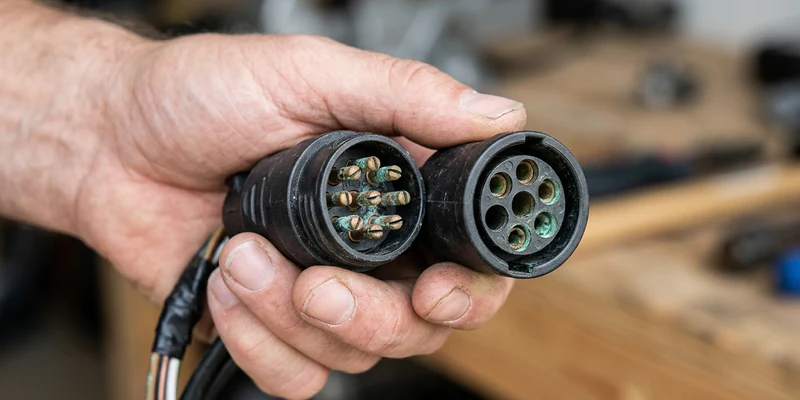
Pull the seven way plug and look inside both halves. Green corrosion on the pins, a bent or pushed back pin, road grime packed into the housing, or a cracked housing that has been letting water in are all common, and all of them are visible without tools. Clean the contacts with a suitable electrical contact cleaner, make sure every pin springs back, and check that the cable is not chafed where it loops between the vehicle and the coupler.
The Ground Nobody Checks
Trailer wiring grounds to the frame, usually with a single screw or bolt near the front. That connection lives in road spray, and it corrodes. A ground that has gone high resistance will still light the running lights while leaving the brakes weak, because the brake circuit draws far more current than a marker lamp does. Loosen it, clean the frame down to bright metal, refasten it tight, and protect it with dielectric grease.
Setting the Brake Controller Correctly
Gain is the setting that decides how much current goes to the magnets when you brake. Too low and the tow vehicle does all the work, too high and the trailer wheels grab. Neither one is a fault, they are just a setting that was never dialed in for the load you are pulling today.
Set it the way the controller maker describes: on a low traffic road at a modest speed, apply the manual lever alone and increase gain until the trailer brakes feel firm without any hint of lockup, then back off slightly. Repeat after any big change in trailer weight, because a full fresh water tank and a loaded pass through change what the trailer needs. A proportional controller behaves differently from a time delay unit here, and a pendulum style controller must be mounted and calibrated within the orientation the manufacturer specifies or it will misread every stop.

When the Controller Itself Is the Fault
Controllers do fail. Common signs are a display that reports no trailer connected when the plug is known good, output that does not change as you move the gain, or a unit that resets every time you hit a bump. Before replacing one, confirm the vehicle side brake circuit fuse is intact and the plug behind the dash is fully seated. Vehicles with an integrated factory controller should be diagnosed by the dealer rather than swapped on a hunch.
The Breakaway System Is Part of the Story
The breakaway switch pulls a pin if the trailer separates from the tow vehicle and applies the brakes at full current using the trailer battery. Two things go wrong with it, and both show up as brake complaints.
A partially pulled or waterlogged switch applies the brakes while you drive, which cooks the shoes and heats the drums. A dead trailer battery, on the other hand, means the switch cannot do anything at all if it is ever needed. Check that the pin seats fully, that the cable is attached to the tow vehicle rather than to the safety chains, and that the trailer battery holds a charge before every trip. Replace a cracked or corroded switch rather than nursing it.

What Is Actually Inside the Drum
Electric drum brakes work by energizing a magnet that is pulled against the rotating drum, and that friction moves a lever that presses the shoes outward. That design explains most of the mechanical faults: magnets wear thin and lose grip, shoes wear and go out of adjustment, drums score, and any oil from a leaking seal turns a working brake into a grabbing one.
Owner level checks stop at the outside. Look for grease or gear oil tracks on the inside of the wheel, uneven wear across a tire, a wheel that is noticeably harder to turn than the others when jacked up safely, and hub temperature differences after a drive. Those observations are genuinely useful to hand a technician, and gathering them costs nothing.
Where the Job Belongs With a Technician
Brake shoes, magnets, drums, adjusters, and wheel bearings are safety critical, they require the rig to be lifted and supported properly, and they need correct torque and correct bearing preload on reassembly. Leveling blocks and stabilizer jacks are not lifting devices and nothing that puts a person beside or under a wheel should rest on them. Unless you have proper jack stands, the right tools, and the service information for your axle, this is work to hand over.
Hand it over immediately, without towing loaded first, if you have braking on one side only, a grinding noise, a hub that runs hot, visible lubricant on a brake backing plate, or brakes that changed behavior suddenly. The same applies to any hydraulic surge brake actuator and to electric over hydraulic systems, which involve brake fluid and pressure and are not comparable to swapping a shoe set. If you tow after a hard sway event, get the brakes and running gear inspected too, since the loads involved reach far beyond the hitch, as described in what causes trailer sway.
Keeping Brakes Out of Trouble
Most trailer brake problems announce themselves early if anyone is listening. A short list of habits catches nearly all of them.
Test the brakes with the manual lever at walking pace at the start of every trip, before you reach a road where you need them. Check hub temperatures at fuel stops with the back of your hand near, not on, each hub. Keep the seven way plug capped and clean, keep the trailer battery charged, and have the brakes and bearings inspected on the schedule in your owner manual rather than when something starts making noise. Loading also matters more than owners expect: an overloaded axle asks more of the brakes than they were designed to deliver, which is one reason RV weight ratings are worth understanding.

Common Mistakes to Avoid
- Replacing the controller first. The plug, the fuse, and the frame ground fail far more often and cost nothing to check.
- Leaving gain set from last season. A heavier or lighter load needs a different setting, so reset it when the load changes.
- Clipping the breakaway cable to the safety chains. It has to attach to the tow vehicle to do its job.
- Ignoring one hot hub. That is a dragging brake or a bearing, and neither improves on its own.
- Towing loaded to the shop with brakes on one side. Uneven braking is exactly what you do not want on the way there.
- Working under a rig on leveling blocks. Use properly rated jack stands on firm ground, or let a shop do the lifting.
Frequently Asked Questions
Why do my trailer brakes lock up? Most often the controller gain is set too high for the current load, or a pendulum style controller is mounted or calibrated outside the orientation the maker specifies. Contaminated shoes at one wheel produce grabbing on that side and need a technician.
Why do my trailer brakes not engage at all? Start with the seven way connector, the tow vehicle brake circuit fuse, and the trailer frame ground. If those are clean and the controller still reports no trailer connected, the wiring or the controller is the next suspect.
Can I adjust trailer brakes myself? You can and should adjust the brake controller gain. Adjusting the shoes inside the drum, replacing magnets, and servicing bearings are jobs for a qualified trailer technician.
Why is one trailer hub hot after driving? A hot hub means a dragging brake or a failing wheel bearing. Stop, let it cool, and have it inspected before continuing, because both failures get worse quickly at highway speed.
Does a dead trailer battery affect the brakes? It does not affect normal braking through the controller, but it does disable the breakaway system, which relies on trailer battery power to apply the brakes if the trailer separates.
How often should trailer brakes be inspected? Follow the interval in your owner manual, and add an inspection any time braking feel changes, after a hard sway event, or before a long trip with heavy grades. See also how to prevent RV tire blowouts, since brakes and tires share the same running gear.
The Bottom Line
Check the seven way connector, the tow vehicle brake fuse, and the trailer frame ground before you suspect anything mechanical, because those three account for most weak brake and no brake complaints. Grabby brakes usually trace back to controller gain or controller mounting, and both are owner adjustable on a quiet road. Braking on one side, grinding, a hot hub, or lubricant on a backing plate means stop towing and hand the job to a qualified trailer technician, and the brakes and bearings inside the drum belong there too.