Last updated: August 14, 2026
An RV inverter generator earns its place through two things a construction site generator cannot offer: clean power that will not upset the electronics in a modern coach, and a noise level your campground neighbors can live with. The mechanical difference is real. An inverter model varies engine speed with the load and rebuilds the output electronically, so it idles down when you are only running a fridge and only revs when the air conditioner kicks in.
The hard part of shopping is that the wattage on the box is not the wattage that matters, and the decibel figure on the spec sheet is measured under conditions you will never replicate. This guide sorts the field by the question that actually decides it: what do you need to run, and how far away are the neighbors. It also covers the carbon monoxide precautions that belong in every generator conversation, because that is the risk that gets people hurt.
This article contains affiliate links. If you buy through them, we may earn a commission at no extra cost to you. Learn more.
Quick Answer
Which inverter generator is right for an RV?
- For a single rooftop air conditioner in the 13,500 BTU class, the 2000 to 2200 watt generators are the popular answer, and a soft start device on the air conditioner makes that pairing far more reliable.
- For a 15,000 BTU unit, two appliances at once, or a 50 amp coach, step up to the 3000 to 4500 watt class or run two small units in parallel.
- Whatever you buy, treat carbon monoxide as the real hazard: exhaust pointed away from the rig, never under an awning or in a compartment, and a working CO alarm inside.
What Separates a Good RV Generator From a Frustrating One
Six specifications decide whether a generator suits your rig. Work down this list and most of the catalog eliminates itself.
| What to check | Why it matters | What to look for |
|---|---|---|
| Running vs starting watts | An air conditioner compressor demands a large surge for a moment, then settles | Compare your largest starting load to the generator’s surge figure, not its running figure |
| Inverter technology | Clean output for electronics, plus a quieter idle at low load | The word inverter in the model description, and a low total harmonic distortion figure |
| Noise rating | Campground rules and neighbor relations | Quiet models commonly sit in the high 40s to low 60s dBA at a stated distance and load |
| RV outlet | Avoids adapter stacking at the generator end | A 30 amp TT-30R outlet built in, or a proper adapter you buy deliberately |
| Parallel capability | Lets two small quiet units combine instead of buying one loud big one | A parallel port plus an available kit for that model family |
| CO shutoff sensor | Shuts the engine down when carbon monoxide builds up nearby | A named CO shutoff feature, now common on current models |
Weight belongs on that list too, informally. A generator that is genuinely portable gets used and gets locked away; one that takes two people to lift out of the truck bed tends to stay home.
Sizing: The Air Conditioner Decides Everything
Almost every RV generator decision comes down to one appliance. A rooftop air conditioner needs a brief surge to start its compressor that can be several times its running draw, and that surge is what stalls undersized generators. Everything else in the rig, the converter, the fridge on electric, the microwave, is comparatively easy.
| Generator class | What it realistically covers | Best fit |
|---|---|---|
| 1000 to 1600 watts | Battery charging, fans, laptops, small appliances one at a time | Vans, teardrops, and anyone who never runs air conditioning |
| 2000 to 2200 watts | One 13,500 BTU air conditioner, usually more comfortably with a soft start | The most common single unit choice for travel trailers |
| 3000 to 3500 watts | A 15,000 BTU unit, or air conditioning plus a second load | Larger trailers and fifth wheels |
| 4000 to 4500 watts | Two air conditioners in sequence, or a 50 amp coach at reduced load | Big rigs and full timers in hot climates |
| Two units in parallel | Combined output of both, with the option to run just one | Owners who want quiet flexibility more than a single box |
A soft start device changes this table more than any generator feature does. Fitted to the air conditioner, it ramps the compressor up instead of slamming it on, which brings a 13,500 BTU unit within reach of a 2000 watt class generator that would otherwise trip. If air conditioning off grid is the whole point of your purchase, also read what to check when an RV air conditioner is not cooling, because a weak unit makes every power source look inadequate.
Our Top Picks at a Glance
How we chose: we compared portable inverter generators on surge and running output, published noise ratings, RV outlet availability, parallel support, fuel options, and CO shutoff, along with the durability and service themes that repeat across owner feedback. Our assessment rests on published specifications and that feedback rather than any hands on trial of our own.
🏆 Best Overall
A 2200 watt class inverter generator with a 30 amp RV outlet, a parallel port, an eco throttle mode, and a CO shutoff sensor. It is the size that fits one rooftop air conditioner, stays light enough to lift alone, and can be doubled later instead of replaced. The default recommendation for a travel trailer, particularly with a soft start on the air conditioner.

💰 Best Budget Pick
A 2000 watt class inverter generator without the extras, aimed at owners who mainly need battery charging, a fridge on electric, and the occasional appliance rather than guaranteed air conditioning. Light, quiet at partial load, and simple to store. Confirm the outlet configuration before buying, since some units at this size skip the RV outlet.

⚡ Upgrade Pick
A 3500 to 4500 watt class inverter generator with electric start, a wheel kit, and a 30 amp RV outlet, for a 15,000 BTU air conditioner or a big rig that wants a second load running at the same time. Heavier and thirstier, but it removes the guesswork about whether the compressor will start on a hot afternoon.

Noise, Rules, and Being the Neighbor Nobody Minds
Quiet is a range, not a promise. Manufacturer decibel figures are usually stated at a fixed distance and at partial load, so a generator advertised in the high 40s dBA will be noticeably louder while starting an air conditioner than while trickle charging a battery. Inverter models still win this comparison decisively, because the engine drops to a low speed whenever the load allows.
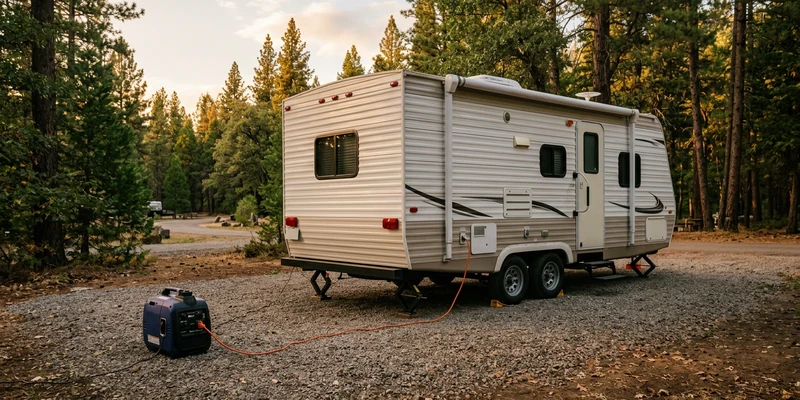
Placement matters as much as the rating. Put the generator on grass rather than concrete or a metal truck bed, keep it away from walls and other rigs that reflect sound back, and point the exhaust away from occupied space. Most campgrounds enforce generator hours, and quiet hours are enforced everywhere, so a generator that can idle down through the evening is worth more than one decibel figure on a spec sheet.
Two small units instead of one big one
Parallel operation is the feature owners appreciate most in hindsight. Two 2000 watt class units linked with a parallel kit deliver roughly the combined output for air conditioning, then you shut one off and run the other alone for the rest of the day at a fraction of the noise and fuel. Each one is light enough to carry with one hand, which is not true of the equivalent single generator.
🔗 For Running Two Units Together
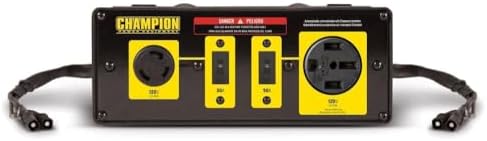
A parallel kit matched to your generator family, with the correct cable and often a 30 amp RV outlet on the box itself. Kits are model specific, so match it to the exact generator you own rather than to the wattage class.
Fuel, Runtime, and Dual Fuel
Runtime figures are quoted at 25 percent load, which is realistic for charging and fans and optimistic for air conditioning. Expect meaningfully shorter run times whenever the compressor is cycling, and plan fuel storage accordingly, in approved containers, never inside the rig or a sealed compartment.
Dual fuel models run on gasoline or propane, and the propane option is genuinely useful for RV owners who already carry propane. It stores indefinitely without going stale, it burns cleaner through the carburetor, and it means one less fuel type in the truck bed. Output on propane is typically somewhat lower than on gasoline, which is worth remembering if you are already at the edge of your air conditioner’s requirement.
⛽ For Owners Who Already Carry Propane
A dual fuel inverter generator in the 3000 to 4000 watt class that runs on gasoline or propane, with a regulator hose included. Useful for long stays and for storage, since propane does not degrade the way gasoline in a carburetor does.

Carbon Monoxide: The Part That Is Not Optional
Generator exhaust contains carbon monoxide, it is odorless, and it kills people every season, usually in situations that felt safe at the time. Treat these as rules rather than suggestions.
- Never run a generator inside anything. Not in a cargo compartment, not in a garage with the door up, not in the bed of a truck with a cap on, and not under a closed awning.
- Point the exhaust away from your rig and your neighbors. Wind and terrain move exhaust in directions that are not intuitive, and open windows, roof vents, and the fridge vent are all entry points.
- Fit a working CO alarm inside the RV and test it. The factory alarm in an older coach may be past its service life, since these detectors expire.
- Refuel with the engine off and cool. Gasoline on a hot muffler is the other way generators cause injuries.
- Never backfeed the coach. Plug the shore cord into the generator outlet. Improvised connections into the RV’s electrical system are work for a certified RV technician, and only through a proper transfer switch.
🚨 The Safety Item Every Generator Owner Should Have
A battery powered carbon monoxide alarm for the sleeping area, in addition to whatever the coach came with. Factory detectors have expiration dates and get ignored until they chirp, and a second independent alarm costs almost nothing in space or weight.

Connecting It to the RV
The simple, correct connection is your shore power cord into the generator’s RV outlet, using a proper adapter if the plug configuration differs. Use a cord rated for the current, keep it out of standing water, and let it lie flat rather than coiled tightly, since a coiled cord under load runs hot.
Surge protection is worth as much here as it is at a campground pedestal, because a generator running low on fuel or overloaded can produce voltage that misbehaves. A protector between the generator and the coach also flags open ground and reversed polarity when you switch back to shore power. Our roundup of RV surge protectors covers the models that suit both situations. If breakers trip when you switch to generator power, the load math is usually the culprit, and why RV breakers trip walks through it.
🔌 For a Clean Connection
A heavy duty 30 amp RV extension cord with a TT-30 plug, long enough to place the generator well away from the rig without stretching. Length is the point here: distance is the cheapest noise and exhaust management you can buy.

Common Mistakes to Avoid
- Sizing by running watts. The compressor surge is what trips generators, so compare against the starting figure.
- Ignoring altitude. Small engines lose output at elevation, which turns a marginal pairing into a failing one in the mountains.
- Leaving stale fuel in it. Gasoline sitting in a carburetor over winter is the single most common reason a stored generator will not start.
- Running it under the awning. It feels sheltered and it is exactly the enclosure that concentrates carbon monoxide.
- Skipping the break in and oil changes. These are small engines with small oil capacities, and they are unforgiving about neglect.
- Assuming a bigger generator is a better one. An oversized unit lightly loaded burns more fuel, weighs more, and annoys more neighbors than a right sized one.
Where to Go From Here
If the goal is quiet power rather than a running engine, compare the generator against the alternatives before you buy. Solar plus a bigger battery bank covers everything except air conditioning for many owners, and our guide to how much solar an RV actually needs gives you the sizing. For 120 volt power from the battery itself, see the RV inverter buying guide.
Air conditioning on batteries alone is a bigger project, and an honest one is covered in running an RV air conditioner on batteries and solar. If you are still working out what your rig can draw in the first place, 30 amp vs 50 amp RV service is the place to start.
Frequently Asked Questions
What size generator runs an RV air conditioner? A 2000 to 2200 watt class inverter generator handles a 13,500 BTU unit in most conditions, more reliably with a soft start device fitted. A 15,000 BTU unit generally wants the 3000 watt class or two units in parallel.
Is an inverter generator worth it over a conventional one? For RV use, yes. The output is clean enough for electronics, the engine throttles down at low load, and the noise difference at a campsite is substantial.
Can I run a generator overnight? Most campgrounds prohibit it during quiet hours, and the carbon monoxide risk while everyone is asleep is exactly the scenario to avoid. A battery bank is the overnight answer.
Do I need a surge protector with a generator? It is sensible. An overloaded or fuel starved generator can produce irregular voltage, and the same protector keeps working when you return to a campground pedestal.
Does propane reduce generator output? Typically a little, compared to gasoline. If your air conditioner is already near the generator’s limit, plan on gasoline for the hottest days.
Where should the generator sit at a campsite? On level ground, away from your rig and your neighbors, with the exhaust pointed into open space and never under an awning or inside a compartment.
The Bottom Line
Size the generator to your air conditioner’s starting surge, not to its running watts, and consider a soft start device before you buy a bigger unit. A 2200 watt class inverter model covers most travel trailers and can be paralleled later; the 3500 watt class removes the doubt for a 15,000 BTU unit. Then handle it as a combustion engine, with the exhaust pointed away, a working carbon monoxide alarm inside, and fuel added only when it is cool.