Last updated: August 14, 2026
When an RV breaker keeps tripping at a campground pedestal, the most common explanation is the least dramatic one: the rig is asking for more current than the service can deliver. Air conditioning plus a water heater on electric plus a microwave adds up faster than most owners expect, especially on a 30 amp hookup, and the breaker is doing exactly what it was installed to do.
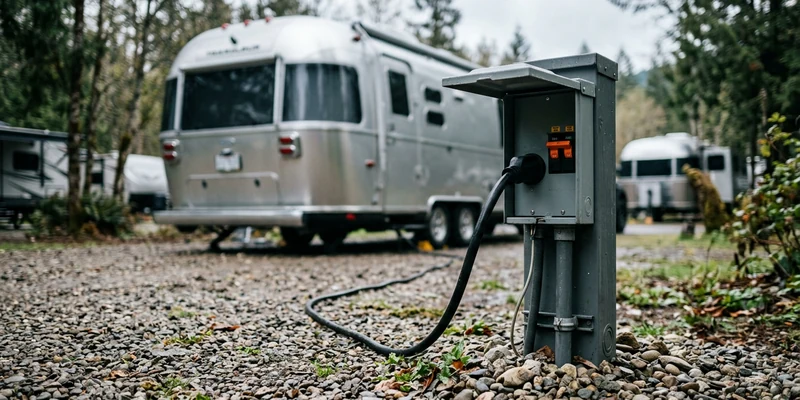
The second most common explanation is the pedestal itself. Campground posts live outdoors for decades, and worn contacts, loose terminals, or a tired breaker in the post will trip under a load that a healthy pedestal would carry all afternoon. This guide separates the load problem from the pedestal problem from the genuine fault, and it is clear throughout about which parts of that you can investigate yourself and which parts belong to a certified technician.
This article contains affiliate links. If you buy through them, we may earn a commission at no extra cost to you. Learn more.
Quick Answer
Why does the breaker keep tripping when your RV is plugged in?
- Usually total load. A 30 amp service delivers roughly 3,600 watts, and an air conditioner, an electric water heater, and a kitchen appliance running together will exceed that.
- Which breaker trips tells you where to look. The pedestal breaker points at total draw or the post itself. A breaker inside the RV points at one circuit. A GFCI outlet that trips is a different fault entirely.
- Reset a breaker once. If it trips again, stop resetting it and start diagnosing, and leave anything inside the distribution panel to a certified RV technician or licensed electrician.
Which Breaker Tripped, and What That Means
Start by identifying exactly what opened. Owners frequently describe three different events with the same sentence, and the causes barely overlap.
| What tripped | What it usually means | What to do first |
|---|---|---|
| Pedestal breaker, under heavy load | Total draw exceeds the service rating | Shed load: water heater to propane, one big appliance at a time |
| Pedestal breaker, almost immediately | A hard fault in the cord, adapter, or the RV, or a worn pedestal breaker | Try a different pedestal before assuming the RV is at fault |
| Pedestal breaker on a hot afternoon only | Air conditioning startup on a weak or overloaded post | Report it to the park and try a different site |
| One breaker inside the RV panel | That circuit is overloaded or has a fault | Unplug everything on that circuit, then reset once |
| The main breaker inside the RV | Whole coach draw is too high, or a fault upstream of the branches | Reduce load and check what came on just before it tripped |
| A GFCI outlet, not a breaker | Current is leaking to ground, often from moisture or a failing appliance | Unplug outdoor and bathroom loads, dry things out, reset the outlet |
| Nothing trips but power keeps dropping | Low voltage, a loose connection, or a protective device shutting things down | Check the surge protector display and the cord ends for heat damage |
The distinction between the last two rows and the rest matters. A GFCI is watching for current going somewhere it should not, which is a safety fault rather than an overload, and low voltage is a supply problem that no amount of resetting will improve.
The Load Math on 30 and 50 Amp Service
Most tripping is arithmetic. A 30 amp RV service is a single 120 volt leg, which works out to somewhere around 3,600 watts total for the whole coach. A 50 amp service is two 120 volt legs, so it delivers roughly 12,000 watts, which is why the two are not remotely comparable despite the numbers looking close.
Put realistic figures against that. A rooftop air conditioner commonly draws in the region of 1,200 to 1,700 running watts, with a much larger spike for a fraction of a second at startup. An electric water heater element is typically in the 1,200 to 1,500 watt range. A microwave pulls considerably more from the wall than its cooking rating suggests. A residential refrigerator, a coffee maker, a hair dryer, and a space heater each add several hundred to well over a thousand watts. On 30 amp service you can run one large appliance comfortably and two only if you are paying attention. If the difference between the two services is the real question, our explainer on 30 amp vs 50 amp RV service lays it out properly.
Shedding load without giving anything up
Three habits solve most overload trips. Switch the water heater from electric to propane while the air conditioner is running, since the heater does not need to be electric to work. Stagger the big draws rather than running them together, especially the microwave and a coffee maker. And treat portable electric space heaters as the largest appliance in the rig, because that is usually what they are.
Ruling Out the Pedestal
Campground power is not a constant. Old posts, long feeder runs, and a full park on a hot day all reduce what actually arrives at your cord, and a breaker that has tripped a few thousand times over the years trips more easily than a new one.
The simplest owner test is to plug into a different pedestal, ideally in a different loop of the park. If the problem follows you, it is the RV. If it stays behind, it is the post, and the right move is to report it to the park office rather than to keep resetting a breaker on equipment you do not own. Never open a pedestal enclosure, remove its cover, or attempt to tighten anything inside it. That is utility grade wiring and it belongs to the park’s electrician.
What a protective device tells you before the breaker does
A surge protector or an electrical management system sits between the pedestal and your cord and reads the incoming supply before your rig sees it. The better units display voltage, amperage, and specific faults such as open ground, reverse polarity, and low voltage, and they refuse to pass power that is out of tolerance. That display turns a guessing game into a reading, and it protects the converter and the air conditioner from the low voltage conditions that quietly damage them.

Our full comparison of these devices, including the 50 amp versions and the hardwired option, is in best surge protectors for RV campground power.
Checking the Cord, Adapters, and Connections
Everything between the post and your coach is fair game for inspection, and this is where a surprising share of repeat trips are found. Look for browned or melted plastic on the shore cord ends, blackened pins, a bent or missing ground pin, and any adapter that feels warm after an hour of use. Heat at a connection means resistance, and resistance means a poor contact that will eventually fail under load.
Adapters deserve particular attention. Plugging a 50 amp rig into a 30 amp post through a dogbone does not give you 50 amps of capacity, it gives you 30, and running the coach as though nothing changed will trip the pedestal every time. Cheap adapters with thin conductors also add resistance and heat of their own. If you use one regularly, use a properly rated one with molded ends rather than the lightest thing on the shelf.

Extension cords are the other frequent culprit. A long undersized cord drops voltage along its length, which makes motors draw more current to do the same work, which trips breakers. If you need reach, use a proper RV rated extension in the correct gauge rather than a hardware store cord.

When It Is a Genuine Fault
Some trips are not about load at all. A breaker that opens the instant you plug in, with everything inside switched off, is reporting a short circuit somewhere in the coach. A GFCI that trips repeatedly after rain or a wash points at moisture in an exterior outlet or a light fixture. And an appliance that fails internally, most often a water heater element or an air conditioner component, can trip its circuit reliably every time it is switched on.
The owner safe way to narrow that down is by elimination rather than investigation. Unplug everything, switch off the water heater and air conditioner at their own controls, then reset once and add loads back one at a time. The load that trips it is the load to have looked at. If nothing is plugged in and it still trips, stop there. That is a wiring fault, and it needs a technician rather than a fourth reset. If the tripping breaker is the one feeding the converter specifically, the pattern and its causes are covered in RV converter repair.
Where This Stops Being a DIY Job
The line here is unusually clear, because everything on this page happens on the 120 volt side. What you may safely do as an owner: reset a breaker at the handle, switch appliances off at their own controls, unplug and inspect cords and adapters, plug into a different pedestal, and read what a surge protector display is telling you.
What belongs to a certified RV technician or a licensed electrician: opening the distribution panel, testing or replacing breakers, any repair to shore cord wiring, replacing a water heater element, and diagnosing an air conditioner that trips its circuit. Also on that list is anything with a burning smell, scorched insulation, melted plastic, or a connection that has discolored from heat. Unplug the shore cord first and diagnose nothing further. And treat a breaker that trips again after one reset as a message rather than an inconvenience, because repeated resetting of a faulted circuit is how small electrical problems become fires.
Common Mistakes to Avoid
- Resetting three times and hoping. A breaker that reopens has found something. The second trip is your signal to start diagnosing.
- Assuming the RV is at fault. Try another pedestal before spending anything. Campground posts fail constantly.
- Treating an adapter as extra capacity. A dogbone changes the plug shape, never the amount of power available.
- Using a household extension cord. Undersized cords cause voltage drop, heat, and the very trips you are chasing.
- Leaving the water heater on electric all day. It is one of the largest continuous loads in the rig and it competes directly with the air conditioner.
- Opening the panel to look. There is nothing an owner needs to see behind that cover, and the risk is immediate.
Frequently Asked Questions
How many appliances can a 30 amp RV run at once? Roughly one large one plus small loads. A 30 amp service supplies somewhere around 3,600 watts total, and an air conditioner alone can take half of that while running.
Why does the breaker only trip on hot days? Air conditioners work harder and draw more as ambient temperature climbs, and a full park pulls the pedestal voltage down at the same time. Both push the circuit closer to its limit.
Is a tripping GFCI the same as a tripping breaker? No. A breaker responds to too much current, a GFCI responds to current leaking to ground. GFCI trips usually mean moisture or a failing appliance rather than overload.
Can a bad surge protector cause tripping? An electrical management system may cut power deliberately when it detects low voltage or a wiring fault, which owners often describe as tripping. Reading its display tells you which it is.
Should I replace the breaker myself if it seems weak? No. Breaker replacement inside the distribution panel is work for a certified RV technician or licensed electrician, even though the part itself is inexpensive.
The Bottom Line
Work out which device opened before you touch anything, because a pedestal breaker, a coach breaker, and a GFCI outlet are three different problems. Most trips are simple overload on a 30 amp service, solved by moving the water heater to propane and staggering the big appliances. Rule out the pedestal by plugging in elsewhere, inspect cords and adapters for heat damage, and hand the panel, the breakers, and anything that smells hot to a certified RV technician.