Last updated: August 14, 2026
The 30 amp vs 50 amp RV comparison confuses people because the numbers look close and the reality is not. A 30 amp service is a single 120 volt leg delivering somewhere around 3,600 watts. A 50 amp service is two separate 120 volt legs, so it delivers roughly 12,000 watts. That is not sixty percent more power, it is more than three times as much.
Understanding that one fact answers most of the questions that follow: why a 50 amp rig on a 30 amp post trips breakers, why an adapter never adds capacity, and why two air conditioners are effectively impossible on 30 amp service. This guide covers the plugs, the math, the adapters in both directions, and the verdict on which service actually matters when you are choosing a rig or a campsite.
This article contains affiliate links. If you buy through them, we may earn a commission at no extra cost to you. Learn more.
Quick Answer
What is the difference between 30 amp and 50 amp RV service?
- A 30 amp service is one 120 volt leg with a three prong plug, giving roughly 3,600 watts. A 50 amp service is two 120 volt legs with a four prong plug, giving roughly 12,000 watts.
- Your rig is built for one or the other. The plug on your shore cord tells you which, and no adapter changes what the coach can use.
- Adapters change the plug shape only. A 50 amp rig on a 30 amp post has 30 amps available, so you manage the load or you trip the pedestal breaker.
30 Amp and 50 Amp Side by Side
Read this once and the rest of the article is confirmation. Every practical difference between the two services follows from the number of legs.
| Question | 30 amp service | 50 amp service |
|---|---|---|
| Plug type | TT-30, three prongs, one flat blade angled | NEMA 14-50, four prongs, two hot legs |
| Legs and voltage | One 120 volt leg | Two 120 volt legs |
| Approximate total power | Around 3,600 watts | Around 12,000 watts |
| Typical rigs | Travel trailers, smaller fifth wheels, most class C motorhomes | Large fifth wheels, class A motorhomes, anything with two air conditioners |
| Air conditioners supported | One, with load management for everything else | Two, often plus a residential refrigerator |
| What the panel looks like | Breakers all fed from one bus | Breakers split across two buses, loads balanced between them |
| Availability at parks | Nearly universal, including older parks | Common but not guaranteed, especially at state parks |
| Adapter behavior | Stepping up gives you the plug, never the power | Stepping down limits you to the smaller service |
The last row is where most owners get caught. Adapters solve a mechanical problem, not an electrical one.
Where the Numbers Come From
The arithmetic is simple and worth doing once. Thirty amps at 120 volts works out to roughly 3,600 watts, and that is the ceiling for the entire coach: air conditioner, water heater, microwave, converter, and every outlet combined. Fifty amps at 120 volts is about 6,000 watts per leg, and because a 50 amp RV service has two legs, the total is around 12,000 watts.
The two legs are the whole story. A 50 amp panel splits its breakers across both buses, which is why a big fifth wheel can run one air conditioner on one side and a second on the other without either leg noticing. On a 30 amp rig everything shares a single leg, so the air conditioner and the water heater are directly in competition. That is also why a badly balanced 50 amp panel can trip one leg while the other sits nearly idle.
Realistic loads against the ceiling
Put numbers to it. A rooftop air conditioner commonly draws in the region of 1,200 to 1,700 running watts. An electric water heater element is typically in the 1,200 to 1,500 watt range. A microwave pulls considerably more from the wall than its cooking rating. On 30 amp service, any two of those running together puts you close to the limit, and a third puts you over it. On 50 amp service the same combination is unremarkable. If yours is tripping regularly, the diagnosis is in why RV breakers trip at a campground pedestal.
How to Tell Which One You Have
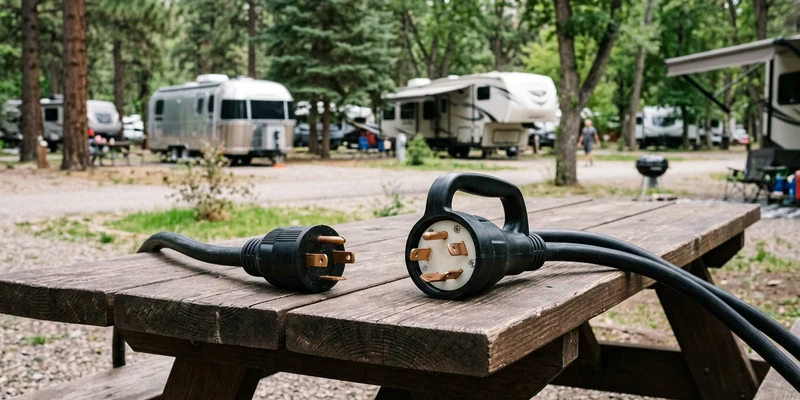
Look at the end of your shore power cord. Three prongs, with one blade angled, is a TT-30 and your rig is 30 amp. Four prongs in a round pattern is a NEMA 14-50 and your rig is 50 amp. The plug is definitive, because the coach’s panel and wiring were built around it.
Two things people mistake for evidence. The main breaker inside the RV panel is labeled with the service rating, which is a useful confirmation, but a previous owner may have changed the cord end, so trust the panel and the cord together rather than either alone. And the pedestal at the campground tells you nothing about your rig, only about what is available at that site. Many posts offer 50 amp, 30 amp, and a standard household outlet all at once.
Adapters: What They Do and What They Do Not
A dogbone adapter is a short cord with one plug type on each end. Two directions exist and they behave differently, though neither creates capacity out of nothing.
Stepping down, meaning a 50 amp rig plugged into a 30 amp post, is the common case and the one that causes trouble. The coach now has roughly 3,600 watts available instead of 12,000, and both of its legs are fed from the same single leg at the pedestal. Everything still works, but you have to manage load exactly as a 30 amp owner does: one air conditioner, water heater on propane, and no running the microwave while the coffee maker is on. Stepping up, meaning a 30 amp rig on a 50 amp post, is harmless and gives you a cleaner supply at a post that is often less loaded, though your coach still only uses 30 amps because that is what it is wired for.
Buy adapters with molded ends, decent conductors, and grip handles. Cheap thin adapters add resistance, and resistance at a connection means heat, which is the failure mode that leaves scorched plugs behind.

The other accessory worth having is a properly rated extension. Reach problems at awkward sites are common, and a household extension cord is the wrong answer because voltage drop over a long undersized cord makes motors draw more current and heats the cord itself.

Protecting Whichever Service You Have
Campground power is the least controlled electricity most RVs ever see. Low voltage during a hot afternoon when the park is full, open grounds, reverse polarity, and outright surges all arrive through the pedestal, and the converter and air conditioner are the components that pay for it.
An electrical management system sits between the post and your cord, reads the incoming supply, and refuses to pass power that is out of tolerance. It also displays voltage and amperage, which turns a mysterious shutdown into a readable fault. Buy the version matching your service, since a 30 amp unit will not physically fit a 50 amp post and the reverse arrangement leaves you adapting around it.

Our full comparison, including hardwired units and the theft problem with portable ones, is in best surge protectors for RV campground power.
The Verdict: Which Should You Care About?
If you are choosing a rig, the service follows the coach rather than the other way around. Two air conditioners, a residential refrigerator, or a washer and dryer means 50 amp, and there is no sensible way around that. A single air conditioner and normal RV appliances means 30 amp is genuinely sufficient, and it comes with a practical advantage: 30 amp hookups exist at essentially every park, including older state and national park campgrounds where 50 amp is rare.
If you already own the rig, the useful conclusion is different. A 50 amp owner should carry a step down adapter and know how to manage load on 30 amp service, because sooner or later that is the only site available. A 30 amp owner should carry a step up adapter for the same reason. Neither should think about converting the coach, because changing the service rating means new shore cord, new panel, and new wiring throughout, which is major work for a certified RV technician and rarely worth it. If the goal is more capacity off grid rather than at the pedestal, the answer is battery and inverter capacity instead, covered in running an RV air conditioner on batteries and solar.
Where This Stops Being a DIY Job
Everything on this page happens on the 120 volt side, so the owner safe list is short and worth stating plainly. You may plug and unplug the shore cord, use adapters, reset a breaker at the handle once, switch appliances off at their own controls, and read what a surge protector display tells you.
You should not open the RV’s distribution panel, test or replace breakers, rewire or repair a shore cord, rebalance loads across the two legs of a 50 amp panel, or convert a rig from one service to the other. All of that is work for a certified RV technician or a licensed electrician. Never open a campground pedestal enclosure either, since that is the park’s equipment and its wiring is upstream of any protection you own. And if a plug, adapter, or cord end is discolored, warm to the touch, or smells hot, take it out of service instead of continuing to use it.
Common Mistakes to Avoid
- Treating an adapter as a capacity upgrade. It changes the plug, never the number of watts available.
- Running two air conditioners on a stepped down 50 amp rig. The pedestal breaker will decide that argument for you.
- Assuming 50 amp is always available. Plenty of older parks and public campgrounds offer 30 amp only.
- Buying the cheapest dogbone. Thin conductors heat up, and heat at a connection is how scorched plugs happen.
- Leaving the water heater on electric. On 30 amp service it is one of the largest continuous loads and it competes with the air conditioner.
- Skipping surge protection. The pedestal is the least predictable power your rig ever sees, and the converter sits directly on it.
Frequently Asked Questions
Can I plug a 50 amp RV into a 30 amp outlet? Yes, with a dogbone adapter, but you have roughly 3,600 watts to work with instead of 12,000. Run one air conditioner, put the water heater on propane, and stagger the big appliances.
Is 50 amp service actually 240 volts? The pedestal supplies two 120 volt legs, and an RV uses them as two separate 120 volt supplies rather than as 240 volts. Your appliances are all 120 volt devices.
Will running on 30 amp damage a 50 amp RV? No. The rig simply has less available, and the pedestal breaker trips if you exceed it. The risk is inconvenience rather than damage.
Can I convert my RV from 30 amp to 50 amp? It means a new shore cord, a new distribution panel, and rewiring, so it is significant work for a certified RV technician and rarely worth the cost.
Why does my 50 amp rig trip only one breaker? Because the loads on that leg are unbalanced against the other. A technician can rebalance which circuits sit on which bus.
The Bottom Line
Thirty amp service is one 120 volt leg at roughly 3,600 watts, and 50 amp is two legs at roughly 12,000, so the gap is far larger than the numbers suggest. Your rig is built for one of them and adapters only change the plug shape, which means a 50 amp coach on a 30 amp post has to manage load like a 30 amp coach. Carry the adapter that matches your direction, protect whichever service you have with an electrical management system, and leave panels, breakers, and cord repairs to a certified RV technician.