Last updated: August 14, 2026
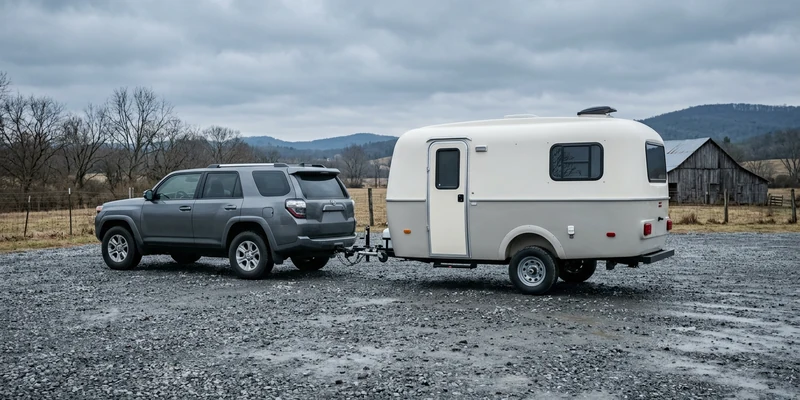
It feels backwards, but it is completely normal to ask why does my trailer sway when empty after a calm trip out and a nervous trip home. An empty trailer has almost no tongue weight in absolute terms, very little mass sitting on its tires, and the same tall flat sides catching wind that it had when loaded. Take the cargo out and you remove most of the stability without removing any of the aerodynamics.
This is most obvious on single axle utility trailers, enclosed cargo trailers, and lightweight travel trailers, where the difference between loaded and empty is a large share of the total weight. The fix is not to drive faster or grip harder, it is to give the empty trailer something to be stable with: a little controlled ballast ahead of the axles, correct tire pressure for an unloaded trailer, and a speed that respects how light the whole thing has become.
This article contains affiliate links. If you buy through them, we may earn a commission at no extra cost to you. Learn more.
Quick Answer
Why does a trailer sway more when it is empty?
- An empty trailer has very little tongue weight and very little mass on its tires, so wind, passing trucks, and road crown move it easily.
- Suspension and tires sized for a full load are effectively too stiff when empty, so the trailer skips instead of settling.
- The usual fix is modest ballast secured ahead of the axles, tire pressure appropriate for the unloaded weight, and a lower cruising speed.
Empty Trailer Sway: Causes and Fixes
Empty sway usually has several small contributors rather than one big one. Work down this table and fix the ones that apply to your trailer.
| What you notice | What it usually means | What to do |
|---|---|---|
| Tail wags in normal traffic, empty only | Tongue weight has collapsed to a very small number | Add secured ballast ahead of the axles, then recheck the balance |
| Trailer skips or hops over bumps | Springs and tires stiff relative to the empty weight | Set tire pressure for the actual load, slow down on rough surfaces |
| Pushed sideways by wind and semis | Full sail area, almost no mass to resist it | Reduce speed, add following distance, consider a calmer travel window |
| Single axle trailer feels twitchy | Short wheelbase between coupler and one axle line | Ballast forward, friction sway control, lower speed |
| Ramp or rear door heavy, nose light | Built in weight sits behind the axles when the box is empty | Ballast well forward, never behind the axles |
| Sway appeared after unloading at a job site | Load balance changed mid trip | Rebalance whatever cargo remains toward the front before driving |
| Empty trailer wanders and tires wear oddly | Possible bent axle, worn bushings, or alignment fault | Have the axle and suspension inspected by a trailer shop |
The Percentage Problem
Tongue weight is normally described as a share of the loaded trailer weight, commonly cited as roughly 10 to 15 percent for a conventional bumper pull. That percentage still applies to an empty trailer, but the absolute number behind it becomes small. A modest downward force on the ball is all that is holding the front of the trailer in line, and it takes very little sideways disturbance to overcome it.
Worse, empty trailers often lose the percentage as well as the pounds. Ramp doors, spare tires, rear mounted toolboxes, and heavy tailgates sit behind the axles and represent a much larger share of the total when everything else is gone. That is why some trailers measure fine loaded and turn tail heavy the moment they are emptied. The mechanics behind that balance are covered in our article on tongue weight and sway.
Why Light Also Means Bouncy
Trailer suspensions are built for the rated load, not for an empty box. With nothing in the trailer, leaf springs barely deflect, and the trailer reacts to every expansion joint by hopping rather than absorbing. A tire that briefly unloads is a tire that is not steering the trailer, and repeated over a rough stretch that turns into a wandering, skittish feel.
Tire pressure amplifies this. Trailer tires are commonly run at the pressure on the trailer’s tire and loading label, which corresponds to the loaded condition, so an empty trailer effectively rides on very stiff tires. Some owners run slightly lower pressure when towing empty for long distances, which is a decision to make against the tire manufacturer’s load and inflation guidance rather than by feel, and always reset to the label pressure before loading again.
Ballast: The Practical Fix
Adding weight to an empty trailer sounds absurd until you try it. A few heavy, dense items placed low and forward of the axles restore both tongue weight and the mass that keeps tires planted. Sandbags, water containers, concrete blocks on a plywood pad, or the tools you were carrying anyway all work.
Three rules make ballast safe. It goes ahead of the axle centerline, never behind. It sits on the floor rather than on shelves. And it is strapped down so it cannot slide rearward under braking, because loose ballast that migrates behind the axles during a hard stop creates the exact condition you were trying to avoid. Keep the total inside the trailer’s weight rating and your hitch’s tongue weight rating.
Ratchet straps and cargo anchors are what turn ballast from a hazard into a fix.

Sway Control on a Light Trailer
Add on friction sway control works well on light and single axle trailers, because the trailer’s own resistance to yaw is small enough that the friction bar’s damping is a meaningful share of the total. It clamps between the trailer A frame and a ball on the hitch shank, and it turns quick oscillations into slow, damped movement.
Two caveats matter. Friction bars are generally disconnected for tight low speed maneuvering and on slick surfaces, per the manufacturer’s instructions, and they need a mounting point the trailer A frame can accept. They also do not replace ballast: they slow the swing, they do not put weight back on the ball. Our explainer on how a trailer sway bar actually works covers the mechanism, and sway bars for light travel trailers compares the options sized for this weight class.

Drive the Empty Trailer Differently
An empty trailer is easier to move sideways, so the disturbances you barely noticed loaded become the main event. Lower your cruising speed, leave extra following distance, and ease off before a semi passes rather than while it is alongside. Crosswind is the one to respect most: a tall empty box is a sail with wheels.
If sway starts anyway, the response is the same as with a loaded trailer. Ease off the throttle, keep the wheel straight, stay off the foot brake while it is swinging, and use a light steady pull on the manual trailer brake lever if your controller has one. Our step by step guide to stopping trailer sway while towing covers the technique, and trailer sway at highway speed explains why a small speed reduction has such a large effect.
When Empty Sway Points at a Mechanical Fault
Empty is also the condition in which a mechanical problem shows itself most clearly, because there is no cargo weight masking it. A trailer that wanders when empty on a calm day, tracks slightly crooked behind the tow vehicle, or wears one tire differently from the other should be inspected rather than ballasted.
The items to have a qualified trailer shop check are axle straightness and alignment, leaf springs and equalizers, shackle bushings, wheel bearings, and the coupler and A frame for cracks or elongated holes. None of those are fixed by loading technique, and a bent axle or a broken spring is not a highway problem you want to discover at speed.
Common Mistakes to Avoid
- Putting ballast near the rear door. It is the easiest place to reach and the worst place for stability.
- Leaving ballast unsecured. Anything that can slide back under braking will, at the worst possible moment.
- Assuming empty means safe. Light trailers are more sensitive to wind and traffic, not less.
- Towing empty at loaded speeds. The same rig has far less resistance to yaw with nothing in it.
- Ignoring the rear bumper rack. Bikes or a cargo box behind the axles dominate the balance of an otherwise empty trailer.
- Overdoing the ballast. Stay inside the trailer’s weight rating and your hitch’s tongue weight rating; more is not automatically better.
Frequently Asked Questions
Is it normal for an empty trailer to sway? It is common, because tongue weight and total mass are both at their lowest while the trailer’s sail area is unchanged. Common does not mean acceptable, and modest ballast plus a lower speed usually settles it.
How much weight should I add to an empty trailer? Enough to restore a sensible tongue weight without exceeding the trailer’s weight rating or your hitch’s tongue weight rating. Place it low and ahead of the axles, secure it, and verify with a scale if you tow empty often. See how to calculate RV tongue weight at home.
Should I lower tire pressure when towing empty? Some owners do, but only within the tire manufacturer’s load and inflation guidance, never below it. Reset to the trailer’s label pressure before loading again, and never exceed the pressure marked on the tire.
Do single axle trailers sway more when empty? They tend to be more sensitive, since all the trailer’s cornering grip acts at one axle line and the empty weight is low. Ballast forward, friction sway control, and reduced speed all help.
Can a weight distribution hitch help an empty trailer? It has little to work with when tongue weight is very low, and spring bars sized for a loaded trailer can ride harshly. Ballast and sway control usually make more difference in the empty condition.
The Bottom Line
An empty trailer sways because you removed the weight that was keeping it planted while leaving the sail area intact, and because springs and tires meant for a full load ride stiff when the box is empty. Add modest secured ballast ahead of the axles, set tire pressure for the actual load within the tire manufacturer’s guidance, slow down, and consider friction sway control on light or single axle trailers. If it wanders empty on a calm day, have the axle and suspension inspected instead.