Last updated: August 14, 2026
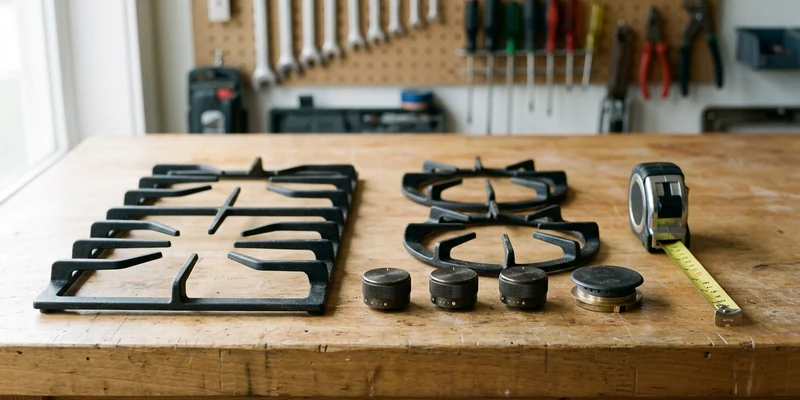
Shopping for RV stove parts goes wrong for one reason: the badge on the front of the appliance tells you almost nothing about fit. RV cooktops are built by a handful of manufacturers and sold under several names, model lines change without changing the name, and the parts that owners actually need, knobs, grates, burner caps, and glass lids, are sized by measurement rather than by brand. Order by measurement and you get it right the first time.
This guide covers what fits what, how to read your appliance label, and which parts are yours to fit at all. That last point matters more here than on any other parts page on the site. Roughly half of the components in a propane cooktop are gas components, and we do not publish instructions for fitting, cleaning, or adjusting any of them. Burner tubes, orifices, valves, thermocouples, and gas lines are certified RV technician parts, and this article names them so you know not to buy them.
This article contains affiliate links. If you buy through them, we may earn a commission at no extra cost to you. Learn more.
Quick Answer
Which RV stove parts can you buy and fit yourself?
- Owner parts: knobs, burner grates, burner caps, the glass lid, oven racks, drip trays, and range hood filters and bulbs. All of them are ordered by measurement, not by brand name.
- Find the data label first, usually under the cooktop lid, on the oven door frame, or behind the drawer below the oven. Photograph it, then measure the specific part before you order anything.
- Technician parts, which we do not publish fitting instructions for: burner tubes, orifices, gas valves, thermocouples, pilot assemblies, regulators, and supply lines. If the part you need is on that list, book a certified RV technician instead of adding to cart.
What Fits What, and Who Fits It
Find the part you need in the left column. The middle column tells you whether it is yours, and the right column tells you what to measure or check before ordering.
| Part | Owner or technician | How to get the right one |
|---|---|---|
| Control knobs | Owner | Measure the valve stem: D shaped or splined, and the stem width. Front styling is irrelevant to fit |
| Burner grates | Owner | Outside length and width, plus the distance between burner centers |
| Burner caps | Owner | Cap diameter and the seating profile, replace warped or corroded caps rather than flattening them |
| Glass lid or cover | Owner | Lid width and depth, hinge spacing, and whether yours is tempered glass or a metal cover |
| Oven racks and drip tray | Owner | Cavity width and depth, measured inside the oven at the rack supports |
| Range hood filter, bulb, vent cover | Owner | Filter cut size, bulb base type, and the exterior vent opening |
| Igniter module or electrode | Technician | Mounted in the burner assembly, so replacement and gap setting are not owner work |
| Burner tube or burner head | Technician | Gas component, we do not publish fitting or cleaning steps |
| Orifice or spud | Technician | Sized to gas type and appliance rating, never a guess or a drill job |
| Gas valve or manifold | Technician | Requires a manometer and a leak test after fitting |
| Thermocouple or pilot assembly | Technician | Safety component on the oven, not an owner adjustment |
| Regulator or supply line | Technician | Coach wide pressure delivery, always a certified job |
Find Your Appliance Before You Find a Part
Every fitment question gets easier once you have the data label, so do this before anything else. On most RV ranges it is a small silver or white sticker in one of three places: under the cooktop lid on the back rail, on the oven door frame where the door closes against it, or on the back wall of the storage drawer beneath the oven.
Photograph it, including the model and serial numbers, and keep the photo on your phone. Labels fade in a galley, and a legible photo is worth more than the sticker itself two seasons from now. If the label is already unreadable, the next best identifiers are the burner count, the overall cutout width, and whether the lid is glass or metal, which narrow the options considerably.
The brands behind the badges
Most RV cooktops in North American coaches come from a short list: Suburban, Atwood, Wedgewood and Wedgewood Vision, Magic Chef, Greystone, Furrion, and Dometic. Ownership and branding have shifted over the years, which is exactly why parts are cross referenced by model rather than by name. Our brand specific pages cover the quirks for Suburban, Magic Chef, Wedgewood Vision, and Greystone cooktops.
Knobs: The Part That Breaks First
Knobs fail more than anything else on an RV range, and the reason is structural. The plastic collar inside the knob grips a flat sided valve stem, heat cycles that plastic for years, and eventually the collar splits. The knob then spins freely while the valve stays put, which owners often misread as a failed valve.
Fit depends entirely on the stem, so pull a good knob off and look at what is underneath. Most RV ranges use a D shaped stem, meaning a round shaft with one flat side, and the two measurements that matter are the shaft diameter and the depth of the socket. A few use splined stems with fine teeth, which need a matching knob. Universal knob sets cover the common D profiles and usually include an adapter or two, and the full detail on choosing between universal and model specific is in RV stove knobs.
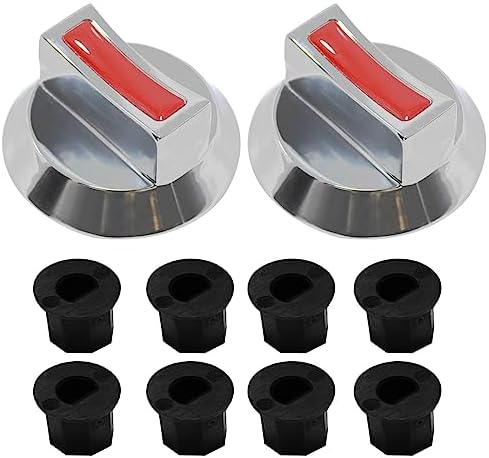
🎛️ The cheapest fix on the whole appliance
A replacement RV range knob set matched to your valve stems. Check whether your stems are D shaped or splined and measure the shaft before ordering, because two knobs that look identical from the front can fit completely different stems.
Grates, Caps, and the Glass Lid
These three take the physical abuse in a galley, and all three are straightforward owner parts as long as you measure. Grates warp, chip their porcelain coating, and rust from the underside where nobody looks. A grate that rocks under a pan is worth replacing rather than shimming, because a pot of boiling water on a wobbling grate is a real hazard in a moving vehicle.
Burner caps corrode and warp too, and a cap that does not sit flat and square changes where the ignition spark lands and how the flame spreads. Replace a warped cap with the matching size rather than trying to flatten it. What you should not do while the cap is off is clean, scrape, or probe the burner head underneath, which is a gas component and technician territory. Glass lids crack from thermal shock, almost always because the lid was closed on a cooktop that had not cooled. All three parts, with sizing detail, are covered in RV stove glass tops, grates and burners.
🍳 For grates that rock, rust, or have chipped
A porcelain coated replacement grate set matched to your cooktop’s burner layout. Measure the outside dimensions of the old grate and the distance between burner centers, since two and three burner spacings vary between brands and model years.

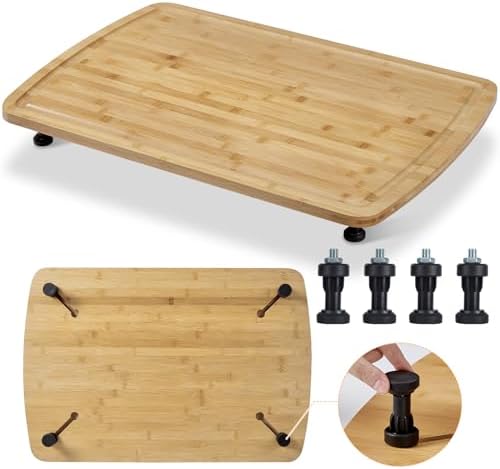
🧱 The part that prevents the next broken lid
A hardwood or bamboo stove cover and cutting board sized to your cooktop, which protects the glass on travel days and gives you counter space at camp. Measure the lid itself rather than the burner area, and see our comparison of RV stove covers for the sizing detail.
Oven and Range Hood Parts
Oven racks, rack supports, and drip trays are ordinary sheet metal parts and entirely owner replaceable. Measure the cavity at the rack rails rather than the door opening, because RV oven interiors are narrower than the frame suggests, and a rack that is a quarter inch too wide will not go in at all.
Range hood parts are the same story: grease filters are cut to a size, bulbs come in a handful of common bases, and exterior vent covers crack from UV and highway wind. None of it touches gas. The full breakdown, including why a weak hood fan matters more in a propane galley than a residential one, is in RV range hoods, vents and replacements, with the specific jobs covered in vent cover replacement and light bulb replacement.
OEM Versus Universal Parts
Both have a place, and the decision comes down to what the part has to do. For anything cosmetic or mechanical that you can measure, knobs, grates, covers, filters, a well made universal part is usually fine and often easier to find in stock than a discontinued original.
For anything that has to seat precisely, meaning burner caps and glass lids with hinge hardware, the original part number is worth chasing, because a near fit is not a fit. And for any gas component, the question does not arise at all: the part has to be the correct one for the appliance and the gas type, and a certified technician sources and fits it. That is the one place where a close enough part is genuinely dangerous rather than merely annoying.
The Parts We Will Not Help You Fit
This section exists so you do not spend money on something you should not install. We do not publish instructions for fitting, cleaning, adjusting, or sourcing burner tubes, burner heads, orifices or spuds, gas valves and manifolds, thermocouples, pilot assemblies, regulators, pigtail hoses, or supply lines, and we would encourage you not to follow instructions that do.
The reason is consistent across every gas article on this site. Those components determine how completely propane burns inside a small living space, and when they are slightly wrong the appliance usually still works. What changes is the combustion, which you cannot see, smell, or judge by eye. A certified RV technician fits the correct part, sets it, and verifies the result with a manometer and a leak test. That verification is the actual service you are paying for.
Stop immediately if
Shut the appliance off, close the tank valve at the bottle, ventilate the coach, and get everyone outside if you smell gas, if a CO or propane alarm sounds, if you see soot or scorching around a burner or vent, or if a flame burns yellow or lifts off the burner. Do not use the appliance again until a certified RV technician has checked it, and never test for a leak with a flame.
🚨 The one part nobody should skip
A working carbon monoxide alarm, or a combined CO and propane gas detector, with the expiration date on the housing checked. It is the cheapest part in this entire article and the only one that matters when something else has gone wrong.

When Parts Stop Making Sense
There is a point where a parts list turns into a replacement decision. Rust through in the burner box or oven floor, a technician finding the gas valve leaking, a discontinued model where knobs and grates no longer exist, or three separate faults in one season all point the same way.
If that is where you have landed, the job itself is in how to replace an RV stove, and the choice depends on how you cook: propane RV stoves for off grid independence, electric cooktops and ranges if you have the power for them, or a cooktop chosen by burner count if you are dropping the oven. Any swap with a gas connection ends with a certified technician making and leak testing that connection.
Common Mistakes to Avoid
- Ordering by brand name alone. Fit comes from measurements, not from the badge.
- Buying knobs without checking the stem. D shaped and splined stems need different knobs.
- Measuring the oven door instead of the cavity. Racks are sized to the rails, which are narrower.
- Flattening a warped burner cap. A cap that does not seat square moves the spark and the flame.
- Cleaning the burner head while the cap is off. That is a gas component and technician work.
- Buying gas parts to fit yourself. Orifices, valves, and thermocouples are not owner parts at any price.
- Losing the data label. Photograph it now, while it is still readable.
Frequently Asked Questions
Are RV stove parts universal? Some are. Knobs, grates, filters, and covers are widely cross compatible when you order by measurement. Burner caps, glass lids, and anything gas related need the correct part for your specific appliance.
Where is the model number on an RV stove? Usually under the cooktop lid on the back rail, on the oven door frame, or on the back wall of the drawer below the oven. Photograph it before it fades.
Can I use a residential stove part in an RV? Cosmetic parts sometimes cross over, but appliance components do not. RV ranges are built for propane, for a moving vehicle, and to a different set of standards, so gas parts are never interchangeable.
Which RV stove parts should I not install myself? Burner tubes and heads, orifices, gas valves, thermocouples, pilot assemblies, regulators, and supply lines. Those belong to a certified RV technician who can verify the result with a manometer.
My knob spins without turning the burner on. What broke? The plastic collar inside the knob has split, which is the most common failure on any RV range. Measure the valve stem and fit a matching replacement knob.
Can I still get parts for a discontinued RV stove? Often yes for knobs, grates, and racks through universal sizing. Model specific glass lids and gas components are the hardest, and their absence is usually what pushes owners toward replacing the appliance.
The Bottom Line
Photograph the data label, then order RV stove parts by measurement rather than by brand. Knobs, grates, burner caps, glass lids, oven racks, and range hood filters and bulbs are all owner parts, and between them they cover most of what actually breaks in a galley. Burner tubes, orifices, gas valves, thermocouples, pilot assemblies, regulators, and supply lines are certified RV technician parts, and we do not publish fitting or cleaning instructions for any of them. Keep a live CO alarm in the coach, and stop everything if you smell gas or see soot or a yellow flame.