Last updated: August 14, 2026
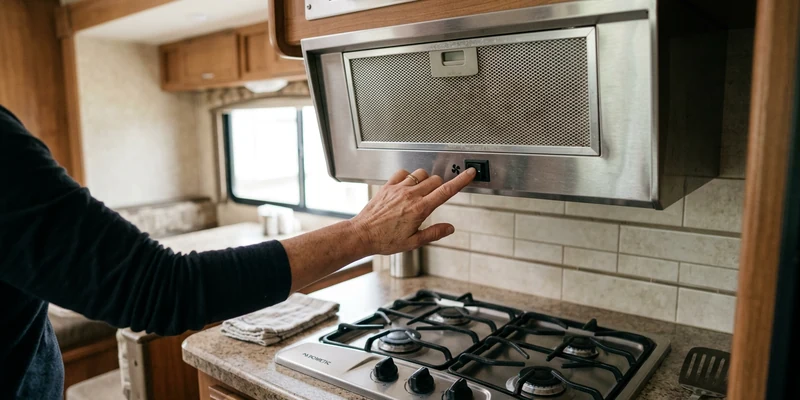
An RV range hood is a small fan, a grease filter, a light, and usually a plastic flap on the outside wall, and almost every complaint owners have comes down to those four parts. Weak suction is nearly always a loaded filter or a blocked exterior vent. The rattle at highway speed is the flap on that vent cover. A dead light is a bulb, a switch, or a 12V feed, in that order of likelihood.
It also helps to be honest about what the hood is for. It takes the edge off steam, smoke, and cooking smell in a small space, and it is no substitute for opening a window while you cook on propane.
This article contains affiliate links. If you buy through them, we may earn a commission at no extra cost to you. Learn more.
Quick Answer
What do you need to know about an RV range hood?
- Most RV hoods are 12V and vent through a short duct to a flap style cover on the sidewall. Some recirculate through a filter instead, which means they never move cooking moisture out of the coach.
- Weak airflow is usually the grease filter or a stuck exterior flap, not a failing motor. Both are free to check.
- The rattle you hear while driving is that flap, and the fix is a new cover rather than more tape.
- Cooking on propane puts water vapor and combustion products into the coach, so ventilate and keep a working carbon monoxide alarm aboard.
Symptoms, Causes, and What to Do
Find the behavior that matches yours and follow the action column. Everything in the top half is free or close to it, and the bottom row belongs to a certified RV technician.
| What the hood does | What it usually means | What to do |
|---|---|---|
| Fan runs but moves almost no air | Loaded grease filter or blocked exterior vent | Wash the filter, then check the outside flap opens freely |
| Rattles or buzzes at highway speed | The flap in the exterior vent cover | Replace the cover, see the vent cover section below |
| Light does not come on | Bulb, switch, or lost 12V feed | Swap the bulb first, then check the fuse and the switch |
| Fan dead on every speed | Blown fuse, failed switch, or seized motor | Check the 12V fuse and voltage at the hood before blaming the motor |
| Fan runs slowly or screeches | Grease loaded blower wheel or dry bearings | Clean the wheel; a screeching motor is a replacement |
| Kitchen still steams up with the fan on | Recirculating hood, not a ducted one | Open a window or run the roof vent while cooking |
| Water stain on the wall under the vent | Failed sealant around the cover | Reseal or replace the cover before the wall takes damage |
| Burning smell or scorch marks | Electrical fault | Kill the power and call a certified RV technician |
If the appliance below the hood is the real problem, meaning burners that will not light or an oven that will not hold heat, start with RV stove repair instead.
First, Work Out What You Have
Two questions decide how you troubleshoot a hood and where your own work has to stop: whether it ducts outside or recirculates, and whether it runs on 12V or 120V. Both are answered in a couple of minutes and neither requires tools.
Ducted or recirculating
A ducted hood pushes air through a short duct that exits the sidewall behind a flap cover, which is the common layout in trailers and fifth wheels. A recirculating hood has no duct, filters the air, and blows it back into the room, which is what vans and small campers usually get. Only the ducted version removes moisture from the coach, so if there is no exterior cover near the kitchen, ventilation is on you and the roof vent, as covered in stopping condensation and mold in an RV.
12V or 120V
Most RV range hoods run on 12V house power, which is why the fan and light work while boondocking, though some larger motorhomes use 120V units fed from the breaker panel. Test it by disconnecting shore power, switching the generator and inverter off, and trying the hood on battery alone. If it works, it is 12V and fair game for owner checks with the fuse pulled. If nothing works until you plug in, treat it as a 120V appliance and read the safety section below.
The Grease Filter Is the First Thing to Check
A hood with a saturated filter is not broken, it is blocked. The aluminum mesh traps cooking grease by design, and after a season of frying it holds enough to strangle the airflow while looking only mildly grubby from below. Owners consistently report that a wash restores most of the suction they thought was gone for good.
Slide it out, wash it in hot water with dish soap, and dry it fully before it goes back. Replace it when the mesh is crushed, torn, or so oxidized that washing no longer clears it, because a deformed filter lets grease past into the blower wheel.
🔧 The Cheap Part That Restores Airflow
A replacement aluminum mesh grease filter cut to your hood’s opening. Measure the old one before ordering, since RV hood filters come in several sizes and the difference is often less than an inch.

The Fan and the Motor
An RV hood fan is a small squirrel cage blower on a 12V motor, and it fails in three ways. It slows down, which almost always means grease on the blower wheel. It gets loud, which means the bearings are going. Or it stops entirely, which is an electrical problem to find before you blame the motor.
Diagnosing a dead fan without guessing
Work from cheap to expensive. Check the 12V fuse for the kitchen circuit first, since a blown fuse takes the light and the fan together and that pattern is a clue on its own. Then check for voltage at the hood with the switch on. A healthy 12V system usually reads somewhere around 12.6 to 12.8 volts at rest, and you should see close to that at the hood. Power present with no fan movement points at the switch or the motor; no power points upstream at the fuse, a connector, or a bad ground.
When the motor is finished, and what to measure
Grinding, screeching, a wheel that will not turn freely by hand, or a burnt smell all mean replacement rather than repair. Hood motors are rarely sold as a serviceable part, so a new assembly is the sensible move, and since the cutout and duct already exist it is a realistic afternoon job on a 12V unit. Before ordering, measure the cabinet opening width, the height above the cooktop, the depth of the hood body, the duct opening size, and which face the duct exits. A hood that is right in every respect except the duct position turns into carpentry.
🔁 When the Hood Itself Is Done
A 12V RV range hood assembly with a two or three speed fan, an integrated light, and a ducted outlet. Kill the 12V supply, photograph the wiring before you disconnect it, and test the fan and light before tightening the mounting screws. Check the listing for the duct size and outlet direction.

The Exterior Vent Cover and That Highway Rattle
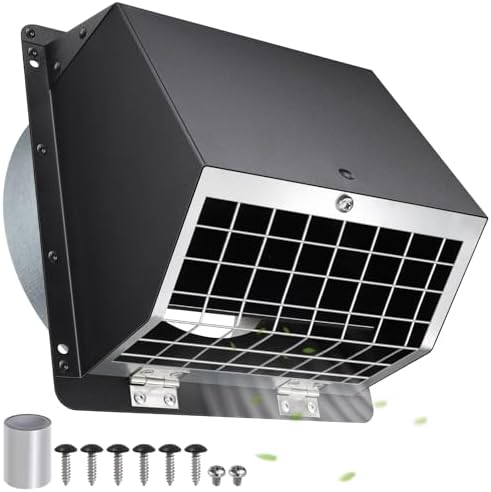
The plastic cover on the outside wall has a hinged flap that opens when the fan pushes air out and drops shut when it stops. That flap is what buzzes at highway speed, and it is the single most common RV range hood complaint there is. Once the plastic has aged in the sun, the fit gets sloppier and the noise gets worse.
The cover also decides whether the fan can move air at all, since wasp nests and a flap glued shut by old grease are common finds behind one. Take it off once a year and look. Sizing, removal, and sealing are covered step by step in RV range hood vent cover replacement.
🔇 For the Rattle at Highway Speed
A replacement vent cover with a properly seating flap and a built in insect screen. Match the duct opening and screw pattern of the existing cover, and buy butyl tape at the same time, since the cover has to be bedded rather than simply screwed back on.
The Light in the Hood
Hood lights fail more often than the fans do, and nine times out of ten it is the bulb. The trap is that RV hood bulbs are not one standard type: depending on the builder you may find a 12V wedge base bulb, a bayonet bulb, or in a 120V hood an appliance bulb.
Take the old bulb out and read what is printed on it before ordering. If a known good bulb still does not light, the problem is the switch, the socket contacts, or the feed, which is the same order as the fan. The full sequence is in RV range hood light bulb replacement.
💡 The Usual Replacement
A 12V LED bulb in the base type your hood uses, bought as a multi pack so there are spares in the drawer. LEDs run cooler than the incandescent bulbs many hoods shipped with, which matters directly above a cooktop. Confirm the base type and voltage against your old bulb before ordering.

Where the Line Is, on Electricity and on Gas
Twelve volt hood work is owner territory with the fuse pulled or the battery disconnected. A 120V hood, and any repair that involves cutting or extending 120V wiring, is work for a certified RV technician or a licensed electrician, and we do not publish instructions for 120V wiring or breaker work.
The hood also sits directly above a propane appliance, so the gas line has to be explicit. You can clean an igniter electrode, replace knobs, grates, glass tops, bulbs, and filters, check the 12V side with a meter, and keep ventilation openings clear. We do not publish instructions for gas lines, regulators, gas valves, burner tubes, orifices, burner adjustment, or thermocouple adjustment, because those need leak testing and a combustion check by a certified RV technician. If you smell gas, if the carbon monoxide alarm sounds, or if you see soot, yellow or floating flames, or scorch marks, shut the appliance off, close the valve at the propane tank, ventilate, get everyone outside, and have a technician inspect the system. Keep a working carbon monoxide alarm in the rig and check the expiration date printed on its back, because these detectors expire on a fixed schedule. If the burners misbehave, an RV stove that will not light covers what is safe to investigate, and how to replace an RV stove covers the appliance itself.
Common Mistakes to Avoid
- Blaming the motor for weak airflow. The filter and the exterior flap account for most cases, and both are free to check.
- Taping the exterior flap shut. That blocks the vent, traps moisture in the duct, and the tape fails at speed anyway.
- Ordering a bulb before reading the old one. Base type and voltage vary between builders.
- Buying a hood on width alone. Duct position and cabinet depth are what turn a swap into a project.
- Ignoring a carbon monoxide alarm because the stove seems fine. Alarms report a condition. Ventilate and get the system checked.
Frequently Asked Questions
Are RV range hoods 12V or 120V? Most are 12V and run off the house battery, which is why the fan and light work without shore power. Some larger motorhomes use 120V units. Test by running the hood on battery power alone with everything unplugged.
Why does my RV range hood rattle while driving? The hinged flap in the exterior vent cover lifts and drops in the wind. A new cover with a properly seating flap is the fix, and taping the old one shut is not.
Why is my range hood fan so weak? Wash the grease filter and check that the exterior flap opens freely and is not blocked by an insect nest. Those two account for most weak airflow complaints on a fan that still spins.
Can I replace an RV range hood myself? A 12V hood, yes, provided the cabinet opening, depth, and duct position match. Disconnect the battery or pull the fuse first. A 120V hood is work for a certified RV technician.
Do RV range hoods vent outside? Ducted ones do, through a flap cover on the sidewall. Recirculating hoods filter the air and return it to the room, so they remove odor and grease but not moisture.
What bulb does an RV range hood take? It depends on the builder. Wedge base and bayonet 12V bulbs are both common, and 120V hoods use appliance bulbs. Read the old bulb before ordering.
The Bottom Line
Four parts explain nearly every RV range hood complaint: the grease filter, the exterior vent cover, the bulb, and the fan motor, and the first two are free to check. Wash the filter, make sure the flap outside opens and closes cleanly, and only then start measuring voltage or shopping for a replacement. Know whether your hood is ducted or recirculating, because only one of them takes cooking moisture out of the coach, and keep the gas line firmly on the technician’s side of the fence.