Last updated: August 14, 2026
A propane RV stove is still the default in almost every trailer and motorhome, and for good reason. It cooks without a shore power hookup, it does not care whether the campground pedestal is thirty amp or fifty, and the fuel it runs on is already on board for the furnace and the water heater. When owners replace one, they are usually not switching technologies. They are looking for the unit that drops into the hole the old one came out of.
That makes this a fitment decision more than a features decision. The two numbers that matter are the cutout in your countertop and the number of burners you want in it, and everything else is finish, ignition style, and whether the top is glass or steel. This guide covers how to measure the opening, what genuinely differs between models, and where the job stops being yours and becomes work for a certified RV technician.
This article contains affiliate links. If you buy through them, we may earn a commission at no extra cost to you. Learn more.
Quick Answer
Which propane RV stove should you buy?
- For most trailers, a three burner LP drop in cooktop that matches your existing cutout is the straightforward replacement, with a piezo or electronic igniter and a sealed or recessed top for easy cleaning.
- Go to two burners if counter space is scarcer than cooking ambition, and to four only if your galley is wide and you genuinely cook full meals on board.
- Measure the countertop cutout, the depth below it, and the clearance to the range hood before you look at a single listing. The gas connection itself is work for a certified RV technician.
What to Check Before You Buy
Seven points decide whether a propane cooktop is a bolt in swap or a cabinetry project. The first three are measurements, and they matter more than every feature on the box.
| What to check | Why it matters | What to look for |
|---|---|---|
| Countertop cutout | The single figure that decides whether it drops in | Measure the existing hole, length and width, and compare to the stated cutout dimensions |
| Depth below the counter | The body, the gas line, and the igniter wiring all have to fit under there | Check the drop below the counter and what is in the cabinet underneath |
| Burner count | Decides how much counter you give up permanently | Two, three, or four, with three the common compromise in most rigs |
| Ignition type | Changes what you do when it will not light | Match ignition, or piezo, or a battery powered electronic igniter |
| Top material | Cleaning, weight, and how it behaves on rough roads | Porcelain or steel for durability, glass for looks and easy wiping |
| Grate style | Affects stability of small pots and how much it rattles | Continuous or heavy cast grates sit steadier than light wire ones |
| Burner output spread | An RV cooktop is not a home range, and one hot burner does most of the work | A mix of outputs rather than four identical small burners |
If your existing stove is misbehaving rather than dead, replacing it may be the expensive answer to a cheap problem. Igniters, electrodes, grates, and knobs are all service parts, and RV stove repair and what you can fix yourself covers which faults are worth fixing first.
Measuring the Cutout Is the Whole Job
Take the grates off, lift the cooktop out if it is only sitting in the opening, and measure the hole in the counter itself, front to back and side to side. That is the number that has to match the cutout dimension in the listing, and it is the number people substitute with the width of the old appliance instead. The two are not the same.
Then look underneath. You need the drop below the counter, the position of the gas line where it enters, and whether a drawer, a false front, or a fridge vent shares the cabinet. Owners who skip this step are the ones who discover that the new cooktop is a half inch deeper than the space it has to live in, with the gas line already disconnected and dinner two hours away.
Sizes cluster, they do not standardize
RV cooktops tend to cluster around a handful of widths, commonly somewhere between roughly seventeen and twenty two inches for two and three burner units, with wider bodies for four burners. Suburban, Atwood, Wedgewood, Furrion, Greystone, and Magic Chef have all built in that general territory, which is why swaps between brands are often possible but never guaranteed. Treat any brand cross reference as a shortlist and confirm it against your own measurements. RV stove parts and what fits what goes into how these families relate.
Our Top Picks at a Glance
How we chose: we compared widely available LP gas RV cooktops on cutout compatibility, burner layout, ignition type, top material, and the complaints and compliments that repeat across owner feedback. Our assessment is based on published specifications and that feedback rather than any trial of our own. Most owners land on the first pick, and the other two exist for galleys at either end of the size range.
🏆 Best Overall
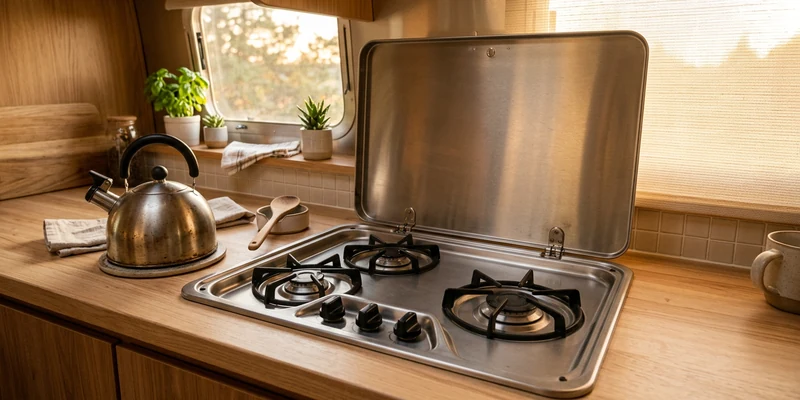
A three burner LP drop in RV cooktop from an established RV appliance brand such as Suburban or Furrion, with a piezo or electronic igniter and a recessed top with a raised edge. Three burners is the layout that suits the widest range of rigs, because you can run a pan, a pot, and a kettle without giving up the entire counter. Confirm the stated cutout against your own measurement before ordering, and expect to reuse or replace the trim strip around the opening.

🚐 Best for Small Galleys
A two burner LP RV cooktop, often supplied with a hinged tempered glass cover that acts as a splash guard while cooking and hands you back the counter when it is folded down. In a van, a teardrop, or a compact trailer this is usually the smarter choice, since the third burner in a three burner unit rarely gets used and the counter space does. Check that the glass lid clears your range hood in the raised position.

🍳 Best for Serious Cooking On Board
A four burner LP cooktop for wide galleys in larger fifth wheels and motorhomes, ideally with heavy continuous grates so pans slide between burners instead of being lifted. This only makes sense if the counter is wide enough that you keep working space either side. On a narrow counter it is a downgrade dressed up as an upgrade.
Matching the Stove to How You Actually Cook
Four situations cover most owners. Work out which one you are before you get attached to a burner count.
- Weekend trailer, simple meals. Two or three burners. The counter you keep is worth more than a burner you use twice a year.
- Full time in a mid size rig. Three burners with a decent output spread, plus a cover so the cooktop becomes counter between meals.
- Large fifth wheel, real cooking. Four burners, heavy grates, and a proper range hood, since four burners produce a lot more moisture and grease than two.
- Van or teardrop. Two burners with a glass lid, or a portable unit you stow, so the galley is not permanently committed to cooking.
Ignition style changes your troubleshooting more than your cooking
Match lighting, piezo, and battery powered electronic ignition all end up with the same flame. What differs is what happens when it fails. A piezo that stops sparking is usually a dirty electrode or a cracked ceramic, an electronic igniter that goes quiet is often a dead battery or a corroded contact, and a match light burner simply keeps working. If yours clicks without lighting, RV stove igniter not clicking or sparking covers the cleaning and checking sequence.
Two Things to Buy With It
Neither is exciting and both change the day to day experience more than the choice between two decent cooktops.
🪵 The Counter Space You Just Gave Up
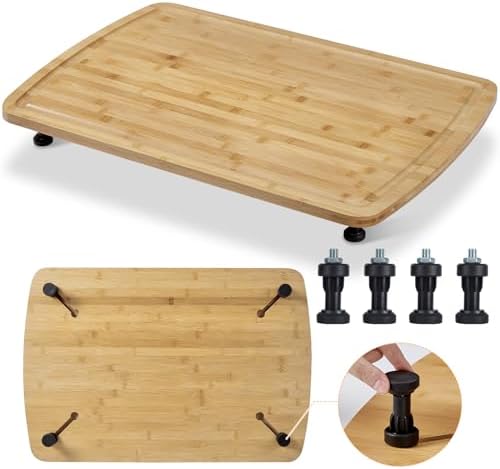
A stove top cover cutting board sized to the new cooktop, so the burners disappear under a work surface the moment you are done cooking. In a small galley this is the difference between a kitchen and an appliance. Measure the new cooktop once it is fitted rather than ordering from the old dimensions, and remember it only ever goes on a cold stove.
🚨 The Alarm That Belongs Near Any Burner
An RV rated carbon monoxide alarm, or a combination LP and carbon monoxide alarm, mounted per the maker’s instructions. Any appliance that burns propane inside a small sealed space needs one, and these units age out on a printed expiry date whether or not they have ever sounded. Check the back of the one you already have while you are working in the kitchen.

Where the Job Stops Being Yours
Pulling the old cooktop, cleaning the opening, fitting the trim, and setting the new unit in place is owner territory. Connecting it to the propane system is not. Gas lines, flare fittings, regulators, gas valves, burner tubes, and orifices are work for a certified RV technician, and we do not publish do it yourself instructions for any of it, because a leak in a small enclosed living space does not give you a second chance and a proper connection includes a leak test an owner cannot perform.
The same line applies to burner adjustment and anything involving a thermocouple. If a burner runs yellow, floating, or sooting after a swap, that is a job for the technician who made the connection.
Stop cooking immediately if you see any of these
Gas smell, a sounding carbon monoxide alarm, soot around a burner, a yellow or floating flame, or scorch marks on the cabinetry. Turn the appliance off, close the valve at the propane bottle, ventilate, get everyone outside, and call a certified RV technician. Do not relight to see whether it does it again. If your propane appliances misbehave as a group rather than one at a time, the pattern usually points upstream, as covered in an RV fridge that cools on electric but not propane and an RV furnace that will not run.
Common Mistakes to Avoid
- Measuring the appliance instead of the cutout. The hole in the counter is the dimension that decides fitment.
- Buying four burners for a narrow counter. You lose the working space that made the galley usable and gain a burner you rarely light.
- Ignoring the depth below the counter. Body depth, gas line routing, and drawers behind the cabinet face all live in the same space.
- Forgetting the range hood clearance. Glass lids and tall pots both need headroom, and hoods in RVs sit low.
- Doing the gas connection yourself. This is the one job on the list that has no acceptable margin for error.
- Replacing a stove that needed an igniter. Electrodes, igniters, and knobs are inexpensive service parts and they cause most of the classic complaints.
Where to Go From Here
If you have not established that the old cooktop is finished, rule out the cheap causes first. An RV stove that will not light covers the sequence, and RV stove parts and what fits what helps you identify what you have before you buy anything.
If you are still deciding on format, RV cooktops by burner count is the fastest way to weigh two against three against four, RV stove and oven combos covers the units with an oven underneath, and electric and induction RV cooktops is the honest look at what happens when you take propane out of the equation. When the new unit is in, how to replace an RV stove walks through the removal and fitting side of the job.
Frequently Asked Questions
Are RV propane stoves interchangeable between brands? Often, but never assume it. Widths cluster in a similar range across Suburban, Atwood, Wedgewood, Furrion, Greystone, and Magic Chef, so a swap is frequently possible if the cutout and the depth match your measurements.
How many burners do I actually need? Three suits most trailers and motorhomes. Two is better in a van or a compact trailer where counter space is the scarcer resource, and four only makes sense on a wide galley.
Can I connect the new stove myself? No. Setting the appliance in place is owner work, but the propane connection, including the leak test that has to follow it, belongs to a certified RV technician.
Do RV cooktops run on the same propane as the furnace? Yes, they share the rig’s LP system and its regulator. That is also why a problem affecting several propane appliances at once usually points upstream rather than at the stove.
Glass top or steel? Glass wipes clean and looks better, steel and porcelain shrug off abuse and travel. Both are fine, so choose on how you clean rather than on cooking performance.
Why does my new stove have a yellow flame? Stop using it and call the technician who made the connection. Yellow, floating, or sooting flames are a combustion issue, and burner and orifice work is not an owner job.
The Bottom Line
Buy a propane RV stove from your tape measure. Measure the countertop cutout, the depth underneath, and the clearance to the range hood, then choose the burner count that matches how you cook rather than the one that looks generous in the photo. Three burners suits most rigs, two suits small galleys, and four earns its place only on a wide counter. Fit the appliance yourself if you like, hand the gas connection to a certified RV technician, and put a working carbon monoxide alarm in the rig before you light anything.