Last updated: August 14, 2026
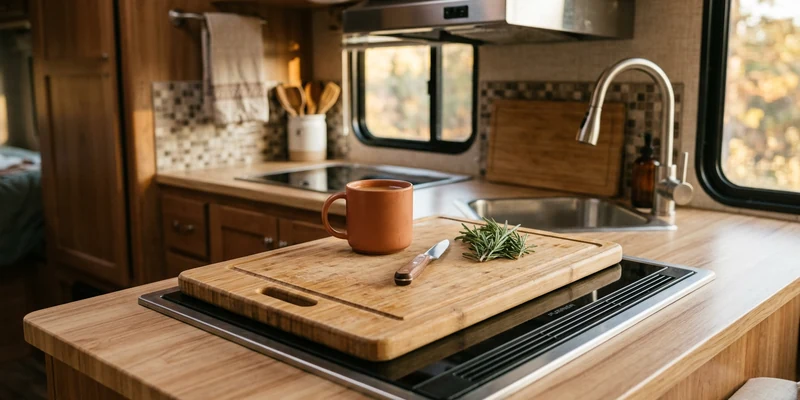
An RV stove cover is the cheapest square foot of counter space you will ever buy. Most RV kitchens give you a strip of laminate barely wide enough for a cutting board, and the cooktop sits in the middle of it doing nothing at all for the twenty two hours a day you are not cooking. A board that drops over the burners hands that surface back to you, and in a small trailer that changes how the whole galley works.
The catch is that stove covers are not one size fits all, and every one of them has the same rule attached: it goes on a cold cooktop, never a warm one. This guide covers how to measure so the cover sits flat, which materials suit which kind of cooking, and the mistakes that turn a nice bamboo board into a scorched one.
This article contains affiliate links. If you buy through them, we may earn a commission at no extra cost to you. Learn more.
Quick Answer
Which RV stove cover should you buy?
- For most rigs, a hardwood or bamboo board cut to sit on the raised edge of the cooktop, sized from your own measurements rather than from your stove’s brand name.
- Choose tempered glass if you want a wipe clean surface that doubles as a splash guard, and silicone or a fitted mat if you mainly want to stop grates rattling on travel days.
- Whatever you buy, it goes on a completely cold cooktop. A cover on residual heat is how boards scorch, silicone deforms, and glass gets stressed.
What to Check Before You Buy
Six things decide whether a cover fits and whether you will actually use it. The first two are pure measuring, and they are where nearly every returned cover goes wrong.
| What to check | Why it matters | What to look for |
|---|---|---|
| Where it rests | Some covers sit on the cooktop lip, others bridge the whole counter opening | Decide first, then measure that surface, not the stove as a whole |
| Length and width | A board that is a fraction too long will not drop in and one too short slides around | Measure the flat area with a tape, and allow a little clearance rather than a snug fit |
| Grate and burner clearance | Most covers go over the grates, some are meant to replace them while parked | Check the height of your grates and whether the cover is flat underneath |
| Material | Decides how it handles heat, moisture, and knife work | Hardwood or bamboo for cutting, tempered glass for wiping, silicone for travel |
| Non slip feet or a liner | An RV is never quite level and a board that slides is a board you stop using | Rubber feet, a routed lip, or a thin silicone liner underneath |
| Hood and cabinet clearance | Cover plus board plus anything on top has to clear the range hood or the cabinet above | Measure the gap from the grates to the underside of the hood |
If your grates are cracked, warped, or missing, a cover will sit unevenly no matter what you buy. Grates, burner caps, and glass tops are all sold as service parts, and our guide to RV stove glass tops, grates and burners covers what actually fits.
How to Measure So It Fits the First Time
Measure the surface the cover will rest on, not the appliance. That sounds obvious and it is still the number one reason covers get sent back. Put a tape across the flat area between the raised edges of the cooktop, then front to back, then write both numbers down before you look at a single listing.
Then measure the vertical space. A cover sitting on top of the grates raises your working surface by the height of those grates, and under a low mounted range hood that can leave barely any room to work. If the gap is tight, a low profile mat or a glass cover sits closer to the burners than a thick wooden board will.
Do not shop by stove brand alone
Listings often say they suit a particular brand of RV cooktop, which is a helpful starting point rather than a guarantee. Suburban, Atwood, Wedgewood, Furrion, Greystone, and Magic Chef have all built cooktops in similar widths, and small differences in the raised edge or the grate profile change what drops in. Your tape measure is the authority, not the badge. If you are unsure which cooktop you have, RV stove parts and what fits what is the place to start.
Our Top Picks at a Glance
How we chose: we compared widely available RV stove covers on fit and sizing options, material behavior around heat and moisture, non slip design, and the complaints and compliments that repeat across owner feedback. Our assessment is based on published specifications and that feedback rather than any trial of our own. Most owners should be choosing between the first two, based on whether they want a cutting surface or a wipe clean one.
🏆 Best Overall
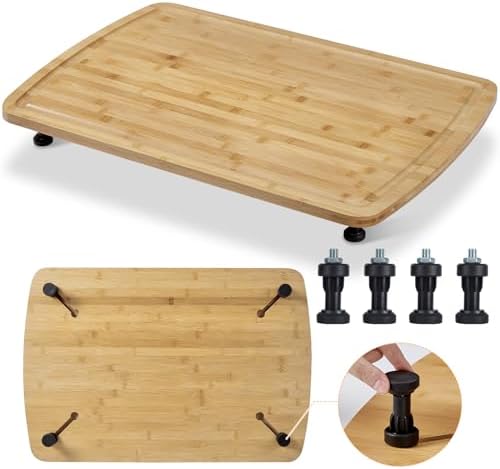
A solid hardwood or bamboo RV stove top cover with a routed underside or rubber feet, sold in several sizes so you can match your own measurements. This is the version that earns its keep, because it gives you counter space and a cutting board in one piece. Choose a thickness you can lift with one hand, since a heavy board that lives in a cabinet gets used far less than a light one leaning against the wall.
🧽 Best Wipe Clean Option
A tempered glass RV cooktop cover, ideally hinged at the back so it can stand up as a splash guard while you cook and fold down flat when you are done. Glass wipes clean in seconds, takes grease and sauce without staining, and adds almost no height over the grates. It is not a cutting surface, so it suits owners who prep on a separate board and want the cooktop to disappear rather than to become a workbench.

🚐 Best for Travel Days
A heat resistant silicone stove top mat or fitted burner cover set, the cheap answer to grates that rattle down the highway and crumbs falling into the burner wells. It folds into a drawer, weighs almost nothing, and doubles as a trivet on the dinette. It gives far less usable surface than a rigid board, so treat it as a companion rather than a replacement.

Wood, Glass, or Silicone: What Each One Is Good At
The material decides what the cover is for, and picking the wrong one is how people end up with a board they never take out of the cabinet. Match it to the job you actually need done in your galley.
- Bamboo and hardwood. The best all rounder. Real counter space, knife friendly, warm looking, and stable if it has feet or a lip. Needs occasional oiling and does not enjoy standing water, so wipe it dry rather than leaving it wet in the sink.
- Tempered glass. The easiest to keep clean and the lowest profile. Excellent as a splash guard, poor as a cutting board, and it can be slippery on top unless the design includes some grip. Handle it like glass when you stow it for travel.
- Silicone and fitted mats. The travel day answer. Stops rattles, catches crumbs, folds away, cheap to replace. Not rigid enough to work on, so look for a stated heat rating and a thickness that holds its shape.
Two boards beat one
The setup that gets used most in small kitchens is a cooktop cover plus a matching sink cover. Together they turn two holes in your counter into one continuous work surface, and you can slide the sink board off to rinse something without disturbing what you are chopping.
Two Things to Buy at the Same Time
Both are inexpensive and both fix the two complaints owners have about covers, sliding and stowing. Buy at least the liner with the board.
🪵 The Matching Second Surface
A hardwood or bamboo sink cover cutting board sized to your galley sink. With the cooktop covered and the sink covered, a typical RV counter goes from a narrow strip to a usable prep area, which is the actual reason these boards sell. Measure the sink opening the same way you measured the cooktop, from the flat area the board will rest on.

🧷 The Cheap Part That Stops the Sliding
A thin non slip silicone or rubber shelf liner, cut to size and laid between the grates and the board. It kills the rattle on travel days, stops the board creeping when the rig is not perfectly level, and protects the finish on both surfaces. A roll costs very little and there is always a use for the offcuts in an RV.

The Cold Stove Rule, and the Rest of the Safety Side
A cover goes on a completely cold cooktop. Not a cooling one, not one you turned off five minutes ago. Cast iron grates hold heat far longer than the burners themselves, and residual heat is what scorches wood, warps silicone, and puts stress into glass. If you cannot rest your hand flat on a grate, the cover stays off.
Never use a cover as a trivet, never leave it on the cooktop with a burner in use, and never let it block the range hood while you cook. If your hood is weak or noisy enough that you avoid using it, that is worth fixing on its own terms, and RV range hoods, vents and replacements covers the options.
The propane symptoms that outrank everything else
If you smell gas, hear a carbon monoxide alarm, or see soot, a yellow or floating flame, or scorch marks around a burner, stop cooking. Shut the appliance off, close the valve at the propane bottle, ventilate, get everyone out, and call a certified RV technician before using the stove again. We do not publish do it yourself instructions for gas lines, regulators, gas valves, burner tubes, or orifices, because a small error there does not have small consequences. Fit a working carbon monoxide alarm and check the expiry date printed on the back.
Common Mistakes to Avoid
- Buying by stove brand instead of by measurement. Similar looking cooktops differ in the raised edge and grate profile. Measure the surface the cover rests on.
- Forgetting the vertical space. A thick board on top of tall grates can leave you almost no clearance under a low range hood.
- Putting it down on a warm cooktop. The grates stay hot long after the flame is out, and that is what scorches boards and warps mats.
- Skipping the non slip layer. Rigs are rarely level, and a board that slides while you chop is a board that lives in the cabinet.
- Leaving a wooden board wet. Standing water lifts the grain and eventually splits bamboo. Wipe it dry and oil it occasionally.
- Driving with a loose glass cover. Stow it flat and padded, or use a mat on travel days.
Where to Go From Here
If your interest in a cover is partly because the cooktop underneath annoys you, it may be worth solving that instead. Burners that light poorly, igniters that click without sparking, and cracked glass tops are all repairable, and RV stove repair and what you can fix yourself is the place to start before you spend anything.
If the stove is genuinely past it, the replacement decision splits by fuel and by whether you want an oven. RV cooktops by burner count is the fastest way to work out how much of your counter you are willing to give up, propane RV stoves covers the standard drop in units, and RV stove and oven combos covers the ones with an oven underneath. The gas connection on any new appliance is work for a certified RV technician, not a weekend job.
Frequently Asked Questions
What size RV stove cover do I need? Measure the flat area the cover will rest on, both length and width, and buy to those numbers with a little clearance. Brand names on a listing are a starting point, not a guarantee of fit.
Can I leave the cover on while the stove is on? No. Covers go on a completely cold cooktop, with every burner off and the grates cool enough to touch. Residual heat in cast iron grates is what damages boards and mats.
Is a wood or bamboo cover safe near a gas burner? It is safe as a cover on a cold cooktop, which is what it is designed for. It is not a trivet, not a heat shield, and not something to leave in place while you cook.
Will a stove cover stop the grates rattling while driving? A silicone mat or a fitted burner cover set does this best, since it sits between the metal parts. A rigid board helps only if it is held down or laid on a non slip liner.
Do I need a cover made for RVs specifically? Not necessarily, but RV cooktops are narrower than home ranges and often have a raised edge, so covers sold for RV use tend to come in the right sizes. Check the dimensions either way.
Can I use a cover if my glass top is cracked? Replace the glass first. A cracked top flexes under load and a cover puts weight on exactly the wrong place. Glass tops and grates are sold as service parts.
The Bottom Line
A stove cover is one of the highest value small purchases in an RV kitchen, provided you buy it from your own tape measure rather than from a brand name. A hardwood or bamboo board suits most owners because it gives you counter space and a cutting surface at once, tempered glass suits anyone who wants a wipe clean surface and a splash guard, and a silicone mat is the cheap fix for rattling grates on travel days. Add a non slip liner, pair it with a sink cover if your galley is tight, and treat the cold stove rule as absolute.