Last updated: August 14, 2026
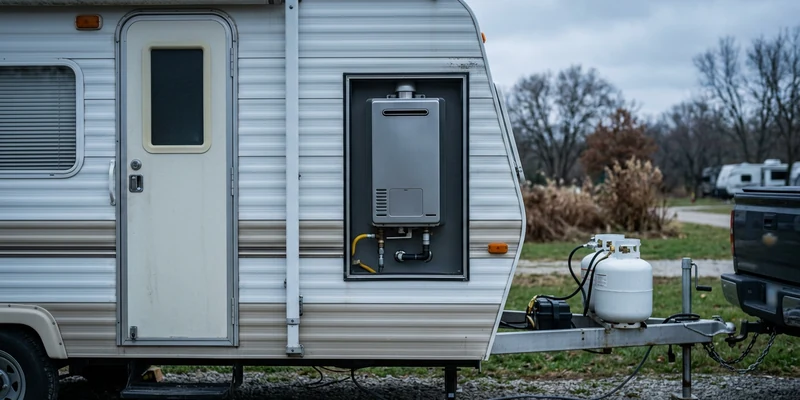
A propane RV tankless water heater is the version of this appliance that actually suits how most people camp, because it does not care whether there is a pedestal at the site. It is also the version with three quirks that nobody mentions at the point of sale: how much gas you genuinely use once hot water stops being rationed, whether the burner will light at the flow rate you shower at, and what happens to combustion when you park at elevation.
Those three points, consumption, low flow ignition and altitude, decide how happy you are with the unit far more than the headline output figure does. This guide works through each one, sets out what to compare between models, and names the picks that suit different rigs. It also draws a firm line around the gas work, which belongs to a certified RV technician and not to a weekend and a wrench, and explains exactly why we do not publish instructions for it.
This article contains affiliate links. If you buy through them, we may earn a commission at no extra cost to you. Learn more.
Quick Answer
Which propane RV tankless water heater should you buy?
- Buy the one that fits your existing wall opening, measured in three dimensions. Fitment eliminates more candidates than any spec does.
- Check the minimum activation flow before the maximum output. A unit that will not fire on a low shower setting is the complaint owners actually live with.
- If you camp in the mountains, look for a published altitude rating or an altitude setting. Combustion changes with elevation and some units simply lock out.
- The gas connection is work for a certified RV technician, full stop. Fit a carbon monoxide alarm and check the expiry date printed on the back of it.
What to Check Before You Buy
These eight points separate propane units from one another in ways that matter day to day. Fitment comes first because it is binary, and the two flow related rows are the ones that decide whether you enjoy the shower.
| What to check | Why it matters | What to look for |
|---|---|---|
| Opening dimensions | Decides whether this is a swap or a cut and reframe on a sidewall | Height, width and depth of your finished opening, compared against the figures on the listing |
| Minimum activation flow | Sets whether the burner lights at the flow you actually shower at | A low published threshold, and a unit known for firing reliably on a modest RV pump |
| Output and temperature rise | Output means nothing without the rise it was measured at | A burner rating quoted with a flow and a rise, rather than an output figure on its own |
| Altitude capability | Air density changes with elevation and combustion changes with it | A published altitude limit or an altitude adjustment, if you camp in the mountains |
| 12 volt draw | Controls, ignition and the combustion fan all run from the battery | The rated amps against your existing fuse, and how the unit behaves at low battery voltage |
| Venting and exterior door | A combustion appliance has to exhaust safely and the door has to close the hole | A matched door and flange kit designed for the model, not a generic panel |
| Freeze and winterizing path | Narrow passages freeze faster than a tank does | A documented drain point and a manufacturer winterizing procedure |
| Parts and manuals | Flow sensors and boards are the parts that fail on these units | A brand that publishes manuals and error codes and sells service parts |
If your current propane heater will not light, that is worth diagnosing before spending anything. A dirty electrode, a tripped reset, low battery voltage or a closed valve account for a large share of no light complaints, and our guide to an RV water heater that will not light on propane covers the checks in the order worth doing them.
Minimum Activation Flow Is the Number That Ruins Showers
Every on demand heater needs to sense a certain rate of water flow before it will fire the burner. Below that threshold the unit stays cold no matter how the tap is set. That threshold, published as the minimum activation flow, decides whether the unit is pleasant to use, and it gets far less attention than the output rating.
It matters in an RV specifically because RV water systems run at modest flow by design. A twelve volt pump delivers less than a house supply, low flow shower heads are standard, and owners throttle back to save fresh water. Set the shower where you want it and you can easily sit just under the threshold, at which point the burner drops out, the water goes cold, you open the tap, it fires again, and you get the cycling owners describe as a cold water sandwich.
What to do about it
Prefer a unit with a low published activation flow, and if you are already living with one that cycles, open the tap slightly rather than mixing in cold at the valve. Keeping the flow above the threshold and setting the outlet temperature lower at the panel is the technique that works. If it cycles even at full flow, the flow sensor itself is the likely culprit, and flow sensor problems covers what that looks like.
Propane Use, and Why On Demand Is Not Automatically Cheaper
Per gallon of hot water, an on demand burner is efficient. It fires only when water is moving and there is no tank being reheated all afternoon, so on paper the fuel case is straightforward. In practice, owners report their propane going faster after the swap, and the explanation is behavioral rather than technical.
A six gallon tank rations you. Everyone knows the second shower is a gamble, so showers are short and the dishes wait. Remove the limit and showers get longer, because they can. The appliance is more efficient and the household uses more hot water, and the second effect is usually larger. Plan cylinder capacity for how you will behave rather than how the brochure calculates it, particularly on long trips away from a refill.
Where the fuel case is genuinely strong
Two situations: back to back showers for a family, where a tank heater cannot keep up, and long periods parked without using hot water, where a tank heater keeps cycling to hold temperature while an on demand unit sits idle. Weekend campers who shower once a day are least likely to see a difference either way.
Altitude Changes Combustion
Air is thinner as you climb, and a burner tuned for sea level gets a different mix of air and gas at seven or eight thousand feet. Manufacturers handle this differently. Some publish an altitude limit above which the appliance is not rated, some fit an altitude switch you select at the panel, and some rely on burner design to tolerate a range.
What you should not do is treat a unit that runs poorly at elevation as a fault to be adjusted out. Burner adjustment, orifice changes and anything involving the gas valve are technician work, and an appliance running rich at altitude is exactly the condition that produces carbon monoxide. If you camp high, buy a unit that publishes an altitude capability, use the setting it provides, and take a lockout at elevation as the appliance protecting you rather than failing you.
Our Top Picks at a Glance
How we chose: we compared available propane on demand units on published fitment dimensions, minimum activation flow, output quoted against temperature rise, altitude capability, 12 volt draw, controls, and the complaints and compliments that repeat across owner feedback. Our assessment is based on manufacturer information and that feedback rather than on any trial of our own. Most owners are choosing between the first two.
🏆 Best Overall
A propane RV tankless heater built as a direct replacement for a standard tank opening, supplied with a matched exterior door and an interior control panel with a temperature setpoint. This format suits the most rigs: the door closes the hole the old heater left, the panel means you set the temperature indoors, and the unit works at any site regardless of the pedestal. Verify the opening dimensions on the listing against your own, since the same model is often sold in more than one size.

📐 Best for Vans and Small Trailers
A compact propane tankless unit for camper vans, truck campers and smaller trailers, where the opening or the depth behind the wall rules out a full size heater. Lower maximum output matters less in a single bathroom rig than owners expect, because you are almost never drawing two hot fixtures at once. Watch the depth clearance, since compact models win on face area and are not automatically shallower.

⛰️ Best If You Camp High or Shower Slowly
A propane unit that publishes an altitude capability or setting, together with a low minimum activation flow. These two features tend to appear together on the more demanding models, and they address the two things that make owners regret the switch: cycling at a low shower setting, and poor combustion or a lockout at elevation. If you camp in the mountains or shower at a trickle, this is the pick worth paying more for.
Buy These at the Same Time
One of these is not optional in a rig with a propane appliance, and the second prevents the slow performance loss that owners on hard water always run into.
🚨 Not Optional
A carbon monoxide alarm suitable for RV use, with a visible expiry date on the housing. Sensors have a service life measured in years and a great many rigs run an alarm that expired some time ago. This is the most important thing to buy alongside any propane appliance, it costs less than the door kit, and checking the date takes ten seconds. A combination alarm mounted low covers the propane leak side too.

🧪 The Seasonal Job That Keeps Output Where It Started
A descaling kit with a small circulation pump, hoses, a bucket and a food safe solution. The heat exchanger is a set of narrow passages, and hard water leaves scale that shows up as reduced flow, temperature swing, and eventually a unit that will not hold a setting. Descaling once a season restores it, and the interval is in our descaling guide.

Installation, and Where It Stops Being Your Job
The mechanical work is genuinely owner friendly. Draining and isolating the old heater, taking off the door and flange, unbolting the old unit, sealing in the new one and connecting the fresh water lines are normal tasks with ordinary tools, and the manual gives you the connection sizes and sealing requirements.
The gas connection is not, and neither is any 120 volt work on a hybrid unit. We do not publish instructions for gas lines, regulators, gas valves, burner tubes, orifices, burner adjustment or thermocouple setting. The reason is specific rather than legalistic: a gas joint that looks perfectly made can weep slowly, propane is heavier than air and collects in the low points of a rig, and the space it collects in is one people sleep in. Proving a joint needs a leak test done properly by someone trained to do it. Book a certified RV technician and have the system pressure tested before you use the appliance. Our installation walkthrough separates your steps from theirs.
Stop, and get everyone out, if you see any of these
A smell of gas, a carbon monoxide alarm sounding, soot around the vent or the burner area, a yellow or lifting flame instead of a steady blue one, or scorch marks near the appliance. Switch the appliance off, close the valve at the propane cylinder, open windows and ventilate, get everyone outside, and call a certified RV technician. Do not relight it to check whether it repeats.
Common Mistakes to Avoid
- Shopping on output rather than activation flow. The maximum figure sells the unit, the minimum figure is the one you live with every morning.
- Not measuring the depth behind the wall. The face dimensions are the easy part. What sits behind that opening is what stops the box going in.
- Expecting the propane bill to fall. Efficiency per gallon improves, total use often does not, because unlimited hot water changes behavior.
- Fitting a generic door kit. The door and flange are part of how the appliance vents and seals. Use the kit made for the model.
- Trying to adjust a burner that runs poorly at altitude. That is technician work, and a rich burner is precisely how carbon monoxide gets made.
- Skipping winterizing. Little water in the unit means fast freezing in the passages, not protection from it. Follow the manufacturer procedure in our winterizing guide.
Where to Go From Here
Still weighing formats rather than models? Tank versus tankless explained covers how the two behave in a rig, and our main tankless buying guide handles fitment and fuel side by side. If shore power is your normal situation, the electric guide is the counterweight to this one.
Once a unit is in, RV tankless maintenance is the short seasonal list and the repair guide covers the parts that actually fail. If your complaint is a sulfur smell on the hot side rather than a heating fault, that is a different problem, covered in why RV hot water smells like sulfur.
Frequently Asked Questions
Does a propane tankless heater use more or less propane than a tank? Less per gallon of hot water, but many owners use more overall because unlimited hot water leads to longer showers. Plan cylinder capacity around your behavior rather than the efficiency figure.
Why does the burner cut out during a shower? Usually the flow has fallen below the minimum activation threshold. Open the tap wider and lower the setpoint at the panel rather than mixing in cold water at the valve.
Do propane units work at high altitude? Some publish an altitude rating or an altitude setting, and others do not. Combustion changes with elevation, so check the manual, and never try to compensate by adjusting the burner yourself.
Does it need 12 volt power? Yes. The ignition, the controls and the combustion fan all run from the rig’s battery, so a flat battery means no hot water even with a full propane cylinder.
Can I connect the gas line myself? No, and we do not publish instructions for it. Gas lines, regulators, valves, burner tubes and orifices are work for a certified RV technician, and the system should be leak tested before use.
What should I do if I smell gas? Turn the appliance off, close the valve at the cylinder, ventilate the rig, get everyone outside, and call a certified RV technician. Do not relight the appliance to test it.
The Bottom Line
Propane is the right fuel for a tankless RV water heater in almost every case where camping is not permanently plugged in. Choose on fitment first, measured in three dimensions, then on the minimum activation flow, then on altitude capability if you camp high. Read output figures alongside the temperature rise they were quoted at, expect your propane use to rise rather than fall because behavior changes, and buy a carbon monoxide alarm and a descaling kit at the same time as the heater. Do the mechanical fit yourself if that suits you, and hand the gas connection to a certified RV technician who can leak test it properly.