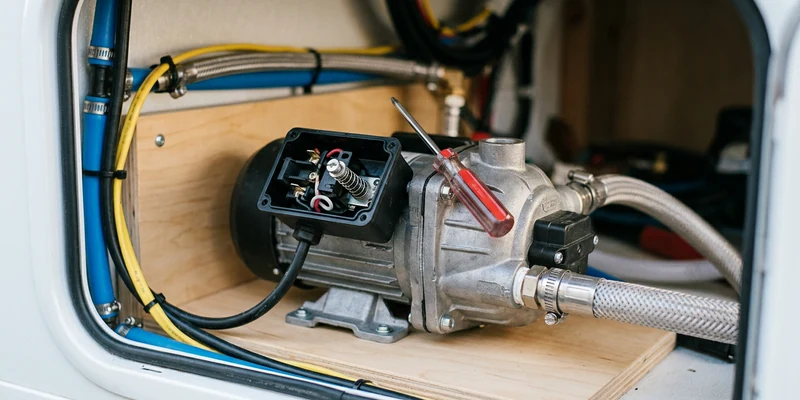
Last updated: August 14, 2026
Nearly all RV water pump issues fall into four families, and knowing which family you are in tells you almost immediately how serious the problem is. Power issues mean the pump never gets the chance to work. Prime and suction issues mean it cannot get hold of water. Pressure control issues mean it does not know when to stop. Noise issues usually mean nothing is wrong at all, mechanically speaking.
That framing matters because the four families have wildly different costs. Two of them are usually fixed with a screwdriver and fifteen minutes, one is a small replacement part, and only a short list of specific symptoms actually means the pump itself is finished. This guide translates what your pump is doing into what it means, in plain terms, so you know whether you are looking at an afternoon annoyance or a shopping trip.
This article contains affiliate links. If you buy through them, we may earn a commission at no extra cost to you. Learn more.
Quick Answer
What do the most common RV water pump problems actually mean?
- No sound at all means power, not the pump: a fuse, a switch, or a corroded ground almost every time.
- Sputtering, lost prime, and weak flow point at the suction side, meaning a clogged strainer or air being drawn in through a loose fitting.
- Cycling with the taps closed, refusing to shut off, or running on city water point at the pressure switch or the check valve, both of which are inexpensive replaceable parts.
The Issues Owners Report Most, and What Each One Means
The right hand column is the honest cost expectation: free means it is a check or an adjustment, part means one component, and replace means the pump has reached the end.
| The issue | What it usually means | Expect |
|---|---|---|
| No sound when switched on | Blown fuse, switch off, or a bad ground connection | Free |
| Runs but delivers nothing | Lost prime, closed valve, empty tank, or an air leak before the pump | Free |
| Spits air and water | Air entering on the suction side, or a low tank | Free |
| Weak flow at every faucet | Clogged inlet strainer or a loaded water filter | Free to part |
| Cycles on and off with taps closed | A small leak, or a check valve letting pressure bleed back | Part |
| Will not shut off | Pressure switch not reaching cutoff, or the system cannot build pressure | Part |
| Pulses hard at the faucet | Normal positive displacement behavior with no accumulator fitted | Part |
| Loud, buzzy, felt through the floor | Rigid plumbing and hard mounting transmitting vibration | Free to part |
| Runs while hooked up to city water | Failed check valve allowing backflow through the pump | Part |
| Blows the fuse every time | Seized motor or a short in the wiring | Replace or investigate |
| Leaking from the pump body | Failed seal or a cracked housing, often after a freeze | Replace |
| Weak pressure with everything else correct | Worn diaphragm or valve set inside the pump | Replace |
Two of those rows have a whole guide behind them, because they generate the most confusion: why the pump keeps running and why it will not shut off look like the same problem and are diagnosed differently.
Family One: Power Issues
If the pump makes no sound at all, it is not a pump problem yet. RV pumps sit on a 12 volt circuit protected by a fuse commonly in the 10 to 15 amp range, controlled by at least one switch and sometimes two or three, and grounded to a chassis point that quietly corrodes over the years.
Check the fuse by pulling it and looking at the element. Confirm every switch, including any second switch in the wet bay. Then measure at the pump’s own terminals: close to battery voltage with the switch on means power is not your problem, while a low reading points at wiring or a bad ground. A pump that clicks and stalls, or blows its fuse instantly, is a different signal entirely and usually means a seized motor, which is one of the few symptoms that goes straight to replacement.
Family Two: Prime and Suction Issues
This family covers everything where the pump is clearly working and water is clearly not arriving. The tell is sound: a pump starved of water runs faster and higher pitched than a loaded one, and the tone alone is often enough to identify the family.
The causes are consistently mundane. An empty tank behind a monitor panel that reads wrong. A winterizing bypass valve still pointed where it was in November. A strainer screen packed with sediment or sanitizer flakes. Or a fitting on the suction side that has loosened just enough to draw air, which never drips because that section of line is under vacuum rather than pressure. Getting water back after any of these usually needs a proper re prime, covered in how to prime an RV water pump, and the symptom itself is treated in detail in when the pump runs but no water comes out.
Why this family repeats
If prime keeps getting lost between trips, something is not sealing, and it is worth chasing rather than living with. Debris is the other repeat offender, and it comes in through the fresh water fill and the city inlet. A filter ahead of the system keeps sediment out of the strainer and off the valve seats, which is why two identical rigs can see very different pump lifespans.
🧴 To stop debris causing the same issue twice
An inline water filter on the fill hose, which catches sediment and rust before it reaches your tank, strainer, and pump valves. Cartridge style filters are the simple version; our comparison of inline RV water filters covers the differences.

Family Three: Pressure Control Issues
Here the pump moves water fine but manages it badly, and the two components responsible are both small, cheap, and replaceable: the pressure switch and the check valve.
The pressure switch decides when to stop. RV pumps commonly cut off somewhere in the 40 to 55 psi range, and a switch that has drifted or stuck produces a pump that runs on after the taps close, cuts out early with weak pressure, or hunts on and off in short bursts. The check valve prevents backflow. When it fails, pressure bleeds back into the tank so the pump wakes every few minutes with nothing running, or city water pushes backward through the pump while you are hooked up. Our guides on the pressure switch and the check valve cover testing and replacing each.
Pulsing is not a fault
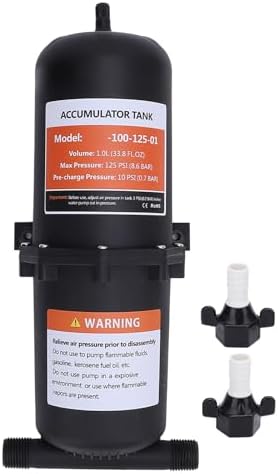
An RV pump is a positive displacement design, so it delivers water in pulses and restarts for even the smallest draw. That is normal behavior, not a defect, and the fix is a small pressurized tank on the outlet side that stores a little water and smooths the delivery. It also cuts down the constant on and off that irritates people most when rinsing dishes.
💧 For pulsing pressure and constant short cycling
An accumulator tank with a pre charged air chamber, plumbed on the pump’s outlet side. It steadies the pressure at the faucet and reduces how often the pump starts, which owners notice as both a comfort and a noise improvement.
Family Four: Noise and Vibration Issues
A loud pump is the most reported issue that usually means nothing is broken. The pump pulses, and whatever it is bolted to turns those pulses into sound. A thin plywood panel is effectively a speaker cabinet, and rigid pipe carries vibration into the walls and along the floor.
The fixes are in order of effort: mount the pump on its rubber feet without crushing them, replace the rigid connections at the inlet and outlet with short flexible hoses, and add the accumulator tank mentioned above. Together those three usually turn a pump you can hear from the bedroom into one you notice only when you listen for it. If noise is the reason you are replacing rather than repairing, the models built for quiet operation are compared in our roundup of the quietest RV water pumps.
Leaks, Freezing, and the Issues That End a Pump
Some symptoms are not diagnostic puzzles. A cracked pump housing, a split port, or water weeping from the body of the pump means the pump is done, because housings cannot be sealed reliably against pressure. The most common cause by far is freeze damage from a missed or incomplete winterization, and ice rarely damages just one part, which is why a rebuild kit is a poor bet on a pump that spent a winter with water in it.
A seized motor is the other definitive one. If the fuse blows the moment you switch on, stop resetting it and find out why. A larger fuse is never the answer, since the fuse protects the wiring rather than the pump.
🚿 When it is genuinely the pump
A 12V RV water pump in the 3 to 5.5 gallon per minute range with a built in pressure switch and standard 1/2 inch NPT ports. Newer pumps run quieter and hold steadier pressure than the basic units many rigs shipped with, and the swap is two hoses, two wires, and four screws. Flow ratings and fitment are compared in our guide to the best RV water pumps.

What Actually Shortens a Pump’s Life
Owners commonly get several years of regular use out of an RV water pump, and the spread between the short lives and the long ones comes down to four things rather than to brand. Freezing is first and by a wide margin. Running dry is second, since an unloaded diaphragm heats and tears. Debris is third, because grit wears valve seats and holds them open. Excess supply pressure is fourth.
That last one is worth a sentence of its own. Campground pedestals vary enormously, and some deliver far more pressure than RV plumbing is designed for. A regulator at the city water inlet protects the fittings, the water heater, and the pump’s check valve alike, and it is the cheapest insurance in the entire water system. The routine that covers all four is in RV water pump maintenance, and the pressure question specifically in how much water pressure is too much.
🛡️ The part that protects everything downstream
A brass water pressure regulator for the city water inlet, ideally an adjustable model with a gauge so you can see what the pedestal is actually delivering. Fit it at the spigot rather than at the rig so the hose is protected too.

Where This Stops Being a DIY Job
Twelve volt pump work is squarely owner territory, with the pump switched off, the fuse pulled or the negative battery cable disconnected, and pressure released at a faucet before opening anything. These are the exceptions.
- Any 120 volt component. Residential style pumps and anything tied into shore power wiring belong to a certified RV technician or licensed electrician.
- Water in the structure. Soft floors, stained ceilings, swollen paneling, or a musty smell need proper assessment.
- A leak with nothing visible. Constant cycling with every fitting dry means water is going somewhere inside a wall or under the floor.
- Repeated fuse failures. A short circuit is a fire risk, and it should be traced rather than reset.
- The water heater’s gas side. Burner, gas valve, and regulator work is for a certified RV technician, no exceptions.
Common Mistakes to Avoid
- Treating noise as failure. A pulsing, buzzy pump is usually a mounting and plumbing problem, not a worn one.
- Buying a pump before checking the strainer. A clogged screen imitates a tired pump almost perfectly.
- Believing the tank monitor. Fouled sensors misreport for years and send people chasing pump faults that do not exist.
- Leaving the pump on while on city water. If the check valve is weak, this is exactly how you push city pressure back into the fresh tank.
- Skipping winterization on a mild forecast. One hard night is enough to crack a pump housing.
- Fitting a bigger fuse. The fuse is protecting the wiring, and the pump is the thing telling you something is wrong.
Where to Go From Here
If you have identified the family but not the fault, run the ordered sequence in troubleshooting an RV water pump step by step, which puts meter readings against each stage. For the repair details and the honest test of when replacing beats rebuilding, our main guide to RV water pump repair is the reference.
If the pump is on its way out, compare replacements by flow rating and noise in our roundup of the best RV water pumps, and keep the new one healthy with the seasonal routine in winterizing an RV water pump.
Frequently Asked Questions
What is the most common RV water pump problem? Loss of prime and air entering on the suction side, closely followed by a clogged inlet strainer. Both imitate a failed pump and both cost nothing to fix.
Why does my water pump cycle when no water is running? The system is losing pressure, either through a small leak or through a check valve that no longer seals. Dry every fitting, pressurize, then check back an hour later.
Is it normal for an RV water pump to be loud? Some noise is inherent to the design. Excessive noise usually traces to rigid plumbing or hard mounting, and flexible hoses plus an accumulator tank resolve most of it.
How do I know the pump itself has failed? When power, water, valve positions, and the suction side all check out and the pump still cannot build steady pressure, the fault is internal. Cracked housings and seized motors are definitive.
Can a bad check valve cause low water pressure? It more often causes short cycling and backflow than low pressure, but a valve stuck partly closed can restrict flow. Test it before assuming the pump is worn.
Should I repair or replace a pump with several years on it? A check valve or pressure switch is worth replacing on any healthy pump. A torn diaphragm or freeze damage on an older unit usually justifies a new pump instead.
The Bottom Line
Sort the symptom into a family before you spend anything. Silence means power, sputtering means suction, cycling and running on mean the pressure switch or check valve, and noise usually means mounting rather than wear. Only cracked housings, seized motors, freeze damage, and worn internals on an older pump justify a replacement, and hand the job to a certified technician the moment you find water inside the structure.
Find your symptom in the table