Last updated: August 14, 2026
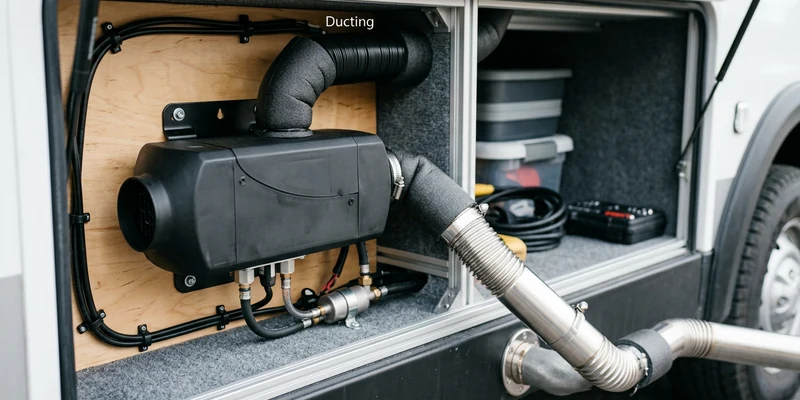
To understand how a diesel heater works, start with the design decision everything else follows from: it burns a very small amount of diesel inside a sealed combustion chamber. The air feeding that flame comes from outside the rig, and the exhaust gas leaves to the outside as well. Only the heat crosses over, transferring through a heat exchanger into a completely separate air circuit that a fan blows through your living space. Combustion air and cabin air never mix. That separation is the entire safety argument for these heaters, which is why the exhaust route, the sealing at the mounting plate, and a working carbon monoxide alarm are not details.
Everything else follows from that principle. The metering pump ticks fuel in at a measured rate, the glow plug lights it, the controller modulates output to hold a temperature, and the shutdown cycle purges the chamber. Once you can picture that sequence, the noises, the power draw pattern, and most common faults become readable.
This article contains affiliate links. If you buy through them, we may earn a commission at no extra cost to you. Learn more.
Quick Answer
How does a diesel heater work in an RV?
- A metering pump feeds diesel into a sealed chamber where a glow plug ignites it, drawing combustion air from outside and venting exhaust outside.
- A separate fan pushes cabin air across a heat exchanger, so you get dry heat without combustion gases ever entering the living space.
- Draw is high only during the glow phase and low once running, which suits off grid camping. A carbon monoxide alarm is mandatory and the exhaust must always terminate outside.
The Parts and What Each One Does
A diesel air heater is a small number of components doing one job each. Knowing which part does what is most of the diagnosis, because each fails in a recognizable way.
| Component | What it does | What goes wrong in practice |
|---|---|---|
| Fuel tank and pickup line | Holds the diesel and feeds the pump, from a dedicated tank or a vehicle tank pickup | Air drawn in at a loose fitting, a cracked line, gelled fuel in deep cold, or sediment |
| Metering pump | Delivers measured pulses of fuel, and its ticking sets the burn rate | Mounted at the wrong angle or too rigidly, or losing prime after a fuel line repair |
| Glow plug | Heats up to ignite the fuel and air mixture at every start | Wears out over hundreds of cycles, giving failed starts and smoke that never lights |
| Combustion chamber | Where the fuel actually burns, sealed off from cabin air | Carbon build up from long periods on the lowest setting, the classic cause of poor output |
| Heat exchanger | Moves heat into the cabin air stream without the two air paths mixing | Cracks with age or overheating, the one failure that makes exhaust a cabin problem |
| Cabin air fan | Pulls inside air across the exchanger and returns it warm | Blocked intake or outlet, dust in the impeller, bearings that get noisy |
| Combustion air intake | Feeds the burner with outside air through its own pipe | Blocked by road debris, insects, or snow, or wrongly routed inside the rig |
| Exhaust and muffler | Carries combustion gas outside and quiets the burn | Loose clamps, crushed pipe, condensate in a low spot, or a termination near a window |
| Control panel | Sets temperature or power level and displays fault codes | Codes get misread, since they usually point at a system condition, not a broken panel |
| Control unit | Runs the sequence, watches the sensors, manages shutdown | Low system voltage causing cutouts that look like heater faults but are battery faults |
One safety component is deliberately missing from that table, because it does not come with the heater and belongs in the rig regardless of your heat source.
🚨 Not optional in any rig with a combustion appliance
A 12V carbon monoxide alarm rated for RV use, mounted at the height the manufacturer specifies, with a visible sensor expiration date on the housing. CO sensors have a limited service life whether or not they ever alarm, commonly quoted somewhere in the five to ten year range, so buy one that shows its replacement date rather than leaving you guessing.

The Start Cycle, Step by Step
Every start follows the same order, and knowing it tells you where a failed start went wrong.
- Glow plug preheat. The controller powers the glow plug and the fan turns slowly. Nothing is burning yet, and this phase has by far the highest current draw.
- The metering pump starts ticking. A soft regular click begins, each tick one measured shot of fuel. After installation or a dry tank, the pump first has to fill the line, which takes a while.
- Ignition. Fuel reaches the hot glow plug and lights. The burn note changes and exhaust temperature climbs. Brief white smoke here is normal; smoke that continues without ignition is not.
- Ramp up to full output. With combustion stable the glow plug switches off, the fan speeds up, and the pump ticks faster to bring the space up to temperature.
- Modulation to the setpoint. As the cabin warms, the controller slows pump and fan. The heater keeps burning at a low rate instead of cycling off, which is what makes the heat feel steady.
- Shutdown and purge. When you switch it off the burn stops but the fan runs on for several minutes to cool the chamber. Never cut power to end this early.
Why running it low all the time is a mistake
These heaters burn cleanest at higher output. Left on the lowest setting for days, the chamber accumulates carbon, output drops, and starts get harder. Technicians commonly recommend running the unit at full power regularly, sometimes called a burn off cycle, and sizing it so it is not permanently idling at minimum. That habit prevents a large share of the faults in diesel heater repair.
Power Draw and Fuel Use, Honestly
Two numbers decide whether one of these fits your setup, and both get misunderstood. Current draw is not one figure but two, and fuel use is lower than most people expect.
During the glow phase a typical 12V unit in the 2 to 5 kW class pulls roughly 8 to 12 amps for a few minutes. Once combustion is established and the glow plug switches off, running draw commonly falls to around 1 amp at low output. Manufacturer information generally quotes consumption in the range of about 0.1 to 0.5 liters per hour depending on output, a small fraction of a gallon over a full night.
What that means for your battery bank
Overnight running is realistic on a modest bank, but the start current catches people out when the battery is already low and the controller cuts out on undervoltage. A healthy 12V battery usually reads around 12.6 to 12.8 volts at rest, and sag under the glow load is an early warning. Our guides on switching an RV to lithium batteries and how much solar an RV actually needs cover sizing for this load.
Diesel Heater or Propane Furnace?
Most rigs already have a propane furnace, so the real question is what a diesel unit adds. Broadly: dry heat, low draw per hour of running, and fuel you may already carry, in exchange for a far more involved installation.
| Aspect | Diesel air heater | Propane furnace |
|---|---|---|
| Fuel source | Diesel from a dedicated tank or a vehicle tank pickup | Propane from the onboard bottles, shared with stove and water heater |
| Electrical draw | High briefly during glow, low while running | No glow phase, but the blower draws steadily whenever the burner runs |
| Noise | Pump ticking plus a burn note, often audible outside too | Blower and burner noise, generally a steadier sound inside |
| Moisture | Dry heat, since cabin air only passes the exchanger | Also sealed combustion, though condensation usually traces to occupancy and ventilation |
| Installation | Involved: floor penetration, exhaust and intake routing, fuel tap, wiring | Already fitted in most rigs, and gas work is not owner territory |
| Who services it | Owner maintenance is realistic; fuel and exhaust work needs competence | Certified RV technician for anything on the gas side |
If your existing furnace is the problem rather than the plan, work through RV furnace troubleshooting before buying a second heat source. Plenty of furnaces that get written off are suffering from low battery voltage, a blocked intake, or a dirty sail switch.
🔥 The unit itself
A 12V diesel air heater kit rated in roughly the 2 to 5 kW range, supplied with controller, metering pump, ducting, and mounting hardware. Webasto and Espar sit at the premium end with dealer support behind them, while Vevor and HCalory dominate the budget end and are widely used by owners comfortable doing their own maintenance. Size it so it is not permanently running at minimum, and confirm what the kit includes before ordering.

Safety Rules That Are Not Negotiable
A correctly installed and maintained diesel heater is a sealed combustion appliance, and that is what makes it safe. Every rule below exists to keep that seal intact.
- Fit a carbon monoxide alarm and keep it in date. Any rig with a combustion appliance needs a working CO alarm, positioned as the manufacturer specifies and tested regularly. Sensors expire on their own schedule, so check the printed date.
- The exhaust always terminates outside. Clear of the rig and angled away from windows, doors, roof vents, and any air intake, never under a slide, skirt, or awning where gas can collect. Wind shifts, so leave real distance.
- Never run it inside an enclosed space. Not in a closed garage, a tent, an awning room, or a sealed compartment. Portable units in cases are still combustion appliances and their exhaust must reach open air.
- Treat the exhaust as a burn and fire hazard. Pipe and muffler get extremely hot. Route them clear of fuel lines, wiring, tires and plastics, support them so they cannot sag, and keep people and pets away from the outlet.
- Deal with condensate. Combustion produces water that collects in low spots. Route the exhaust so it drains continuously downward and away, since standing water corrodes and can block the pipe.
- Set the altitude configuration. Less oxygen at elevation makes the mixture rich, which shows up as smoke and soot and eventually a coked burner.
- Fuel work belongs with someone competent. Tapping a vehicle tank, running fuel lines, and sealing the floor penetration are where mistakes get serious. If you are not confident, have a certified RV technician do it.
- Exhaust smell inside means stop. Switch the heater off, ventilate, get everyone out, and do not run it again until the leak is found and fixed.
🔩 The exhaust side, done properly
An exhaust pipe, clamp and muffler kit with heat shielding, which is where installations most often fall short. Buy pipe long enough to reach a genuinely safe termination point rather than routing to wherever the supplied length ends, add the muffler if you value sleeping, and shield the pipe wherever it passes near anything vulnerable. Match the diameter to your heater outlet before ordering.

Where This Stops Being a DIY Job
Owner maintenance is realistic here: cleaning the intake, replacing a glow plug, changing a fuel filter, running a burn off cycle. These are not.
- Tapping into the vehicle fuel tank. Getting a pickup into a factory tank at the right depth with the right seal is a job for someone who has done it. A poor tap leaks fuel or draws air.
- Cutting the floor penetration. The mounting plate has to seal against exhaust intrusion from below, and the cut has to miss frame members, wiring, tanks, and plumbing.
- Routing and terminating the exhaust. Clearances, pipe support, condensate drainage, and protection of nearby components are the whole safety case for the installation.
- Any suspicion of exhaust inside. A smell, an alarm, headaches or nausea while it runs, or soot marks around the mounting plate mean stop using it and get it inspected.
- A cracked heat exchanger. That is the failure that removes the separation between combustion and cabin air. Replace the unit or have it professionally repaired, and do not run it meanwhile.
Where to Go From Here
If your heater is installed and misbehaving, the fault patterns are laid out in diesel heater repair, which works through failed starts, smoke, shutdown codes, and the carbon build up behind most of them.
If you are still deciding, the built in options are compared in best RV diesel heaters for winter camping, and case style units needing no permanent installation are in best portable diesel heaters for RVs, with the same exhaust rules for both. Heat is half of cold weather comfort, so pair this with staying warm in freezing weather and stopping condensation and mold.
Frequently Asked Questions
Is a diesel heater safe to use in an RV? Correctly installed, it keeps combustion sealed from cabin air and vents exhaust outside, which is what makes it safe. That depends entirely on a sound exhaust route, a properly sealed mounting plate, and a working carbon monoxide alarm in the rig.
Does a diesel heater use a lot of battery power? Only briefly. The glow phase commonly draws roughly 8 to 12 amps for a few minutes, after which running draw typically falls to around 1 amp at low output. Overnight use is realistic on a healthy bank, and a weak battery often shows up as a shutdown during a start.
How much diesel does one use per hour? Manufacturer information generally puts consumption in the range of about 0.1 to 0.5 liters per hour depending on output level, which amounts to a small fraction of a gallon over a full night.
Why does my diesel heater smoke? White smoke without ignition usually means fuel is reaching the chamber and not lighting, often a worn glow plug. Black smoke while running points at a rich mixture: a blocked intake or exhaust, carbon build up, or an altitude setting that does not match where you are parked.
Can I run a diesel heater inside a tent or a garage? No. The exhaust has to terminate in genuinely open air, well away from windows, vents and doors. Running any combustion heater in an enclosed space is how carbon monoxide poisoning happens, and portable units are no exception.
Why should I not cut the power right after switching it off? The shutdown cycle keeps the fan running for several minutes to cool the chamber and clear residue. Cutting power mid purge leaves unburned fuel and heat in the burner, and repeating it is the fastest route to a coked chamber and hard starting.
The Bottom Line
A diesel heater burns a metered trickle of fuel in a sealed chamber, taking combustion air from outside and venting exhaust outside, so only heat crosses into the cabin air through a heat exchanger. That design gives dry heat and a low running draw, at the cost of a brief high current glow phase and an installation that has to be done properly. Keep a working carbon monoxide alarm in the rig, terminate the exhaust well clear of windows, vents and enclosed spaces, never run it indoors, and hand fuel taps, floor penetrations and any exhaust smell inside to a certified RV technician.