Last updated: August 14, 2026
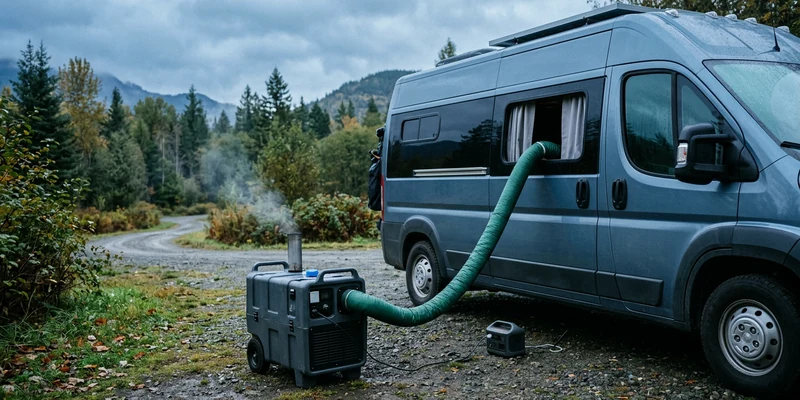
A portable diesel heater for RV use is an all in one unit: heater, fuel tank, controller, and exhaust plumbing packed into a case or a plastic tote with a handle on top. You carry it out, set it down, connect a warm air hose, and run it. Nothing gets cut into the floor and nothing gets tapped into the vehicle fuel tank, which is exactly why owners who are not ready for a permanent install keep buying them.
There is one thing these units are not, and it is the most important sentence in this guide. Portable does not mean you can run it inside. The case sits outside the rig or in a ventilated storage bay, the exhaust stays outside and points away from windows, doors, air intakes, and roof vents, and only the warm air hose comes indoors.
This article contains affiliate links. If you buy through them, we may earn a commission at no extra cost to you. Learn more.
Quick Answer
Which portable diesel heater should you buy for an RV?
- Buy on integrated tank capacity and hose length first, because those two decide whether the unit actually runs through a night without you going outside in the cold.
- Size it to the space, since a unit that is too large for a van will idle on its lowest setting and build carbon.
- The case goes outside or in a ventilated bay, the exhaust stays outside and clear of every opening, and a carbon monoxide alarm with an unexpired sensor is mandatory. Never run one in a tent, a closed garage, or under a closed awning.
What to Check Before You Buy
Nine things separate a portable unit you use every winter from one that lives in the bay after the first trip. Output rating is only the beginning.
| What to check | Why it matters | What to look for |
|---|---|---|
| Enclosed case or loose kit | A case protects the components and makes it genuinely portable | A sealed case with handle, tank, and controller integrated, not parts in a box |
| Integrated tank capacity | Small tanks mean refilling in the middle of a cold night | Enough capacity for a full night at your expected output, with margin |
| Warm air hose length | Too short and the unit ends up too close to the rig | Enough hose to place the case well clear, with insulation to keep heat in |
| How the hose gets inside | A door propped open defeats the whole purpose | A window vent panel, a bay pass through, or a proper grommet, not a gap |
| Power supply | These are 12V loads with a heavy startup moment | A decent battery, or a 12V supply on shore power, plus solid clamps or leads |
| Weight and handle | You carry this in and out every time you use it | A handle you can use with gloves and a size that fits your bay |
| Noise level | The pump ticks and the fan hums, close to where you sleep | An isolated pump mount and a case that damps rather than resonates |
| Altitude compensation | Thinner air changes the fuel to air ratio and causes sooting | A controller with an altitude mode if you camp in the mountains |
| Exhaust length | A short exhaust puts fumes right beside the case and the rig | Enough pipe to terminate well clear, pointing away from every opening |
If the sequence a diesel heater follows is new to you, our explainer on how a diesel heater works in an RV covers glow, priming, and steady burn, and explains why several of those rows are safety items rather than convenience items.
Where the Unit Goes, and Where It Never Goes
This is the section to read twice. A portable diesel heater burns fuel, and burning fuel produces exhaust containing carbon monoxide, which has no smell and gives very little warning. Portability changes where you can put the case, not whether the exhaust needs to be outside.
Set the case on level ground outside the rig, on a hard surface where it will not tip and where nothing flammable is within reach of the exhaust. A ventilated storage bay is acceptable only if that bay is genuinely sealed from the living space and vented to outside, with the exhaust run out through the bay wall. Point the exhaust away from windows, doors, air intakes, roof vents, and your neighbors, with enough pipe to end well clear of the rig.
The absolute limits
Never run one inside the living space, in a tent, in a closed garage, or under a closed awning, which traps exhaust exactly where you sit. Keep the exhaust clear of the fuel line and of anything combustible, because the pipe gets extremely hot and stays hot after shutdown. Keep a carbon monoxide alarm with an unexpired sensor inside, and if you ever smell exhaust indoors, shut down immediately, ventilate, and do not restart until you have found where it is getting in. Never cut power to a running unit: let the purge cycle finish.
Powering It Without Ruining Your Night
These units are a two phase electrical load. During the glow cycle at startup the plug draws heavily, usually somewhere in the 8 to 12 amp range depending on the unit, for a minute or two. Once the flame is established the draw falls a long way, down to the fan and the dosing pump, which most banks handle overnight without complaint.
That shape is why portable heaters frustrate people running small batteries. The unit runs happily for hours, then refuses to restart at two in the morning because the bank sagged just enough during the glow cycle. Lithium banks hold voltage far more steadily under load, which is why owners who upgrade often report the heater becoming more reliable without anything changing on the heater.
Practical supply notes
Keep supply leads short and generously sized, because thin clip leads across a bay create their own voltage drop and the heater gets blamed for it. On shore power, a good 12V supply removes the problem entirely. For off grid use, our walkthrough on switching an RV to lithium batteries covers what changes, and how much solar an RV actually needs is worth reading with winter output in mind, since production is weakest exactly when the heater runs most.
Our Top Picks at a Glance
How we chose: we compared widely available cased portable diesel air heaters on published output ratings, integrated tank capacity, hose and exhaust length, controller features including thermostat and altitude modes, and the themes that repeat in owner feedback across RV and van forums. Our assessment rests on manufacturer information and that feedback rather than any trial of our own.
🏆 Best Overall
A cased all in one unit with an integrated fuel tank, commonly rated around 5 kW and running on 12V, is the format most owners end up with. Everything lives in one box you can carry with one hand, the tank means no external fuel plumbing, and the controller sits on the case. Check tank capacity against how long you want it running, and confirm the hose and exhaust are long enough to place the case clear of the rig.

💰 Best Compact Pick
A smaller portable unit, commonly rated around 2 kW, suits vans and truck campers better than the larger class. The output matches the space so the unit cycles properly instead of idling, the startup draw is easier on a modest battery, and the case is small enough to live in a bay. Owners of insulated vans consistently report the smaller output is plenty.

⭐ Upgrade Pick
A branded unit or a version with better control is worth the step up if you use the heater seriously. What you are paying for is thermostat control that holds a temperature instead of a fixed power level, altitude compensation that keeps combustion clean in the mountains, documented error codes, and parts you can still buy in a few years. Webasto is the reference point, and comparable units are judged against that support structure.

Which Setup Suits Your Rig?
The right unit depends less on the badge than on where you camp and how you plan to get the warm air inside without leaving a door ajar.
| Your rig and use | What matters most | What usually works |
|---|---|---|
| Van or truck camper | Small space, small battery, little storage | A compact unit around 2 kW with a short insulated hose run |
| Travel trailer, weekends | Fast warmup without an installation | A cased unit around 5 kW, hose in through a window vent panel |
| Full time in cold weather | Running all night, every night, reliably | A permanently mounted heater instead, with the portable as backup |
| Mountain and winter camping | Thinner air changes combustion | A controller with altitude compensation and regular high output runs |
| Powering from a small battery | Surviving the glow cycle draw | Lithium, or a 12V supply on shore power, plus short heavy leads |
| Drying gear and a damp rig | Dry heat rather than raw output | Any properly sized unit, with a hose routed toward the wet area |
If the third row describes you, the portable format is probably the wrong answer long term. Carrying a case out and setting it up every evening gets old fast in freezing weather, and our roundup of the best RV diesel heaters for winter camping covers the mounted units that duct heat in without any of that ritual.
Two More Items Worth Buying at the Same Time
The three picks above cover the heater. These two cover the parts owners buy second, after the first cold night teaches them why.
🚨 The Part That Is Not Optional
A 12V carbon monoxide alarm made for RV use, with the sensor expiration date visible on the housing. A portable diesel heater is still a combustion appliance running a few feet from where you sleep, carbon monoxide gives no warning, and these alarms expire regardless of whether the test button still beeps. Mount it inside at the height the maker specifies and note the replacement year.

🔩 The Kit That Solves the Door Problem
An insulated ducting hose kit with vents and clamps, so the warm air hose gets inside properly instead of through a door held open with a bungee. Insulated hose loses far less heat across the run, the vent lets you aim the outlet, and a proper pass through keeps the rig sealed. Check the hose diameter against your unit’s outlet, since the common sizes are not interchangeable.

Common Mistakes to Avoid
- Treating portable as indoor rated. The case goes outside or in a ventilated bay, the exhaust stays outside, and only the warm air hose comes in. There is no version of this where the exhaust is indoors.
- Running it under a closed awning. That traps exhaust in exactly the space you are sitting in. Awning out means the heater goes somewhere else.
- Propping a door open for the hose. You lose the heat you are making and let exhaust drift in. Use a window vent panel or a bay pass through.
- Buying the biggest output for a small van. Oversized units idle on their lowest setting, and permanent low output running is what carbons them up.
- Ignoring tank capacity. A short run time means refilling outdoors at three in the morning, which is how these units end up unused.
- Cutting power to shut it off. Always use the controller and let the purge cycle finish, however long it takes.
Where to Go From Here
If your unit runs badly rather than not at all, the diagnosis is in diesel heater repair and the common faults, which covers the symptom table, the checks that cost nothing, and the wear parts.
If you are weighing portable against permanent, our guide to the best RV diesel heaters lays out the installed option. If the rig also has a propane furnace that has stopped cooperating, see RV furnace not working, and the wider job of getting through a freezing week is covered in how to stay warm in an RV in freezing weather.
Frequently Asked Questions
Can you use a portable diesel heater inside an RV? No. The case belongs outside or in a ventilated bay sealed from the living space, and the exhaust always terminates outside away from windows, doors, air intakes, and vents. Only the warm air hose comes inside.
How long does a portable diesel heater run on one tank? It depends on tank capacity and output setting, and makers publish figures for both. Run it at a realistic setting when estimating, because output has a large effect on consumption.
What battery do I need to run one? The glow cycle at startup is the demanding moment, usually somewhere in the 8 to 12 amp range. Small or tired batteries typically run the unit fine and then fail to restart it later in the night.
Is a portable unit as good as an installed one? For occasional use, yes, and it avoids cutting into the rig. For full time cold weather living, most owners eventually prefer an installed unit because there is no setup ritual every evening.
Do portable diesel heaters work at altitude? Not as well without help, since thinner air changes the fuel to air ratio and causes sooting and weak heat. Look for a controller with an altitude mode if you camp in the mountains.
Do I still need a carbon monoxide alarm? Always, with an unexpired sensor. Portability does not change what combustion produces, and the date printed on the housing matters more than the test button does.
The Bottom Line
Choose on integrated tank capacity, hose and exhaust length, and output matched to your space, because those decide whether the unit runs a full night without you standing outside in the cold. Size it down rather than up for a van, prefer thermostat and altitude control if you camp high, and plan the 12V supply around the glow cycle peak. Then follow the one rule that is not negotiable: the case and the exhaust stay outside, only the warm air hose comes in, and a current carbon monoxide alarm goes inside.