
Last updated: August 14, 2026
Every RV solar panel calculator asks the same first question, and it is the one most owners cannot answer: how much power do you actually use in a day? Without that number, sizing an array is guesswork dressed up in arithmetic, which is how people end up with a roof full of panels feeding a battery bank too small to store what they collect.
So this guide runs the calculation backwards from real usage. You will find realistic starting points by camping style, a load table you can add up in ten minutes, an honest figure for what a panel produces on an average day rather than on a lab bench, and the reason the battery bank, not the array, usually decides how long you can stay out. The math is simple. The discipline is in being honest about the inputs.
This article contains affiliate links. If you buy through them, we may earn a commission at no extra cost to you. Learn more.
Quick Answer
How much solar does an RV need?
- Weekend campers who mostly use hookups are usually well served by a small array in the 100 to 200 watt range, mainly to keep batteries topped up.
- Regular boondockers with a 12 volt fridge and laptops typically land somewhere around 400 to 600 watts with a matched battery bank.
- Add up your real daily watt hours first. A 100 watt panel commonly returns roughly 300 to 400 watt hours on a good summer day and far less in winter or shade.
Solar Sizing by How You Actually Camp
Start here to get in the right neighborhood, then refine with the calculation below. These are the ranges owners and installers commonly work with, and they assume a matched battery bank rather than an array bolted onto whatever came with the coach.
| How you camp | Typical array range | What it realistically covers |
|---|---|---|
| Hookups almost always | Around 100 watts | Battery maintenance in storage and between trips |
| Occasional weekend without hookups | Roughly 100 to 200 watts | Lights, water pump, phone charging, propane fridge control board |
| Regular boondocking, propane fridge | Roughly 200 to 400 watts | The above plus a roof fan, laptops, evening television |
| Regular boondocking, 12 volt compressor fridge | Roughly 400 to 600 watts | Full-time fridge load plus normal electronics, most of the year |
| Full-time off-grid with an inverter | Roughly 600 to 1200 watts | Kitchen appliances, induction cooking, working from the road |
| Air conditioning off-grid | Beyond a simple array | A whole-system project with a large lithium bank and a big inverter |
Two caveats keep these numbers honest. Winter output can be a fraction of summer output at the same location, and any array on an RV roof spends part of the day partly shaded. Sizing to the sunniest possible day is how people end up running the generator in October.
The Four-Step Calculation
This is what every solar calculator does under the hood. Doing it by hand takes a few minutes and gives you a number you can defend.
- List every load and how long it runs. Work in watt hours per day, or in amp hours if you prefer to stay in 12 volt terms. Multiply the draw by the hours it is genuinely on, not the hours it is available.
- Total the day. Add it all up for a typical day of the trips you actually take, then again for a bad day: cold, gray, everyone inside, furnace fan running.
- Divide by usable sun hours. Not daylight hours. Usable solar hours commonly land somewhere around four to five in good summer conditions and two to three in winter or under haze, depending heavily on where and when you camp.
- Add a derate for the real world. Panels rarely deliver their rated output. Shade, heat, dust, panel angle, cable losses, and controller efficiency all take a share, so most planners multiply by something in the region of 0.7 to 0.8 before trusting the result.
Worked through, a coach consuming around 1000 watt hours per day in summer conditions with four usable sun hours and a 0.75 derate needs roughly 330 watts of panel to break even on an average day. Break even is not the goal, though. You want surplus for gray days, which is why the practical answer usually rounds up to the next panel.
What Your Gear Actually Uses
These are the ranges most commonly quoted by owners for typical RV equipment. Your own numbers will differ, which is exactly why measuring beats estimating, but this is enough to build a first draft.
| Load | Typical daily use | Notes |
|---|---|---|
| LED interior lighting | A few amp hours per day | Small enough that it rarely changes the answer |
| Water pump | A few amp hours per day | Short bursts, high current, low total |
| Absorption fridge on propane | Very low, control board only | The propane does the cooling, not the battery |
| 12 volt compressor fridge | Commonly around 30 to 60 amp hours per day | Usually the largest single load in a modern coach |
| Roof vent fan | Roughly 1 to 4 amps while running | Speed setting changes this dramatically |
| Furnace fan and board | Often the biggest surprise in cold weather | Cycles all night, and it is the fan, not the propane, that drains the bank |
| Laptops, phones, cameras | Commonly 10 to 30 amp hours per day for a working couple | Add inverter losses if charged through an inverter |
| Television, evening use | A few amp hours per hour of viewing | Screen size matters more than anything else |
| CPAP without heated humidifier | Commonly under 10 amp hours per night | Heated humidifier and heated hose raise this substantially |
Note what dominates. In a coach with a 12 volt compressor fridge, the fridge alone can account for more than half the daily total, and in winter the furnace fan is the item that catches people out. Neither shows up as an obvious power hog while you are using it.
What a Panel Really Produces
A panel’s rating is measured under standard test conditions that your roof will never reproduce: a specific light intensity, a cool cell temperature, and a perfect angle. In the field, owners commonly report something in the region of 300 to 400 watt hours per day from a 100 watt panel in good summer conditions, which is roughly 25 to 35 amp hours at 12 volts. In winter, under cloud, or when the roof spends the afternoon in tree shade, that can fall by half or more.
Three things influence the outcome more than panel brand. Angle matters, and a flat roof panel gives up real output at high latitudes or in winter, which is why some owners add tilt brackets for cold season use. Shade matters disproportionately, especially in series wiring, as explained in our solar wiring diagram guide. And controller type matters, with MPPT typically harvesting more from the same panels than PWM, particularly in cold and low light.
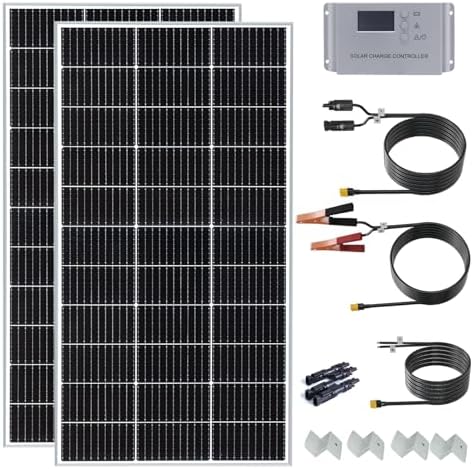
For most owners the sensible entry point is a rigid panel kit with a matched controller, sized around 100 to 200 watts, which can be expanded later if the array proves too small.
The Battery Bank Is Usually the Real Limit
Solar collects, batteries store, and the mismatch between the two is the most common design error in RV systems. An array that produces plenty by noon is useless if the bank is already full at ten in the morning and empty again by two.
Usable capacity, not nameplate capacity
Lead acid and AGM banks are conventionally treated as offering about half their rated capacity in day-to-day use, because taking them much deeper shortens their life considerably. Lithium iron phosphate banks can be worked far closer to their rated figure, which is a large part of why they are so popular for off-grid builds despite the higher purchase price. That difference means two banks with the same number on the label can deliver very different real-world endurance. Our guide to switching an RV to lithium batteries covers what else has to change alongside them.
A practical target
Most planners aim for a bank that holds at least one full day of usable consumption, and preferably closer to two, so a gray day does not end the trip. Then size the array to refill that consumption on an average day rather than a perfect one.
Measure Instead of Guessing
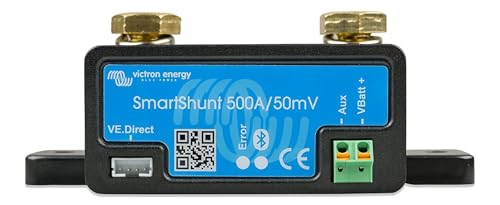
Every estimate above is a starting point, and there is a far better source of truth: your own coach, over a real weekend. A battery monitor with a shunt reads actual current in and out and reports consumption in amp hours, which turns the entire sizing exercise from theory into arithmetic.
Owners who fit one before buying panels regularly discover their real consumption is nothing like their estimate, in both directions. It is also the tool that tells you afterward whether the array is genuinely keeping up, which no amount of watching the sun will.
Where Solar Stops Being the Answer
Solar is excellent at replacing what you use in a day. It is poor at delivering large bursts of power on demand, and rooftop air conditioning is the obvious example. Running one off batteries needs a large lithium bank, a substantial inverter, and usually a soft start device, with solar acting as a slow refill rather than the source. That project is covered in running an RV air conditioner on batteries and solar, and for many owners a generator remains the more practical answer, as discussed in our inverter generator guide.
One boundary is worth restating. Solar sits entirely on the 12 volt side of the coach, which is why it stays an owner-friendly project as long as you take the standard precautions of covering panels while wiring, opening the battery disconnect, and fusing every feed at the battery. Adding an inverter to run household outlets crosses into 120 volt territory, and hardwiring that output, adding a transfer switch, or changing bonding is work for a certified RV technician. The split is laid out in how to wire an RV inverter.
Common Mistakes to Avoid
- Sizing the array without sizing the bank. Panels that fill a small battery by mid morning waste the rest of the day.
- Using rated panel wattage in the math. Real output is meaningfully lower, and planning without a derate produces an array that disappoints.
- Forgetting the furnace fan. Cold weather consumption looks nothing like summer consumption, and the fan runs all night.
- Ignoring shade in the layout. A vent cover shading one corner costs far more output than its size suggests.
- Guessing consumption instead of measuring it. A shunt-based monitor pays for itself in avoided over-buying or under-buying.
- Expecting solar to run high-draw appliances. Kettles, hair dryers, and air conditioners are battery and inverter questions, not panel questions.
Frequently Asked Questions
How many solar panels do I need for my RV? Work from daily watt hours rather than panel count. Weekend campers often manage with 100 to 200 watts, while regular boondockers with a 12 volt fridge commonly land around 400 to 600 watts.
How much power does a 100 watt panel produce per day? Owners commonly see roughly 300 to 400 watt hours, or about 25 to 35 amp hours at 12 volts, on a good summer day. Winter, cloud, and shade reduce that considerably.
Is 400 watts of solar enough for boondocking? For many people, yes, provided the battery bank matches it and the fridge is the largest load. It is usually not enough for air conditioning or induction cooking.
Do I need more panels or more batteries? If you run out overnight, you need more battery. If you never reach full charge by evening, you need more panel. A battery monitor tells you which one applies.
Does tilting panels really help? Yes, especially in winter and at higher latitudes, where a flat panel loses a meaningful share of its potential output. The tradeoff is that tilting is a manual job at every stop.
Can I add panels to an existing system later? Usually, as long as the charge controller has capacity for the extra current and the new panels match the existing ones electrically. Our installation walkthrough covers planning for expansion.
The Bottom Line
Size solar from your real daily watt hours, divide by usable sun hours, and derate to something in the region of 0.7 to 0.8 before you believe the answer. Weekend campers rarely need more than a couple of hundred watts, regular boondockers with a compressor fridge usually land in the 400 to 600 watt range, and the battery bank has to hold at least a day of consumption or the array is wasted. Fit a shunt-based monitor first and let your own numbers decide.