Last updated: August 14, 2026
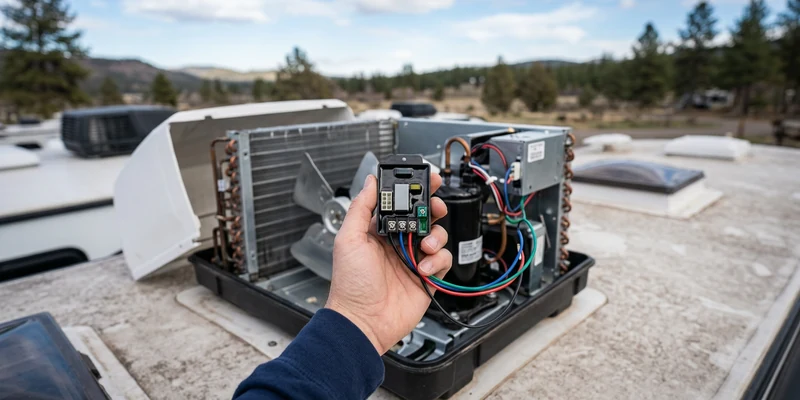
An RV air conditioner soft start solves exactly one problem, and it solves it well: the enormous current spike a compressor draws in the instant it starts. That spike, not the running load, is what stalls a small generator, trips a breaker, and makes an inverter shut down in protest. A soft start ramps the compressor up instead of slamming it on, and the startup surge drops to a fraction of what it was.
What it does not do is make your air conditioner colder. The running capacity is unchanged, and if your rooftop unit already struggles on a hot afternoon, a soft start will not add a single degree. That is the most common misunderstanding about these kits. Buy one to run the air conditioner on a smaller generator, an inverter and battery bank, or a marginal pedestal, and buy something else if the complaint is weak cooling.
This article contains affiliate links. If you buy through them, we may earn a commission at no extra cost to you. Learn more.
Quick Answer
Which RV soft start should you buy?
- Choose an electronic soft start controller that names your air conditioner brand and model on its compatibility list. Fit is decided by the compressor, not by the size of your rig.
- Buy it to start the air conditioner on a smaller inverter generator, on an inverter and battery bank, or on a sagging pedestal. It does not increase cooling capacity.
- If your AC blows warm or weak, this is the wrong purchase. Start with our guide to an RV air conditioner not cooling instead.
- Installation is 120V work inside the rooftop unit, next to a start capacitor that holds a charge after the power is off. That is a certified RV technician’s job.
What to Check Before You Buy
Six things decide whether a soft start is the right purchase and which one fits. The first two are the ones people skip and then discover on the roof, and the last two decide whether the result meets the expectation you had when you ordered.
| What to check | Why it matters | What to look for |
|---|---|---|
| Air conditioner make and model | Compatibility is per compressor, not per rig | Your exact model on the manufacturer’s published compatibility list |
| Why you want one | It reduces startup current, not running load | Generator, inverter, or pedestal limits, never a cooling complaint |
| Existing hard start capacitor | A hard start kit does the opposite job and may need removing | Whether the instructions call for it to come out first |
| Generator or inverter capacity | The soft start lowers the peak, it does not lower the running draw | Enough continuous capacity to keep the unit running once it is on |
| Number of air conditioners | Each unit needs its own module | A two pack if the rig has two rooftop units |
| Who installs it | It wires into the 120V compressor circuit on the roof | A certified RV technician, and a written quote before you buy |
If your rig struggles to run several appliances at once rather than to start the AC, the constraint may be the service rather than the compressor. Our explainer on 30 amp versus 50 amp RV service covers what your pedestal connection can realistically carry.
What a Soft Start Actually Does
An air conditioning compressor is a motor under load from the first revolution, and getting it turning takes several times the current it needs once it is running. That inrush lasts a fraction of a second, but a small generator sees it as an overload and stalls or trips, and an inverter sees it as a fault and shuts down. A soft start controller sits in the compressor start circuit and eases the motor up to speed, which cuts that peak dramatically while leaving the running current essentially where it was.
The three problems it genuinely solves
The first is generator size. Owners commonly report that a rooftop unit that would not start on a 2000 watt class inverter generator will start reliably on one after a soft start is fitted, which is the most popular reason to buy one. The second is running the air conditioner from an inverter and battery bank, where the surge trips the inverter long before the battery is the limitation. The third is a weak or shared campground pedestal, where the voltage dip at startup is enough to make the unit hum and stall.
What it does not solve
It does not add cooling capacity or fix a unit that blows barely cool air. Those symptoms are airflow, refrigerant, or heat load, and they are covered in RV air conditioner not cooling and, for that brand, in Coleman Mach AC not cooling. It also does not reduce the continuous power the unit consumes, so a generator that could never keep the AC running still will not.
Our Top Picks at a Glance
How we chose: we compared soft start controllers sold specifically for RV rooftop air conditioners on published compatibility lists, whether the module self configures on first run, how clearly the maker documents removal of an existing hard start capacitor, warranty terms, and the patterns that repeat in owner feedback. Our assessment is based on published specifications and that feedback rather than any trial of our own. Confirm your air conditioner’s model against the maker’s current compatibility list before ordering, because these lists change as new units come to market.
🏆 Best Overall
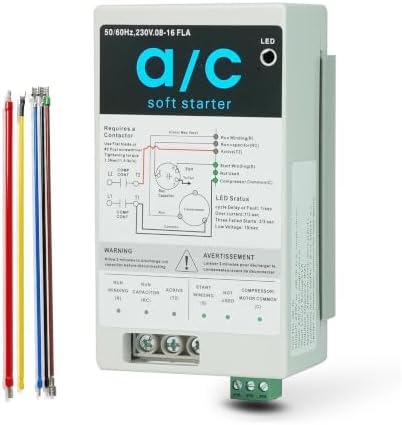
An electronic soft start controller made specifically for RV rooftop air conditioners, with a published model by model compatibility list and a self configuring routine that learns your compressor over the first few starts. This is the category to buy in: designed for the compressors used in rooftop units, documented for RV installers, and supported when the answer is not obvious. Check the listing for your exact model and note whether an existing hard start capacitor must be removed.
🏭 Best When Your AC Brand Sells Its Own
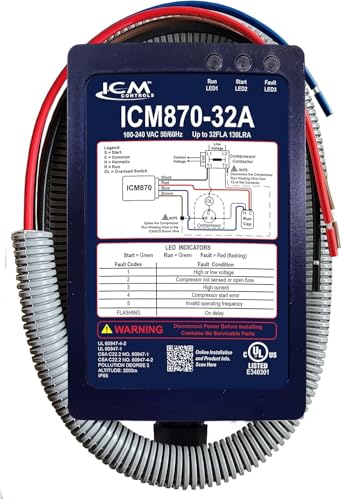
A soft start module offered by the maker of your rooftop unit, matched to its own air conditioners. The appeal is that compatibility is not a research project and the wiring interface is designed around that unit, which usually makes the technician’s job shorter. The trade off is that it is only useful if your rooftop unit is that brand. GE’s version is a common example, and we cover it in detail in the GE RV soft start explained.
🚐 Best for Two Rooftop Units
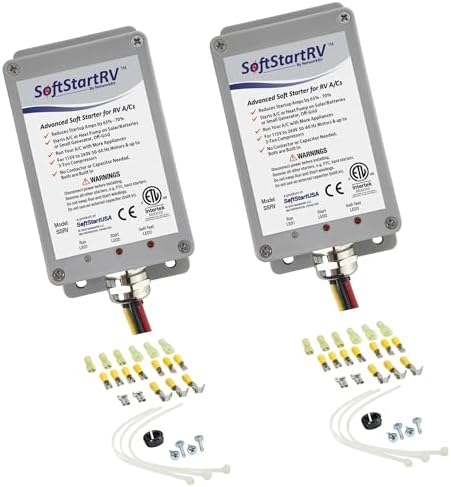
A two module kit, because each air conditioner needs its own controller. Fitting a soft start to only one unit leaves you with a coach where the other AC still cannot be started on the generator. Buying the pair at once usually costs less than two singles and means one visit to the technician rather than two.
Matching It to Your Generator or Inverter
Work out which of the three situations you are in before you spend anything, because the answer changes what else you need to buy. The soft start lowers the peak. Your power source still has to cover the continuous load once the compressor is turning.
- Small inverter generator. The classic case. A soft start commonly makes the difference between a generator that stalls on startup and one that carries the unit, but only if that generator can supply the running load afterward, as covered in RV inverter generators.
- Inverter and battery bank. The surge is the first hurdle and battery capacity is the second. A soft start gets you past the first; how far the second takes you is worked through in running an RV air conditioner on batteries and solar.
- Campground pedestal. If your unit hums and stalls on a busy loop, a soft start reduces the dip your own unit creates. It does not protect the compressor from a pedestal that is already sagging.
- Shared circuit at home. Owners who run the AC on a household outlet while the rig is parked trip the breaker on startup rather than while running, which is exactly what a soft start addresses.
The thing to buy alongside it
Low voltage during startup is a known cause of premature compressor failure, and a surge protector with voltage monitoring disconnects the coach before a sagging pedestal does damage. It also catches miswired pedestals and open grounds, which are more common than most owners expect.
🛡️ Protect the Compressor You Just Spent Money On
A surge protector with low and high voltage cutout in your service size, meaning 30 amp or 50 amp. It watches incoming voltage and disconnects the rig when the pedestal goes out of range, which is the protection a soft start does not provide. Check the listing for your amperage and for whether it is a portable or hardwired version.

A Soft Start Is Not a Hard Start Kit
These two get confused constantly and they do opposite things. A hard start capacitor gives the compressor a bigger kick to get it moving, which raises the startup current rather than lowering it. It is a legitimate part for a tired compressor that struggles to break away on shore power, but it is the wrong answer if your goal is running the air conditioner on a generator or an inverter.
This matters practically, because a rooftop unit that already has a hard start capacitor fitted, from the factory or from a previous owner, usually needs it removed before an electronic soft start is installed. Manufacturers state this in their instructions, and it is one of the reasons the installation is not a job for a first afternoon with a screwdriver. Ask your technician to check for one before the kit is ordered.
Installation: Know What You Are Committing To
The module is small and the wiring is not complicated in principle, which is exactly what makes this dangerous. The work happens inside the rooftop shroud, in the 120V section of the unit, alongside a start capacitor that can hold a charge after the power has been switched off, and you are kneeling on a roof while you do it.
We do not publish wiring instructions for this job and we recommend a certified RV technician. What you can do yourself is the preparation: read the model number off the air conditioner label, confirm it against the compatibility list, buy the correct kit, ask whether an existing hard start capacitor has to come out, and get a labor quote before you order the part. Our walkthrough of what an RV soft start installation involves covers the whole sequence.
Common Mistakes to Avoid
- Buying one to fix weak cooling. It changes startup behavior only. Cooling complaints are airflow, refrigerant, or heat load.
- Ignoring the compatibility list. Fit is decided by the compressor in your specific rooftop unit, not by the brand on your rig.
- Leaving a hard start capacitor in place. Check the instructions. The two parts work against each other.
- Expecting a generator to run what it cannot carry. The soft start lowers the peak, not the continuous draw.
- Doing the install to save the labor. Capacitors hold a charge, the wiring is 120V, and the job is on a roof.
Frequently Asked Questions
Will a soft start make my RV air conditioner cool better? No. It reduces the current spike at startup and leaves cooling capacity unchanged. If the unit blows weak or warm air, the cause is airflow, refrigerant, or heat load.
Can I run my RV air conditioner on a 2000 watt generator with a soft start? Owners commonly report that a soft start is what makes a 2000 watt class inverter generator able to start a single rooftop unit. The generator still has to carry the running load afterward, so check its continuous rating rather than its peak.
Is a soft start the same as a hard start capacitor? No, and they do opposite things. A hard start kit increases starting current to get a tired compressor moving. A soft start reduces it. Many installations require an existing hard start capacitor to be removed.
Do I need one for each air conditioner? Yes. Each rooftop unit has its own compressor and needs its own module.
Can I install a soft start myself? We do not recommend it. The work is inside the 120V section of a rooftop unit, near a capacitor that holds a charge with the power off, and it is performed on a roof. Use a certified RV technician.
Will a soft start let me run the AC on batteries? It removes the surge that trips the inverter, which is the first obstacle. Whether the battery bank and inverter can sustain the running load is a separate question of capacity.
The Bottom Line
Buy a soft start to start your air conditioner, not to improve it. It cuts the startup surge so a small inverter generator, an inverter and battery bank, or a marginal pedestal can get the compressor turning, and it leaves cooling capacity exactly where it was. Check your air conditioner’s model against the maker’s compatibility list, buy one module per rooftop unit, ask whether an existing hard start capacitor has to come out, and have a certified RV technician do the installation. Then add voltage protection, because the pedestal is what damages compressors.