Last updated: August 14, 2026
A Coleman Mach air conditioner not cooling usually has one of four brand specific explanations: filters and coils choked in the ceiling assembly, a sun damaged shroud that has cracked or shifted and disturbed the airflow across the condenser, a thermostat and control box that are not a matched pair, or a pedestal that cannot hold voltage while the compressor starts. These units are workhorses, and when they disappoint it is more often the installation around them than the machine itself.
Because Coleman Mach units appear on everything from small travel trailers to large fifth wheels, the same model number can be non ducted with a ceiling assembly you open from below, or ducted through a roof plenum with a divider that has to be positioned correctly. That difference changes the diagnosis, so this guide splits it out. The brand neutral version of the checklist lives in our guide to an RV air conditioner not cooling.
This article contains affiliate links. If you buy through them, we may earn a commission at no extra cost to you. Learn more.
Quick Answer
What makes a Coleman Mach stop cooling well?
- Pull the filters from the ceiling assembly and look at the evaporator coil behind them. Airflow restriction is the number one cause of weak cooling on these units.
- Inspect the roof shroud. Coleman Mach shrouds go brittle in UV, and a cracked or loose shroud lets condenser air short circuit instead of pulling through the coil.
- Confirm the thermostat matches the control box. Mixing a thermostat from another brand with a Coleman Mach control system causes cooling behavior that looks like a failed unit.
Coleman Mach Symptoms, Causes, and What to Do
Work from the top down. The upper rows are owner maintenance, the lower rows involve the 120V section or the sealed system and belong to a certified RV technician.
| What the unit does | What it usually means | What to do |
|---|---|---|
| Blows steadily, cooling is weak | Filters and evaporator coil loaded with dust | Wash or replace filters, clean the coil, then measure the split again |
| Weak only in strong sun | Condenser airflow restricted or shroud damaged | Inspect the shroud for cracks and gaps, clean the condenser coil |
| Fan works, compressor never engages | Voltage, capacitor, or control fault | Check pedestal voltage first; capacitor work is technician only |
| Thermostat reads strangely or cycles oddly | Mismatched thermostat and control box | Confirm the thermostat is specified for your Coleman Mach control system |
| Air near the unit is cold, far end is warm | Ducted plenum divider misplaced or duct leak | Have the plenum baffle and duct connections inspected |
| Rattling or grinding on the roof | Fan blade or motor mount trouble | Stop using it and have the fan assembly inspected before further damage |
| Coil ices over | Airflow starvation or cool damp operation | Run fan only until thawed, then clear the restriction |
| Breaker trips on startup | Circuit overload or a failing component | Shed loads once, and if it repeats, stop resetting and call for service |
The Ceiling Assembly Is Where Most of It Hides
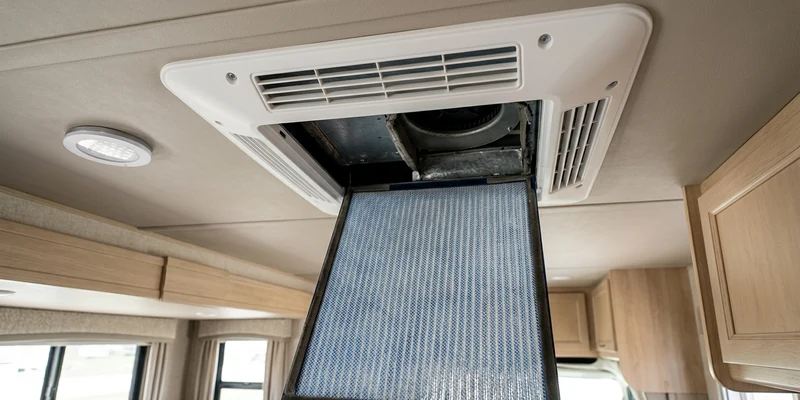
On non ducted Coleman Mach installations the filters sit in the ceiling assembly and slide out from the sides, which makes them easy to check and easy to forget. Owners report finding filters that have gone stiff and gray after a couple of seasons, and behind them an evaporator coil wearing a felt of dust that halves the airflow.
Clean it in the right order
Remove and wash the filters, let them dry completely, and replace them if the foam has hardened or torn. Then look at the coil itself with a flashlight. A no rinse coil cleaner and a soft brush restore most of what dust took away, working with the fins rather than across them. Do this before you conclude anything about the compressor, because a restricted evaporator produces exactly the same complaint as a tired machine.
🔧 Best routine part for a Coleman Mach
Replacement filters sized for the Coleman Mach ceiling assembly restore airflow that stiff, dust loaded foam has been quietly stealing.

The Shroud: A Coleman Mach Specific Weak Point
The plastic shroud on the roof is not just cosmetic. It directs outside air through the condenser coil and out again, and it keeps rain and debris off the electrical section. Years of UV make these shrouds brittle, and forum threads consistently mention cracks along the mounting points and around the edges after long storage in the sun.
A cracked or partly detached shroud lets hot discharge air recirculate straight back into the condenser inlet, so the unit rejects its own heat over and over and cooling falls off exactly when you need it most. It is also a straightforward part to replace, provided you use a ladder rated for your weight, work only where the roof structure supports you, and stay off the roof in wind or wet weather. Note that any work under the shroud that touches wiring or capacitors stops being an owner job.
🔧 Best fix for a sun damaged unit
A replacement shroud restores the condenser airflow path and stops water and debris reaching the electrical section.

Thermostat and Control Box Have to Match
Coleman Mach units use a control box paired with a compatible thermostat, and this is where a lot of second hand RVs come unstuck. Somebody replaced a thermostat with whatever was on the shelf, or a repair shop fitted a different brand, and the result is a unit that runs the fan but rarely calls the compressor, or that satisfies far too early and leaves the coach warm.
Before you spend money on refrigeration diagnosis, confirm the thermostat is the type specified for your control system, and check that the thermostat is not mounted where sun, a nearby lamp, or a supply vent skews its reading. On heat pump equipped models, also confirm the unit is set for cooling rather than auto, since auto changeover behavior surprises owners in shoulder seasons.
Prove It With a Thermometer, Not a Hand
Measure the air entering the return grille and the air leaving a supply vent after the unit has run steadily for around fifteen minutes. A healthy rooftop unit commonly shows a difference of roughly 16 to 22 F. If your Coleman Mach hits that range, it is working correctly and the real issue is heat load, insulation, or expecting one rooftop unit to beat a hundred degree afternoon.
If the split stays below about 15 F after the filters, coil, and shroud are sorted, you have a genuine refrigeration or electrical fault and a technician should take it from there. Recording the number before you call saves diagnostic time. For the heat load half of the equation, see our guide on how to keep an RV cool in summer heat.
🔧 Best way to settle the argument
A pocket digital thermometer turns a vague complaint into a number a technician can act on.

Power, Pedestals, and Generators
Coleman Mach compressors are as voltage sensitive as any other. On a hot afternoon in a full campground, pedestal voltage sags, and a compressor starting on low voltage draws hard and runs hot. Owners who camp in summer heat commonly add a surge protector with low and high voltage cutout, which disconnects the coach before that becomes a repair bill.
Generator power deserves the same caution. A generator that is undersized or loaded with other appliances gives the air conditioner a rough start, and older units without a soft start draw a substantial surge at the moment the compressor engages. Our roundup of the best RV inverter generators covers sizing for rooftop air conditioning, and if your breaker is the thing giving up, start with why RV breakers trip at a campground pedestal. Hard start or soft start kits do help older units, but they are wired into the 120V section and should be installed by a certified RV technician.
What Not to Touch
Under the shroud sit capacitors, a compressor, a fan motor, and 120V wiring. Capacitors hold a charge after power is disconnected, and you are working at roof height. Leave capacitor testing and replacement, relay and control board work, compressor diagnosis, hard start kit wiring, and anything involving refrigerant to a certified RV technician.
Stop immediately and cut power at the breaker if you smell burning, see discolored or scorched wiring, or the unit trips the breaker more than once. Repeatedly resetting a breaker on a faulting appliance is not persistence, it is how an electrical fault becomes a fire in a vehicle you sleep in.
Common Mistakes to Avoid
- Cleaning the coil with a pressure washer. Flattened fins restrict airflow permanently and cannot be undone with a comb in most cases.
- Ignoring a cracked shroud. It looks cosmetic and behaves like a performance fault.
- Fitting any thermostat that fits the hole. Control compatibility is a real constraint on these systems.
- Running through a long household extension cord. Voltage drop at startup is what damages compressors.
- Expecting one unit to cool an open, sunny coach. Shade, closed vents, and reflective window covers do more than turning the dial down.
Frequently Asked Questions
How do I reset a Coleman Mach air conditioner? Switch it off at the thermostat, then turn its breaker off for several minutes before restoring power. Give the compressor a few minutes before it restarts, since short cycling protection delays engagement.
Where are the filters on a Coleman Mach? On non ducted models they slide out of the ceiling assembly, usually from the sides of the return grille. Ducted systems draw through a return grille elsewhere in the ceiling.
Why does my Coleman Mach cool near the unit but not at the back? In ducted coaches that pattern points at the plenum divider or a disconnected duct, which lets cold air return to the unit instead of traveling down the coach.
Can I replace the shroud myself? The shroud itself is a mechanical part, so many owners do, working safely on a rated ladder and only on supported roof areas. Anything electrical underneath it belongs to a technician.
Is a soft start kit worth it? It reduces the startup surge, which helps on generators and weak pedestals. It is 120V wiring inside the unit, so have a certified RV technician install it.
The Bottom Line
On a Coleman Mach, check the filters and evaporator coil first, then the roof shroud, then whether the thermostat actually matches the control box. Measure the temperature split so you know whether the unit is weak or simply outmatched by the heat, and protect it from sagging pedestal and generator voltage. Everything under the shroud that carries 120V, including capacitors and soft start wiring, is certified RV technician work.