Last updated: August 14, 2026
A heater that has quit on both propane and electric at the same time is not two failures. It is one failure in something the two modes share, and that is genuinely good news, because the shared list is short. The gas side and the electric side of an RV water heater run almost entirely separate parts. What they have in common is the 12 volt supply that wakes the appliance up, the switch or switches that command it, the ground path back to the chassis, the high limit safety cutout, and on many units a control board. Five things, in a specific order of likelihood.
The odds are also heavily weighted toward the cheap end. Owners who arrive at a shop with an RV water heater not working on electric or gas most often leave with a fuse, a reset, a cleaned ground or a switch, not a board. So this walkthrough runs the shared components in that order, and flags clearly where the job stops being yours.
This article contains affiliate links. If you buy through them, we may earn a commission at no extra cost to you. Learn more.
Quick Answer
Why is my RV water heater not working on electric or gas?
- Because both modes depend on the same handful of parts. Look at the 12 volt fuse, the switch, the ground connection, the high limit cutout and the control board, in that order.
- Even in propane mode the appliance needs 12 volts, so a blown fuse or a flat battery kills gas and electric together and looks like a dead heater.
- A tripped high limit is the other classic. It resets with a button, but a cutout that keeps tripping is reporting a real fault rather than being annoying.
- Gas valves, burner tubes, orifices and 120 volt wiring are certified technician work. We do not publish those procedures.
The Shared Parts, and How Each One Fails
These are the only components both heat modes depend on. Work down the list, because they are ordered from most likely and free to least likely and expensive.
| Shared part | What it does | How the failure looks | Your first check |
|---|---|---|---|
| 12V fuse | Feeds the control board and switches | Completely dead, no click, no indicator lamp | Pull it and inspect the element rather than glancing at it |
| Battery or converter supply | Provides the voltage the board needs | Weak spark, random lockouts, works on shore power only | Read battery voltage at rest and while charging |
| Wall switch or switches | Commands gas mode, electric mode, or both | Nothing responds, or one mode works and the other never did | Test continuity with the switch on and off |
| Ground connection | Completes the 12V circuit back to chassis | Intermittent operation, worse in damp weather | Find the ground screw, clean it to bare metal, retighten |
| High limit cutout | Kills everything if the tank overheats | Dead on both modes after a period of normal use | Press the reset button behind the outside access door |
| Control board | Runs ignition and switching logic | No response with good power, or a fault code sequence | Confirm 12V is arriving at the board, then diagnose |
| Thermostat sensing | Tells the appliance the tank is cold | Never calls for heat even when water is stone cold | Compare tank temperature to what the unit is doing |
Before you accept any of these, rule out the two impostors: bypass valves left in the winter position, and an empty tank. Both look exactly like this and both are covered in where to start.
Start With the 12 Volt Supply
Every electronic ignition water heater is a 12 volt appliance first and a gas appliance second. The board, the spark, the gas valve solenoid and the mode switching all run on battery power, which is why a rig plugged into shore power with a disconnected or flat battery can have a completely dead heater while every light in the trailer works.
Pull the water heater fuse from the 12 volt distribution panel and look at the metal element. RV water heater circuits commonly use a small blade fuse in the 5 to 15 amp range, and a hairline break is easy to miss through the plastic. Then read voltage at the panel: a healthy 12 volt battery at rest usually sits somewhere around 12.6 to 12.8 volts, higher while the converter is charging. Well below that and you have a charging problem rather than a heater problem, which is covered in RV converter repair.
The ground nobody checks
A 12 volt circuit needs a return path, and RV grounds live in damp bays where they corrode quietly. A furred green ground screw can pass just enough current to light an indicator lamp and not enough to hold a gas valve open, which produces exactly the maddening intermittent behavior owners describe. Find the ground connection at the appliance, back the screw out, clean the ring terminal and the contact area to bright metal, and refit it snugly.
🔧 The reading that ends the guessing
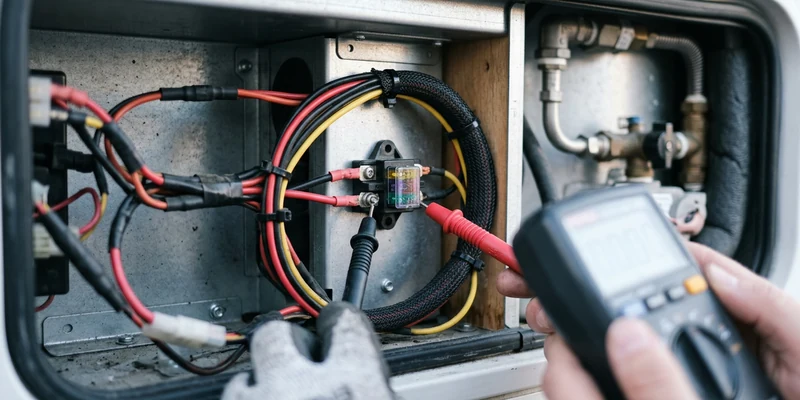
A basic digital multimeter that measures DC volts and continuity. Fuse, switch, supply voltage and ground quality are all one meter reading each, and a meter turns four hypotheses into four answers in about five minutes. Choose one with an audible continuity beep so you can test a switch without watching the screen.

🧰 For the corroded connection you just found
A terminal cleaning brush set with dielectric grease. Clean the ring terminal and the mounting point to bare metal, reassemble, then seal the joint with grease so the same connection is not back on your list next season. This is the fix that stops intermittent 12 volt faults from returning.

The High Limit Cutout and What Tripping Really Means
Every RV water heater has a safety cutout, often called an ECO, that shuts the whole appliance down if the tank temperature runs away. When it trips, both gas and electric go dead together, which is exactly the symptom you are reading about. It is a manual reset device with a small button, usually on the thermostat assembly mounted against the tank face behind the outside access door.
Press it once with the appliance switched off and listen for a distinct click. If the heater comes back to life and stays working, note the date and move on. If it trips again within days, stop resetting it.
Why a repeat trip is not a nuisance
A cutout that keeps tripping is doing its job, and it is telling you the tank is genuinely overheating. The usual reasons are a thermostat that has failed closed, heavy sediment insulating the sensor from the water, or a burner running outside its normal condition. The first two are things you can address, and flushing the tank is the cheapest of them. The third is a combustion question and it goes straight to a certified RV technician, not to another press of the button. Repeatedly resetting a safety device until it stops resetting is how a heater becomes a fire.
When the Board Is Actually the Suspect
Control boards do fail, and they are the last thing on the list rather than the first because they are the expensive answer to a question that is usually cheap. The honest test is whether clean 12 volt power is arriving at the board with the switch on. If it is, and nothing happens on either mode, and the high limit is not tripped, the board becomes a genuine candidate.
Many boards flash a fault code sequence on a small lamp, and your manual translates it. Read that before you order anything, because a code often points at the flame sensing circuit or the gas valve rather than at the board itself. Boards are also model specific, so match the part to your exact appliance rather than to the brand. If your unit is a Suburban, our Suburban walkthrough covers its layout; for Atwood and Dometic units see the Dometic walkthrough.
Faults That Only Look Like Both Modes Failing
Three situations mimic this symptom perfectly and cost nothing to eliminate. Rule them out before you buy a single part.
- Bypass valves in the winter position. The heater works, the tank heats, and none of it reaches a tap. This is the most common false alarm of the spring.
- An empty or airlocked tank. No water to heat means no hot water, and firing the electric element into an empty tank destroys it in seconds. Open a hot tap and confirm steady flow first.
- Heavy sediment. A thick layer on the tank floor insulates both the burner heat and the sensing bulb, so the appliance stops behaving predictably in either mode. An annual flush prevents it, and our water heater guide covers the routine.
If water delivery rather than heat turns out to be the problem, with sputtering taps or no flow at all, start instead at RV water pump repair.
Where This Stops Being a DIY Job
Fuses, switches, grounds, meter readings, the reset button and the tank housekeeping are all yours. These are not, and the boundary is not negotiable.
- Gas components. Gas lines, regulators, gas valves, burner tubes, orifices, burner adjustment and thermocouple adjustment go to a certified RV technician. We do not publish those instructions, because a mistake there produces carbon monoxide or a leak with no warning.
- 120 volt work. Element wiring, thermostat wiring and breaker work belong to a certified technician or licensed electrician.
- A hot or pressurized tank. Never open the drain, the anode rod or the relief valve on a warm tank. Switch off, cool for several hours, shut the water supply, open a hot tap, then lift the relief valve lever.
- A high limit that will not stay reset. That is a diagnosis job with proper tools, not a button to keep pressing.
- Gas smell, CO alarm, soot, yellow flame or scorch marks. Shut it down, close the propane valve at the tank, ventilate, get everyone outside, and call a technician.
🚨 The alarm with a hidden expiry date
A combination propane and carbon monoxide alarm for RV use. The service life is printed on the housing, commonly five to ten years from manufacture, and an expired unit looks identical to a working one from across the room. Check the date on yours while you have the panel open.

Common Mistakes to Avoid
- Buying a control board first. It is the least likely and most expensive item on the shared list.
- Assuming gas mode is independent of the battery. On electronic ignition it is not, and this trips up more owners than any other single misunderstanding.
- Pressing the reset repeatedly. A cutout that trips again is reporting a real overheat and needs the cause found.
- Ignoring the ground. Corroded grounds cause intermittent faults that get blamed on boards and switches for years.
- Skipping the bypass check. Free, thirty seconds, and it explains a surprising share of these calls.
- Fitting a bigger fuse. A circuit that keeps blowing fuses has a fault, and upsizing the fuse moves the failure point to the wiring.
Where to Go From Here
If one mode comes back to life during these checks, you are no longer reading the right article. Head to not heating on electric or will not light on propane, whichever half is still dead.
If the whole appliance turns out to be finished, the tank is leaking, or the heat damage is beyond a parts fix, that is the moment many owners reconsider the format entirely. Our tankless versus tank comparison covers whether that switch makes sense for how you camp.
Frequently Asked Questions
Why did my RV water heater stop working on both gas and electric at once? Because both modes share the same 12 volt supply, switch, ground, high limit cutout and control board. A single failure in any of those kills both at the same time, and a blown fuse or a tripped cutout are the two most common.
Where is the reset button on an RV water heater? On most units it sits on the thermostat assembly against the tank face, behind the outside access door. Press it once with the appliance switched off and listen for a click. If it trips again, find the cause instead of resetting it again.
Does the propane side really need 12 volt power? Yes, on any electronic ignition model. The board, the spark generator and the gas valve solenoid all run on 12 volts, so a dead battery or fuse stops the burner even with full tanks.
Can a bad ground stop a water heater from working? It can, and it typically produces intermittent rather than total failure. Corroded ground connections pass enough current to light an indicator and not enough to run the appliance, which is why cleaning them fixes faults that resisted new parts.
How do I know if the control board has failed? Confirm clean 12 volt power is arriving at the board with the switch on and the high limit not tripped. If nothing happens in either mode after that, the board becomes a genuine candidate. Read any fault code sequence in your manual first.
Is it safe to keep resetting the high limit switch? No. One reset to clear a one off event is reasonable. Repeated trips mean the tank is genuinely overheating, and that needs the cause diagnosed by a certified RV technician.
The Bottom Line
Dead on both modes narrows the search to five shared parts. Check the 12 volt fuse, then supply voltage, then the switch, then the ground connection, then the high limit reset, and treat the control board as the last resort rather than the first purchase. Rule out bypass valves and an empty tank before any of it. Keep the meter work and the housekeeping for yourself, and send every gas component and every 120 volt connection to a certified RV technician.