Last updated: August 14, 2026
Water pumps rarely die of old age. They die of grit in the strainer, a season of running dry, a winter with water left in the head, and vibration that slowly cracks a fitting. Sensible RV water pump maintenance is a short list of habits, and almost all of it costs nothing but a few minutes at the start and end of a season.
This guide is deliberately not a troubleshooting article. It is the schedule that keeps you out of the troubleshooting articles: what to check before every trip, what to do a few times a season, and the two annual jobs, sanitizing and winterizing, that decide whether your pump sees another five years. If something is already wrong, start at our hub for RV water pump repair instead.
This article contains affiliate links. If you buy through them, we may earn a commission at no extra cost to you. Learn more.
Quick Answer
What maintenance does an RV water pump actually need?
- Keep the inlet strainer clean, never let the pump run dry, and keep the fresh tank from running to the bottom on the road.
- Twice a year or so: sanitize the fresh water system, check mounting screws and hoses, and replace the inline filter.
- Once a year: winterize properly, since water left in the pump head through a freeze is the most expensive mistake on this list.
The Maintenance Schedule at a Glance
Nothing here takes long individually. The value is in the rhythm, because most pump failures are the end of a slow process that a five minute check would have caught early.
| Task | How often | Why it matters |
|---|---|---|
| Check fresh tank level before use | Every trip | Running the tank dry pulls air and wears the diaphragm |
| Listen to the pump cycle | Every trip | A change in note or a new cycle pattern is the earliest warning you get |
| Clean the inlet strainer | Every few months of use | Debris restricts flow and makes the pump work harder |
| Replace the inline water filter | Per filter guidance, or when flow drops | A clogged filter starves the pump and mimics a failure |
| Check mounting screws and hoses | Seasonally | Vibration loosens fittings and cracks hardened hose |
| Use a pressure regulator on city water | Every hookup | Protects fittings, the water heater, and the pump head |
| Sanitize the fresh water system | Twice a year, and after storage | Keeps the tank and lines clean and the water tasting fresh |
| Winterize the pump and lines | Every fall in freezing climates | Ice in the pump head cracks housings and ruins diaphragms |
The Habits That Matter Most
If you only adopt two things from this page, make them these. Both are free, and between them they prevent the majority of the failures that send owners looking for a new pump.
Never let it run dry
A diaphragm pump depends on water for lubrication and cooling in the head. Minutes of dry running is enough to harden seals and score sealing faces, and it is exactly what happens when a tank empties on the road and the pump keeps hunting. Switch the pump off at the panel when the tank is low, when you leave the coach, and any time you are diagnosing a problem rather than using water.
Keep the water clean going in
Everything the tank swallows eventually reaches the strainer and then the check valve seat. Fill through a filter when you are on unfamiliar water, use a drinking water safe hose rather than a garden hose, and keep the fill cap clean before you open it. Grit is the number one reason a pump starts cycling, losing prime, or running noisy.

Filters are consumables rather than fittings, so replace them on the manufacturer’s schedule rather than when they finally clog. Our Camco TastePURE review and roundup of the best inline RV water filters cover the differences that matter for taste and flow.
The Seasonal Fifteen Minutes
Do this two or three times a season, or at every long stop if you live in the coach. Pull the pump fuse or disconnect the negative battery lead before you handle wiring, and open a faucet to relieve pressure before opening anything on the water side.
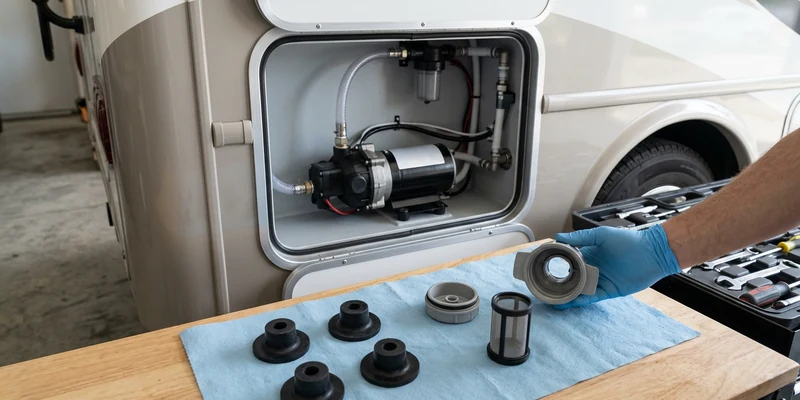
- Clean the strainer. Unscrew the bowl, rinse the screen, and inspect the O ring for flattening or dryness. Reseat by hand only, since a wrench cracks plastic bowls. A clear strainer body lets you spot debris and air without disassembly.
- Check the mounting. Pumps ride on rubber feet for a reason. Confirm the screws are snug but not crushing the mounts, and that the pump is not resting against a wall or a floor panel where it drums.
- Inspect hoses and fittings. Look for stiffness, cracking, clamp bite marks, and any white mineral crust that signals a slow seep. Flexible connectors on the inlet and outlet reduce the vibration that loosens fittings over time.
- Look at the wiring. Green or chalky terminals, a loose spade connector, or a chafed wire near the pump is worth fixing before it strands you. Keep it to the 12 volt side.
- Confirm normal behavior. Pressurize the system, close everything, and time the cutoff. A healthy pump reaches cut-out and goes quiet, usually within about half a minute, and then stays quiet.

Sanitizing and Winterizing
These are the two calendar jobs, and they matter to the pump as much as to the plumbing. Sanitizing keeps the tank and lines clean so less debris ever reaches the pump. Winterizing keeps water out of the head where ice would expand and crack it.
Sanitize twice a year
Owners typically sanitize in spring before the first trip and again before long storage, plus any time the water develops an off taste or the coach has sat with water in the tank. The routine is a diluted bleach solution circulated through every fixture, a soak, then a thorough flush until the smell is gone. Our step by step guide to sanitizing an RV fresh water tank covers ratios and timing.
Winterize before the first hard freeze
The pump is the part that suffers most from a missed winterization, because a small amount of trapped water in the head has nowhere to go when it expands. Whether you blow the lines out or pump antifreeze through, make sure the pump itself is included rather than bypassed and forgotten. Our guide to winterizing an RV water pump covers doing it without a blowout kit.
When you de-winterize in spring, return every valve to normal service and expect to reprime. That procedure is in our guide to priming an RV water pump.
Knowing When Maintenance Turns Into Replacement
Maintenance buys years, not immortality. Replace the pump rather than keep nursing it when it has spent long periods running dry, when the head is cracked or weeping, when it will not prime from a bucket at pump height with a clean strainer, or when the noise and vibration have become the reason nobody wants to shower after dark.
Modern replacements are quieter and smoother than the units that shipped in many older coaches, and the swap is two fittings, two wires, and four screws. Match the flow rating and port size to what came out, most RV pumps run around 3 to 5.5 gallons per minute on 12 volts with 1/2 inch ports, and see our roundup of the best RV water pumps for the tradeoff between flow, noise, and current draw.

Where the DIY Line Sits
Strainer service, hose and mount checks, sanitizing, winterizing, and a 12 volt pump swap are all owner jobs with the fuse pulled and the system depressurized. Call a certified RV technician when the work moves into 120 volt wiring at the converter or breaker panel, when a freeze has split lines inside a wall or the underbelly, or when the water heater needs attention beyond its bypass valves and drain. Leave the propane side of any appliance, including the water heater burner and gas fittings, to a certified tech.
Common Mistakes to Avoid
- Skipping the strainer for years. It is the cheapest maintenance on the coach and the most commonly ignored.
- Running the tank to empty on the road. The last gallon is mostly air and sediment, and both go straight into the pump.
- Hooking up without a pressure regulator. Campground pressure varies, and unregulated hookups are a known source of fitting failures.
- Bypassing the pump when winterizing. If antifreeze never reaches the head, the head is the part that cracks.
- Overtightening plastic. Strainer bowls and elbows crack easily. Hand snug, then stop.
Frequently Asked Questions
How often should I clean the RV water pump strainer? Every few months of active use, and any time flow drops or the pump starts cycling oddly. It takes minutes and prevents a long list of complaints.
How long does an RV water pump last? There is no fixed lifespan. Owners commonly report many seasons from a pump that is kept primed, filtered, and winterized, and early failures from pumps that ran dry or froze.
Do I need an accumulator tank? It is optional. It smooths flow, reduces cycling, and quiets the system, which takes wear off the pressure switch, but it is a comfort upgrade rather than required maintenance.
Should I leave the pump switch on all the time? Turn it off when you leave the coach and when the tank is low. A pump left on with a leak somewhere can empty a tank and cause water damage.
Can I use a garden hose to fill the fresh tank? Use a hose sold for drinking water instead. Garden hoses are not intended for potable use and often leave a taste in the tank.
The Bottom Line
Pump maintenance comes down to clean water in, a clean strainer, no dry running, and no ice in the head. Add a seasonal fifteen minutes on mounts, hoses, and wiring, sanitize twice a year, and use a pressure regulator on every hookup. When a pump has already run dry, cracked, or lost its ability to prime, stop nursing it and replace it, because the failures downstream cost more than the pump.