Last updated: August 14, 2026
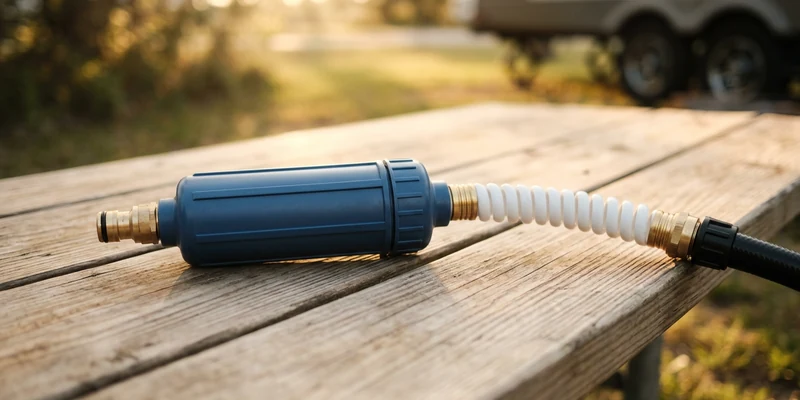
The Camco TastePURE RV water filter is the blue cylinder you see hanging off three quarters of the hoses in any campground loop. It has been the default inline filter for so long that most owners buy one without really deciding to, and that makes it worth looking at honestly. Is it the right filter, or just the familiar one?
The short version is that it is genuinely well matched to what most owners need, provided you understand what it is for. It is a disposable carbon cylinder on a hose thread, designed to deal with chlorine taste, odor, and coarse sediment. It is not a purifier, it does not manage pressure, and its rated capacity assumes cleaner water than a lot of parks supply. Within those limits it does its job, screws on in ten seconds, and costs less than almost any other upgrade you can make to a fresh water system.
This article contains affiliate links. If you buy through them, we may earn a commission at no extra cost to you. Learn more.
Quick Answer
Is the Camco TastePURE worth buying?
- Yes for weekend and seasonal campers who want better tasting water and less grit, with no installation and nothing to store.
- Buy the version that includes the flexible hose protector, since without it the filter’s weight kinks the hose right at the spigot.
- Skip it if you are hooked up for months at a time or want a finer rating on drinking water, where a cartridge based system makes more sense.
The TastePURE at a Glance
Here is what the format is and what it is not, before any judgment about whether it suits you.
| Aspect | What it is |
|---|---|
| Type | Disposable inline filter that screws between the spigot and your fresh water hose |
| Media | Granular activated carbon, with KDF included in the design |
| Targets | Chlorine taste and odor, plus coarse sediment |
| Fittings | Standard garden hose thread at both ends, hand tight, no tools |
| Installation | None. Screw it on at the spigot and go |
| Typical service life | Camco publishes a seasonal figure, and owners report shorter life on sediment heavy or well water |
| Not designed for | Biological treatment, pressure regulation, or cleaning a fresh tank that is already dirty |
| Best suited to | Weekend and seasonal camping, and anyone filling a fresh tank from varied sources |
| Storage | Drain it, bag it, keep it indoors and out of a freeze between trips |
Our assessment here is based on published specifications and the patterns that repeat across owner feedback rather than on any trial of our own. That matters most for the service life question, where the printed figure and the reported experience differ noticeably.
What It Gets Right
The taste improvement is the part nobody argues about. Campground water often carries a strong chlorine note, and a carbon cylinder handles that reliably enough that owners notice within one glass. Coffee, ice, and drinking water all improve, which is the reason the format sold so well in the first place.
The second strength is that there is nothing to get wrong. No housing to mount, no cartridge to seat, no wrench, no bay space required. You screw it on hand tight, you use it, and at the end of the season it goes in the trash. For anyone who camps a handful of weekends a year, that simplicity is worth more than a finer filtration rating they would have to maintain.
The hose protector is not a bonus
Buy the version that comes with the flexible hose protector, or buy one separately. The filter is heavy enough that hanging it directly off a spigot puts a permanent bend in the hose right at the fitting, and that bend is what eventually splits. Owners who skip it tend to buy one after the second ruined hose.
Where It Falls Short
The honest limitations are three, and none of them is a defect so much as a mismatch between what people expect and what the format is.
First, service life. The rated capacity assumes reasonably clean water, and a park on a well with sediment in the line can exhaust a cylinder far sooner than the published figure suggests. Judge by symptoms rather than the calendar: when flow drops at the shower with no other explanation, or the chlorine taste returns, it is finished. Second, it does nothing about pressure, which is the risk that actually damages rigs, and the two get conflated constantly. Third, it is a taste, odor, and sediment filter, not a purifier, and it is not designed or rated for biological treatment.
The disposable math changes if you camp a lot
For a few weekends a year, a disposable cylinder is the sensible choice. For someone hooked up for months, replacing cylinders repeatedly costs more over a season than a cartridge housing where you swap only the element, and it produces a pile of plastic. That is the point at which the format stops making sense, not because it works badly but because it is being asked to do a job it was not designed for.
Check It Out
If the format fits how you camp, this is the version to get. There is not much to specify beyond making sure the hose protector is in the box.
🏆 The Standard Choice
The Camco TastePURE inline RV water filter supplied with the flexible hose protector. It screws onto the spigot in seconds, deals with chlorine taste and coarse sediment, and stores in a drawer between trips. Flush it for a minute or two before drinking, since a new cylinder releases carbon fines that give the first water a gray tint, and that clears on its own.

Who It Is For, and Who Should Skip It
The decision is mostly about how many weeks a year you are connected to a spigot, and secondarily about what your local water is like.
- Buy it if you camp weekends and seasonally, want better tasting water without installing anything, or fill your fresh tank from a different source every trip.
- Buy it if you want a cheap layer of sediment protection ahead of your pump strainer and fixtures, which is a quieter benefit than taste but arguably a more useful one.
- Skip it if you are hooked up for months at a time, where a cartridge housing works out cheaper per season and gives you a finer stage.
- Skip it if your water leaves visible grit within days, in which case a sediment prefilter ahead of the carbon stage is what you actually need.
- Skip it if your complaint is a rotten egg smell on the hot side only, which is a water heater matter rather than a filtration one, covered in RV hot water that smells like sulfur.
Alternatives and What to Pair It With
Two of these replace the TastePURE and one is the thing you should buy alongside it regardless of which filter you choose.
🔁 If You Camp for Months at a Time
A hose mounted cartridge filter such as the Camco EVO, where the housing stays and only the element gets replaced. Over a long season it works out cheaper than a run of disposables, the media is generally finer, and there is far less to throw away. It is bulkier and needs a spot in the bay, so it suits full timers rather than weekenders.

🪨 If Your Water Is Full of Grit
An inline sediment prefilter fitted ahead of the carbon filter. Where water clouds a housing within days, the prefilter takes the load and the carbon cylinder stops choking early. Two cylinders on a hose looks excessive until you see how much longer the second one lasts.

🛡️ Buy This Whichever Filter You Choose
An adjustable brass water pressure regulator with a gauge, fitted at the spigot ahead of the filter. A filter protects your taste buds, a regulator protects the plumbing behind your walls, and campground pedestals vary far more than most owners assume. Our guide on how much RV water pressure is too much covers what to set it to.

Frequently Asked Questions
How long does a Camco TastePURE filter last? Camco publishes a seasonal figure that assumes reasonably clean water. In practice, judge it by flow and taste, and expect considerably less on sediment heavy or well water.
Does it make campground water safe to drink? No. It targets chlorine taste, odor, and coarse sediment, and it is not designed or rated for biological treatment. Fill from potable sources and follow any advisory posted at the park.
Which end does it go on? At the spigot, after the pressure regulator, with your drinking water hose running from the filter to the rig. That keeps the hose full of filtered water rather than the other way round.
Why is the first water gray? Carbon fines from a fresh cylinder. Run it for a minute or two before drinking and it clears by itself.
Can I reuse one from last season? Not worth it. A filter stored damp and warm for months should be replaced, and a cylinder left connected through a freeze may be cracked without showing it.
Does it help if I only fill my fresh tank? Yes, arguably more so. Filtering at the fill point keeps sediment out of the tank and the pump strainer, though it does nothing for a tank that is already dirty. That needs a proper sanitize.
The Bottom Line
The Camco TastePURE earns its place as the default inline filter for weekend and seasonal camping: no installation, a clear improvement in taste, and useful sediment protection for the pump and fixtures. Buy the version with the flexible hose protector, treat the rated life as a ceiling rather than a promise, and step up to a cartridge system if you are hooked up for months. Whatever you choose, pair it with a pressure regulator, because that is the part that protects the rig itself.