Last updated: August 14, 2026
If you want to know how does a trailer sway bar work, the mechanism is less exotic than the name suggests: it adds resistance to the trailer rotating around the hitch ball. Most designs do that with friction, a few do it with cam geometry that actively pushes the trailer back toward straight, and the trailer’s own oscillation has to work against that resistance instead of building freely.
Understanding this matters because it also explains the limits. A sway bar removes energy from a swing that has already started. It does not move your cargo forward of the axles, it does not add tongue weight, and it does not raise any weight rating. Owners who treat it as a cure for a badly loaded trailer end up disappointed, and often surprised at the speed where sway shows up anyway.
This article contains affiliate links. If you buy through them, we may earn a commission at no extra cost to you. Learn more.
Quick Answer
How does a trailer sway bar work?
- A friction sway bar clamps between the trailer A frame and the hitch shank, so any yaw movement has to drag against friction pads and loses energy.
- Cam and integrated systems build that resistance into the weight distribution hitch, using spring bar geometry to pull the trailer back toward center.
- Sway control raises the disturbance level your rig can absorb. It does not fix cargo loaded behind the axles, low tongue weight, or an overloaded rig.
Sway Control Types Compared
Four approaches show up on travel trailers and cargo trailers. They differ in how they generate resistance and in how much trailer they suit.
| Type | How it resists sway | Typically suits | Limits to know |
|---|---|---|---|
| Friction sway bar | Adjustable friction pads squeezed inside a telescoping bar | Light and single axle trailers, add on to an existing hitch | Damps motion after it starts; usually disconnected on slick roads and tight turns |
| Dual cam system | Spring bars seat in cams that resist moving off center | Mid size and larger travel trailers with weight distribution | Needs correct setup and specific hitch head compatibility |
| Integrated weight distribution hitch | Spring bar geometry and friction built into the head | Long travel trailers, everyday towing | Spring bars must match measured loaded tongue weight |
| Vehicle trailer sway control | Stability control brakes individual wheels to damp yaw | Tow vehicles that offer it from the factory | Reactive backup, not a substitute for correct loading and a hitch |
The Friction Bar, Step by Step
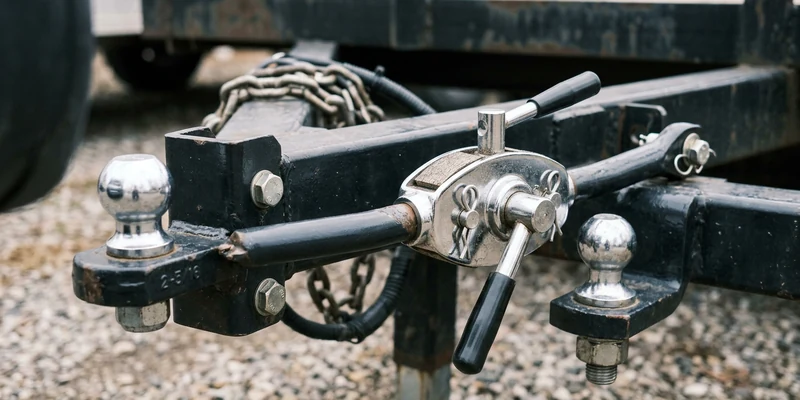
A friction sway bar is a telescoping tube with friction material inside and a tension handle on the outside. One end attaches to a ball on the trailer A frame, the other to a ball on the hitch shank, forming a triangle between trailer and tow vehicle.
When the trailer starts to rotate around the hitch ball, that triangle has to change shape, which means the bar has to slide through its own friction pads. Sliding takes force, that force resists the rotation, and the energy that would have built into the next swing is turned into heat in the pads instead. Tightening the handle increases the clamping force, and therefore the damping, up to the maximum the manufacturer specifies.
Why Friction Bars Get Disconnected
The same friction that damps sway also resists the deliberate angle changes of tight, low speed maneuvering, which is why most manufacturers instruct you to disconnect the bar for sharp turns, backing into a site, and driving on ice, snow, or wet, slippery surfaces. Follow the instructions that came with your unit rather than a general rule, and remember to reconnect before rejoining the highway.
Cam and Integrated Systems
Dual cam and integrated designs work with the weight distribution hitch rather than beside it. The spring bars that transfer load also sit in cam brackets or in a shaped head, and the geometry gives the straight ahead position the lowest energy state. Push the trailer off center and the bars have to climb out of that seat, which produces a force pulling the rig back toward straight.
The practical difference is that cam and integrated systems tend to be proactive rather than purely damping, and they generally do not need disconnecting for normal maneuvering. They also demand a correct setup, since spring bar tension, ball height, and head tilt determine both the load transfer and the sway resistance. Our comparison of weight distribution hitches with sway control covers how to match spring bar rating to your measured loaded tongue weight.

Electronic Sway Control in the Tow Vehicle
Many modern trucks and SUVs include a trailer sway control function inside the stability control system. Yaw sensors detect the oscillation and the system brakes individual wheels, and often reduces engine torque, to damp it. It is genuinely useful and it works faster than a driver can react.
It is still a last line of defense. It acts only once sway is under way, it cannot compensate for a tail heavy trailer, and it depends on tires and brakes being in good shape. Treat it as a backup behind correct loading and a properly set up hitch, not as a reason to skip either. Check your owner’s manual for what the system does on your specific vehicle and what warning light indicates it has intervened.
What a Sway Bar Cannot Do
Sway control adds resistance to yaw. That is the whole job. It does not add tongue weight, so a trailer loaded behind the axles is still a pendulum, just a slightly slower one. It does not restore load to the tow vehicle front axle, which is what a weight distribution hitch is for. And it does not change any rating on your vehicle door jamb label or the trailer’s weight label.
The correct order of operations is therefore load first, weigh second, hitch third, sway control fourth. Get tongue weight into the range commonly cited as roughly 10 to 15 percent of the loaded trailer weight, confirm every figure is inside the ratings, then let the hardware handle the disturbances that remain. Our hub on what causes trailer sway works through that sequence, and tongue weight and sway covers both ends of the balance.
Choosing and Fitting One
Match the hardware to the trailer, not to the biggest number available. Light single axle trailers are well served by a friction bar, since their own resistance to yaw is small and the damping is a meaningful share of the total. Larger travel trailers benefit more from a cam or integrated system that works together with weight distribution.
Check three things before buying: the trailer weight range the unit is rated for, whether your A frame has room for the mounting ball and clearance for the bar through its full range of motion, and whether your existing ball mount can accept the second ball. Some trailers with front mounted generators, battery boxes, or propane racks need a specific bracket. Installation is straightforward on most A frames and is covered in how to install a trailer sway bar, while sway bars and control kits and sway bars for light travel trailers compare the common options.

Keeping It Working
Friction sway control is a wear item, because damping is created by material rubbing against material. Pads glaze and thin over time, and a bar that no longer resists movement is not doing anything except adding weight to the tongue. Inspect it once a season, replace pads when the tension handle no longer produces real resistance, and keep grease off the friction surfaces even though the mounting balls do want grease.
Cam and integrated systems need their own attention: greased sockets or thrust washers where the manufacturer specifies, spring bars checked for cracks, and chains or brackets inspected for wear and elongation. On any system, confirm the setup again after a change of tow vehicle, a new hitch ball height, or a significant change in how you load the trailer.

When Hardware Is the Wrong Answer
Do not use sway control to compensate for a rig that is over its ratings, a trailer with a cracked or bent A frame, elongated holes at the coupler or receiver, a shifted axle, or broken springs and equalizers. Those are inspection and repair items for a qualified trailer shop, and adding friction to a damaged structure does not make it safe.
The same applies to installation. If mounting requires drilling or welding on the trailer A frame beyond what the instructions describe, have a trailer shop do it. A frame is structural, and a sway control bracket that tears loose at speed becomes the disturbance rather than the cure.
Common Mistakes to Avoid
- Buying sway control instead of rebalancing. Cargo forward of the axles is still the first fix, and it is free.
- Leaving a friction bar connected in tight turns or on ice. Follow the manufacturer’s disconnect instructions.
- Overtightening the handle. More is not better past the specified setting, and it accelerates pad wear.
- Greasing the friction surfaces. Grease the mounting balls, keep it off the pads.
- Mismatched spring bars. Bars rated far above your measured loaded tongue weight ride harshly and reduce compliance.
- Assuming vehicle sway control replaces a hitch. It intervenes after the fact and cannot rebalance a trailer.
Frequently Asked Questions
How does a friction sway bar stop sway? It forces any yaw movement of the trailer to drag a telescoping bar through friction pads, which converts the motion into heat and damps the oscillation before it can build.
Do I need one sway bar or two? Some manufacturers recommend a second friction bar on the opposite side for heavier or longer trailers, since a single bar resists one direction slightly differently from the other. Follow the unit’s own weight guidance and your trailer manufacturer’s recommendation.
Is a sway bar the same as a weight distribution hitch? No. A weight distribution hitch transfers tongue load onto the tow vehicle front axle and the trailer axles. A sway bar adds resistance to yaw. Many hitches combine both functions in one head.
Should I disconnect the sway bar for backing up? For friction bars, most manufacturers say yes for tight, low speed maneuvering and on slippery surfaces. Cam and integrated systems generally stay connected. Check your instructions.
Will a sway bar fix a badly loaded trailer? No. It raises the level of disturbance the rig can absorb, but the pendulum effect of cargo behind the axles remains. Fix the load first, as covered in how to prevent trailer sway before you leave.
The Bottom Line
A sway bar works by making the trailer’s yaw motion fight friction or cam geometry, so oscillations lose energy instead of building. Friction bars suit lighter trailers and get disconnected for tight turns and slick roads; cam and integrated systems work with a weight distribution hitch and act more proactively. All of them are the fourth step, after correct loading, verified tongue weight inside the ratings on your vehicle and trailer labels, and a properly set up hitch.
Compare the sway control types