Last updated: August 14, 2026
Most diesel heater repair jobs have nothing to do with a failed control unit, even though that is what owners suspect first. Four things cause the majority of faults: battery voltage that sags while the glow plug pulls its heaviest current, fuel delivery problems (air in the line, a line that drained back, a clogged filter, or a worn dosing pump), carbon on the glow plug and glow screen, and a restricted or kinked exhaust or air intake.
This guide runs from a symptom table to the free checks, then the parts that genuinely wear out, and finally the point where the job hands over. That line matters more here than on almost any RV repair, because a diesel heater burns fuel and routes hot exhaust past the space you sleep in. A carbon monoxide alarm with an unexpired sensor is mandatory, and the exhaust always terminates outside, clear of windows, doors, air intakes, and roof vents.
This article contains affiliate links. If you buy through them, we may earn a commission at no extra cost to you. Learn more.
Quick Answer
How do you fix a diesel heater that will not run properly?
- Measure battery voltage under load during the glow cycle first, because voltage drop causes more no start faults than every failed part combined.
- Then work the fuel path (level, filter, air in the line, dosing pump output) and confirm the exhaust and air intake are clear and unkinked.
- The real wear parts are the glow plug and glow screen, the dosing pump, and the exhaust. If you smell exhaust inside, shut it down at once, check your carbon monoxide alarm, and do not restart until the leak is found.
Symptoms, Causes, and What to Do
Find the behavior you are seeing on the left. The rows are ordered so the free checks come before anything you have to buy.
| What the heater does | What it usually means | What to do first |
|---|---|---|
| Nothing at all, no fan, no display | No power reaching the unit | Check the inline fuse, the connector, and voltage at the supply terminals |
| Fan runs, blows cold air, never ignites | Glow failing, no fuel arriving, or voltage sagging | Measure voltage under load during glow, then confirm fuel reaches the pump |
| Fuel pump ticks but no ignition | Fuel is metered but not burning | Suspect a carboned glow plug or screen, and check the air intake |
| White smoke, then a shutdown | Unburned fuel, weak glow, or restricted air | Stop restarting it, check intake and exhaust, then the glow plug |
| Black smoke and a sooty smell | Too much fuel for the air available, or a blocked exhaust | Check the exhaust for crushing or soot packing, then intake restriction |
| Starts, then shuts down after a few minutes | Flame out, overheating, or fuel supply that cannot keep up | Look for a drained line, a clogged filter, and blocked hot air outlets |
| Error code on the controller | The unit stopped for a reason it can name | Look the code up in the manual for your own unit, then work the cause |
| Loud whistling or rattling | Loose exhaust joint, failing blower bearing, or a resonating mount | Check exhaust clamps and mounting bolts cold, before blaming the motor |
| Weak heat at altitude | Less oxygen for the same fuel dose | Set the controller altitude mode if it has one, and expect some derating |
| Pulsing or hunting flame | Air in the fuel line or inconsistent pump output | Purge the line, check every fuel joint for air ingress, then test the pump |
| Diesel smell inside | A weeping fuel joint, a loose cap, or a spill in the bay | Find and fix the leak before running the heater again, no exceptions |
| Exhaust smell inside | An exhaust leak, a failed grommet, or an outlet too close to an opening | Shut down at once, ventilate, check your CO alarm, do not restart until the leak is found |
| Only starts after several attempts | Marginal glow plug, drained fuel line, or borderline voltage | Charge the battery fully, then plan a glow plug and screen service |
For the sequence the unit actually follows, from glow to priming to steady burn, see how a diesel heater works in an RV, which makes most of the rows above obvious.
Start With the Checks That Cost Nothing
Run these six in order before you open a parts catalog. Technicians and long time owners report this sequence resolves the complaint far more often than any component swap does.
- Battery voltage under load, during the glow cycle. The plug is a heavy draw, usually somewhere in the 8 to 12 amp range, and a heater that reads fine at rest can drop out of range the moment glow starts. Meter at the heater’s own terminals.
- Connections and grounds. Undersized wiring, long thin supply leads, a corroded ring terminal, or a ground on painted metal all produce the same voltage drop as a tired battery.
- Fuel level and whether the line drained back. A heater that has sat for weeks often has a partly empty line, and the controller gives up before the pump refills it. Allow a longer priming sequence after standing.
- The fuel filter and the line. Look for cloudiness, bubbles traveling toward the pump, and kinks at bulkheads. Air on the suction side causes pulsing and flame outs that look like a failing unit.
- Combustion air intake and exhaust. Both must be clear, unkinked, and not crushed, and the intake must not draw from a sealed compartment. The exhaust always terminates outside, clear of windows, doors, air intakes, and roof vents.
- The controller altitude setting. Running a sea level fuel dose at elevation is a classic cause of sooting, weak heat, and shutdowns that vanish once you drive back down.
Error Codes Are a Starting Point, Not a Diagnosis
An error code tells you which condition tripped, not which part failed. The same fault, a flame that never established, can come from voltage, fuel, glow, or air, and the controller cannot tell those apart.
Codes also vary. Webasto and Espar publish their own documented sets, while the many inexpensive clone units use numbering that differs between sellers and even between production runs. Use the code list that came with your own unit and be suspicious of generic lists found on forums.
The Parts That Actually Fail
Once power, fuel, and airflow are confirmed good, the fault is inside the heater, and it is nearly always one of a small handful of components sold as service parts.
Glow plug and glow screen
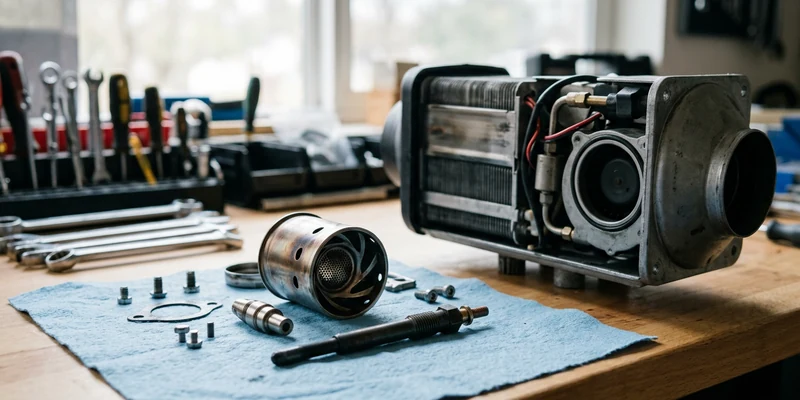
This is the most common service item on any diesel air heater. The plug ignites the fuel at startup and the screen, a mesh sleeve around it, holds fuel against the heat so it lights cleanly. Both collect carbon, and a carboned screen is the usual reason a unit needs three attempts to start, makes white smoke, or stops lighting at all.
🔥 For hard starting, white smoke, or repeated ignition failures
A glow plug and glow screen service kit for your unit, ideally with the removal tool, since the retaining nut sits in a tight space. Check the plug type against your own heater, because clone units and branded units do not always share a part.

The fuel dosing pump
The dosing pump is the ticking box in the fuel line, delivering fuel in measured pulses. It fails by going silent, by ticking without moving fuel, or by metering less than it should, which shows up as weak heat and flame outs under load. Mounting matters too: these pumps want the angle the maker specifies, typically tilted with the outlet upward, so air passes through instead of collecting inside.
⛽ For a silent pump, or a flame that hunts and dies
A replacement 12V metering pump matched to the output rating of your heater. The rating is not interchangeable between sizes, so check what your unit calls for rather than buying on connector shape.

Combustion chamber and gasket
The gasket between the combustion chamber and the heat exchanger is a genuine wear part on units with a lot of hours, and a leaking one shows up as uneven running and difficulty holding a flame. This is where the repair stops being casual, because anything that lets combustion gases into the cabin air path is a safety fault, not a performance complaint.
Exhaust pipe, muffler, and mounting
Exhaust components corrode, work loose, and get crushed. Flexible stainless pipe fatigues at the bends, clamps back off with vibration, and mufflers rot from the inside where condensation collects. Inspect the whole run cold, from the heater outlet to where it ends outside.
Three rules apply without exception. The exhaust terminates outside, pointing away from windows, doors, air intakes, and roof vents. It runs clear of anything flammable and clear of the fuel line, because the pipe gets extremely hot in normal operation. And the heater never runs in an enclosed space, a tent, a closed garage, or under a closed awning.
💨 For a corroded, rattling, or crushed exhaust run
An exhaust pipe, muffler, and clamp kit with heat shielding, sized to your heater’s outlet diameter. Fit new clamps rather than reusing tired ones, and route the pipe with a slight fall so condensation drains out.

The part that is never optional
A diesel heater is a combustion appliance a few feet from where you sleep, and carbon monoxide has no smell. Any rig with a diesel heater, propane furnace, cooktop, or generator needs a working alarm, and these alarms expire. A unit that still beeps on the test button can be years past the sensor life printed on its housing.
🚨 Mandatory equipment, not an accessory
A 12V carbon monoxide alarm made for RV use, with the sensor expiration date visible on the housing. Mount it at the height the maker specifies and write the replacement year on your maintenance list.

Blower motor and, last of all, the control unit
A failing blower bearing announces itself as a rising whine or a rattle that changes with fan speed. The control unit is genuinely last on the list: boards do fail, but far less often than the four causes at the top of this article, and a board on a clone unit frequently costs close enough to a whole heater that a fresh unit is the more sensible move.
🔁 When the repair no longer makes sense
A complete 12V diesel air heater kit, commonly rated around 2 to 5 kW depending on your rig, fitted as a replacement. A heater too large for the space runs on its lowest setting constantly, which is what builds carbon. Our roundup of the best RV diesel heaters covers sizing.

Carbon Buildup and Why Running It Hot Is Maintenance
Carbon is a consequence of how you run the unit, not a defect. Burning at the lowest setting for long stretches drops combustion temperature, fuel burns less completely, and soot accumulates on the glow screen, in the burner, and along the exhaust. Forum threads consistently mention that the same model stays much cleaner in a smaller rig, where it cycles between high and low instead of idling.
The fix is periodic high output running. Once every week or two of use, run the heater at or near full output for a stretch with a window cracked for ventilation, which burns off soft deposits. Some controllers offer a dedicated high burn mode.
What high burn will not fix
Hard, baked on carbon does not clear itself. Once the glow screen is packed, a decarbonizing run will not restore it, and the answer is a new plug and screen. A soot packed muffler needs replacing rather than clearing.
Where This Stops Being a DIY Job
A glow plug, a dosing pump, and general electrical checking are within reach of most owners. The following are not.
- Exhaust routing and through floor penetrations. Where the exhaust exits, how it is sealed, and how it is isolated from combustible material is safety critical. If in doubt, a certified RV technician.
- Tapping the vehicle fuel tank. Fitting a standpipe or tapping the vehicle’s own tank involves fuel system work and sealing. Have it done by someone who does it regularly.
- Any exhaust smell inside. Shut down, ventilate, verify your carbon monoxide alarm is current, and do not restart until the source is found and corrected.
- Repeated flame outs after a full diagnosis. A unit that keeps losing its flame despite good voltage, fuel, and airflow has a combustion side fault.
- A heater that no longer runs its cooldown. Never cut power to a running unit and never fit a switch that does. The purge cycle clears remaining fuel and cools the chamber.
Where to Go From Here
If the sequence itself is still a mystery, start with how a diesel heater works in an RV, which explains why voltage, fuel, and air have to arrive in a particular order.
If the unit is finished, our comparison of the best RV diesel heaters for winter camping covers mounted units and sizing, and the best portable diesel heaters guide covers the cased units you set outside. If a propane furnace is also misbehaving, see RV furnace not working, and for cold nights generally, how to stay warm in an RV in freezing weather.
Common Mistakes to Avoid
- Replacing the controller first. It is the least likely failure and the most expensive guess.
- Measuring battery voltage at rest. A battery that looks healthy sitting still can collapse under the glow load.
- Repeated start attempts after a failure. Every failed attempt puts unburned fuel into the chamber, which makes the next attempt worse.
- Cutting power to stop it. Always shut down through the controller and let the purge cycle finish.
- Running it oversized on low forever. Constant low output carbons a unit up fast, and that is a sizing mistake rather than a fault.
- Trusting an old carbon monoxide alarm. Sensors expire. Read the date on the housing rather than relying on the test button.
Frequently Asked Questions
Why does my diesel heater blow cold air but never ignite? The fan is running while ignition has failed. The usual causes are voltage sagging during the glow cycle, no fuel arriving because the line drained back, or a carboned glow screen. Check voltage under load first.
What voltage does a diesel heater need to start? Manufacturers publish a working range rather than a single number, and these units get unreliable as voltage under load falls toward the low tens. The glow cycle is the heaviest draw, so that is the moment to measure.
Why is my diesel heater making white smoke? White smoke is generally unburned fuel, caused by weak glow, restricted combustion air, or repeated failed start attempts. Stop restarting it, check the intake and exhaust, and inspect the glow plug and screen.
How often does a glow plug need replacing? There is no universal interval, and it depends heavily on how the unit is run. Owners who run oversized heaters on low output report needing it far sooner than those who cycle between high and low.
Can I run a diesel heater inside the RV? The heater body can be mounted inside a sealed enclosure or under the floor, but the exhaust must always terminate outside, clear of windows, doors, air intakes, and roof vents. Never run one in a tent, a closed garage, or under a closed awning.
Is it worth repairing a cheap diesel heater? Glow plugs, dosing pumps, and exhaust parts are all worth replacing on a unit that otherwise runs well. Once the fault is the control board or the blower motor, a complete replacement unit is often the more sensible move.
The Bottom Line
Work from free to expensive: battery voltage under load during the glow cycle, then connections and grounds, then the fuel path, then the exhaust and air intake. Only after that do the real wear parts come into play, and the glow plug, glow screen, dosing pump, and exhaust cover almost all of them. Treat the exhaust, the tank tapping, and any smell of exhaust inside as work for a certified RV technician, keep a current carbon monoxide alarm on board, and never cut power before the purge cycle has finished.