Last updated: August 14, 2026
A portable air conditioner for an RV can work well, and the owners who are happy with theirs are the ones who understood the deal before they bought. A portable unit is a heat pump in a box on your floor. It takes heat out of the air inside and it has to put that heat somewhere else, which means a hose out of the rig, through a window, a roof vent, or a purpose cut opening. There is no version of this product that skips that step, and any unit sold without an exhaust route is a fan or an evaporative cooler, not an air conditioner.
The other three realities are floor space, condensate, and power. It will occupy a corner you were using for something else, it will produce water that has to go somewhere, and it will take a serious share of a 30 amp service while it runs. None of that makes it a bad purchase: for a rig with no rooftop unit, a van conversion, or a second cooled space in a big fifth wheel, it can be the sensible answer. Venting is what separates a portable that works from one that runs all day and cools nothing.
This article contains affiliate links. If you buy through them, we may earn a commission at no extra cost to you. Learn more.
Quick Answer
Which portable air conditioner should you put in an RV?
- Sort out the exhaust route first. Decide whether the hose goes through a window, a roof vent, or a cut opening, then buy a unit whose hose reaches and seals there.
- For most rigs a mid size portable in the 8,000 to 12,000 BTU class is the sensible band. Bigger units draw more current and take more floor space than a camper can spare.
- Prefer a dual hose design in a small space. Single hose units pull their exhaust air from inside the rig, which drags hot outside air in through every gap to replace it.
- Plan for water. Look for a self evaporating design with a continuous drain option, and know where that drain hose is going before the first humid night.
What to Check Before You Buy
These seven points decide whether a portable unit suits your rig, and the first two are where most disappointed owners went wrong. Work through them with a tape measure in hand before you look at any product page.
| What to check | Why it matters | What to look for |
|---|---|---|
| Exhaust route | The heat has to leave the rig, with no exceptions | A window, roof vent, or cut opening you are willing to commit to |
| Single or dual hose | Single hose units create negative pressure and pull hot air in | Dual hose in a small, leaky space if the option exists |
| Cooling capacity | Too small never wins, too large is current you cannot spare | Commonly the 8,000 to 12,000 BTU class for RV sized spaces |
| Current draw | A 30 amp service fills up fast on a hot afternoon | The rated amps in the listing, checked against what else runs |
| Condensate handling | Emptying a tank at 2 a.m. is nobody’s idea of camping | Self evaporating with a continuous drain port |
| Footprint and weight | It lives on the floor and travels in the rig | Measured floor space plus a plan for where it rides |
| Noise | The compressor is inside the room with you | The published sound rating, and a sleep or eco mode |
If your rig already has a rooftop unit that is simply not keeping up, a portable is an expensive way to work around a fixable problem. Check the airflow and voltage diagnosis in RV air conditioner not cooling first.
The Hose Is the Whole Story
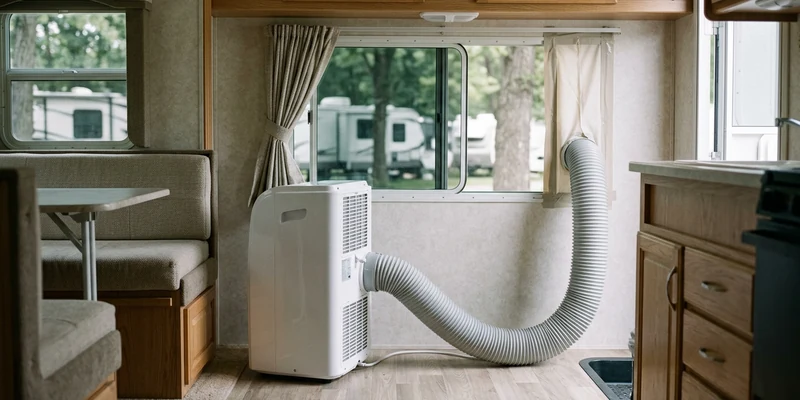
Every complaint about a portable air conditioner that barely does anything traces back to venting. The unit blows hot air down a flexible hose, and everything about that hose matters: its length, its bends, how well it seals where it exits, and how much heat radiates back into the room on the way out. A hose lying across a camper floor in a long loop is reheating the space it just cooled.
Where the hose actually goes in an RV
Three routes are realistic: out a sliding window with a panel filling the gap, up through a roof vent opening with a fitted cover, or through a purpose cut opening in a wall or bay hatch. The window is easiest, the roof vent usually gives a shorter and straighter run, and the cut opening is tidiest and least reversible. Whichever you choose, seal it, because an unsealed panel with a hose poking through undoes much of what the machine is doing.
Single hose versus dual hose
A single hose unit takes air from inside the rig, uses it to cool the condenser, and blows it outside. That air gets replaced by hot outside air pulled in through the door seals, the vents, and every gap a camper has. In a house that effect is diluted by volume; in a small RV it is significant, and it is the main reason owners report a portable that seems to fight itself. A dual hose unit draws its condenser air from outside and returns it outside, which leaves the interior pressure alone, so it is usually the better fit for an RV.
Our Top Picks at a Glance
How we chose: we compared portable air conditioners on the criteria that matter in a camper rather than a living room, meaning hose configuration and reach, footprint, rated current draw, condensate handling, noise, and the patterns that repeat across owner feedback. Our assessment is based on published specifications and that feedback rather than any trial of our own. Check the listing for dimensions, hose length, and rated amps before ordering.
🏆 Best Overall
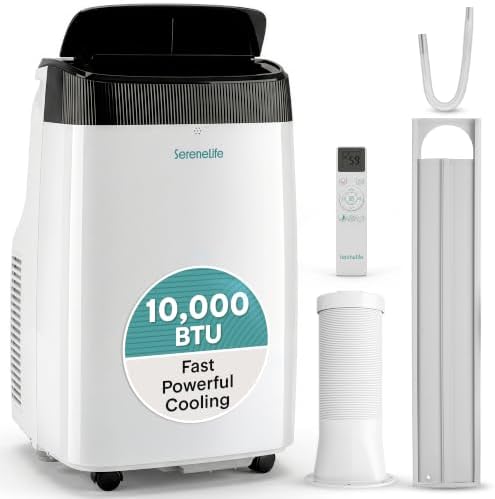
A dual hose portable air conditioner in the 10,000 to 12,000 BTU class with a self evaporating condensate system and a continuous drain port. This format behaves best in a small, leaky space because it does not depressurize the rig to feed its own condenser. Check the listing for hose length and window kit dimensions against your actual window.

⚡ Best for a Tight 30 Amp Service
A single hose portable in the 8,000 BTU class, chosen deliberately for its lower current draw rather than its capacity. Where the water heater, the fridge, and a coffee maker already compete for the same pedestal, the smaller unit is the one you can actually run. It will not beat a desert afternoon, and taking the edge off a warm evening is often all that is being asked. Confirm the rated amps in the listing.

📏 Best When Space Is the Constraint
A compact portable with a small floor footprint, for vans, truck campers, and any rig where the difference between fitting and not fitting is a couple of inches. Capacity is modest by definition here, so match your expectations to the space you are cooling. We cover this category in detail, including how to measure before ordering, in small portable air conditioners that fit an RV.
Power: What It Costs You on a 30 Amp Pedestal
A portable air conditioner is a significant load, and on a 30 amp service it competes directly with everything else in the rig. Compressor loads also spike at startup, several times the running current, which is why a portable can trip a breaker the moment it kicks in rather than while it runs. Watch the rated amps in the listing and add up what else is on.
Two consequences follow. On 30 amp service you will be managing loads by hand, switching the water heater to propane and keeping the microwave for later, and 30 amp versus 50 amp RV service covers what the two connections carry. On a generator, size for both the surge and the continuous load, as covered in RV inverter generators. On batteries it is a capacity question rather than a gadget question, and a portable is no easier on a battery bank than a rooftop unit simply because it sits on the floor, which is worked through in running an RV air conditioner on batteries and solar.
Condensate, Humidity, and the Puddle Nobody Plans For
Air conditioning removes water from the air, and in a humid climate a portable unit removes a lot of it. Modern designs are usually self evaporating, throwing most of that water onto the condenser and exhausting it as vapor, but in genuinely humid weather they still fill an internal reservoir and stop until you empty it.
Look for a continuous drain port and use it. A short hose to a bucket outside, or through the same opening the exhaust uses, means the unit never shuts down on a full tank at two in the morning. Keep that hose sloping downhill the whole way, since a sagging loop holds water and stops the flow. If your real problem is damp rather than heat, a dedicated dehumidifier is cheaper and quieter, and we cover those in RV dehumidifiers.
🪟 Seal the Opening Properly
An adjustable window vent kit with a sealing panel, or a fitted roof vent adapter if you are venting upward. The kit in the box is designed for a residential sliding window and often does not suit an RV window at all, and a panel that seals fully is the difference between a unit that keeps up and one that recirculates its own heat. Check the adjustable range against your measured opening.

🔥 Stop the Hose Reheating the Room
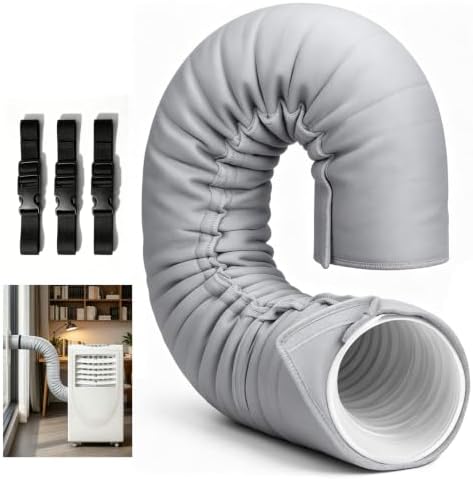
An insulating sleeve for the exhaust hose. The hose runs hot along its whole length, and in a small camper that heat goes straight back into the space you are cooling. A jacket over it is one of the cheapest improvements available and owners consistently notice it. Match the sleeve to your hose diameter, commonly around five or six inches.
Getting the Most Out of It
A portable unit works best when the rig is doing half the job. Reflective covers on sunlit windows, an awning on the sunny side, and a closed up coach during the hottest hours all reduce the heat the machine has to remove, and our summer guide on how to keep an RV cool in summer heat covers that side in full. Beyond that, run the unit before the rig gets hot rather than after, keep the intake filter clean, and if you are venting through the roof anyway, consider upgrading an RV roof vent for airflow at the same time.
Common Mistakes to Avoid
- Buying before solving the exhaust. Decide on window, roof vent, or cut opening first. The unit is chosen around that route.
- Leaving the window kit unsealed. Every gap around the panel lets back the heat you just paid to remove.
- Coiling the hose for tidiness. Short and straight is the rule. Loops radiate heat into the room and restrict flow.
- Oversizing on a 30 amp service. Capacity you cannot power is not capacity. Check the rated amps.
- Expecting an evaporative cooler to be an air conditioner. Those add humidity and are ineffective in the muggy conditions where you need cooling most.
- Ignoring the drain. A full reservoir shuts the unit down, always on the most humid night.
Frequently Asked Questions
Can you use a portable air conditioner in an RV? Yes, provided you commit to an exhaust route out of the rig. The heat has to leave through a hose, and a sealed window panel, roof vent adapter, or cut opening is what makes the unit work as intended.
What size portable air conditioner do I need for a camper? Most RV spaces fall in the 8,000 to 12,000 BTU class. Choose toward the smaller end if you are on a 30 amp service with other loads running, and check the rated amps in the listing.
Do portable air conditioners have to be vented outside? Always. A unit that is not vented moves heat from one side of the room to the other and adds the heat of its own motor. Anything sold as ventless is a fan or an evaporative cooler.
Is a single hose or dual hose better in an RV? Dual hose, in most cases. A single hose unit exhausts interior air and pulls hot outside air in to replace it, and that effect is much more noticeable in a small camper than in a house.
Can I run a portable air conditioner on a 30 amp hookup? Usually yes, with load management. It competes with the water heater on electric, the microwave, and the converter, so run the water heater on propane and stagger the big loads.
Where does the water go? Most units are self evaporating and send the moisture out with the exhaust, but in humid weather they still collect water. Use the continuous drain port with a downhill hose so the unit does not stop on a full reservoir.
The Bottom Line
Decide the exhaust route before you decide the model, because a portable air conditioner is only as good as the hole it vents through and the seal around it. Favor a dual hose design in a small rig, stay in the 8,000 to 12,000 BTU band unless you have the service to feed more, and check the rated amps against everything else on a 30 amp pedestal. Plan the condensate drain in advance, insulate the exhaust hose, and reduce the heat load with shade and covers, since a modest unit that is kept ahead of the sun beats a large one fighting a baked interior.