Last updated: August 14, 2026
When an RV stove will not light, the fault falls into one of three buckets, and telling them apart takes about ten minutes without any tools. Either no propane is arriving, or the ignition is not producing a spark where the gas is, or the burner lights briefly and the control valve refuses to stay open. Each bucket has a completely different answer, and only two of the three are yours to act on.
This guide sorts the buckets in the order that costs you the least. It also draws a hard line that we do not move: the checks below stop at the burner face. Cleaning burner tubes, clearing orifices, adjusting the air shutter, and anything involving gas lines, the regulator, or a gas valve is work for a certified RV technician with a manometer, and we deliberately do not publish steps for it.
This article contains affiliate links. If you buy through them, we may earn a commission at no extra cost to you. Learn more.
Quick Answer
Why will my RV stove not light?
- Start with propane. Confirm the tank has gas and the valve is fully open, reopen it slowly if it was just refilled, and see whether another gas appliance in the coach lights.
- Then separate spark from gas. If the igniter clicks and sparks but nothing catches, gas is not reaching the burner. If there is no spark at all, the ignition system is the fault.
- A burner that lights and then dies the moment you release the knob is a flame sensing or valve problem. That one is not an owner repair, and neither is anything behind the burner face. Book a certified RV technician.
Symptoms, Causes, and What to Do
Match the behavior you are seeing, then work the action column. The rows run from the free checks down to the point where the job leaves your hands.
| What the burner does | What it usually means | What to do |
|---|---|---|
| No burner lights, no other gas appliance works | Supply side, empty tank, closed valve, or tripped excess flow | Check the tank, reopen the valve slowly, see not getting gas |
| Furnace and water heater work, no burner lights | Fault at the appliance rather than at supply | Separate spark from gas with the steps below |
| Sparks strongly, nothing catches | Ignition is fine, gas is not arriving at the burner | Confirm supply, then hand the burner side to a technician |
| No click and no spark anywhere | Dead ignition power or a failed module | See igniter not clicking or sparking |
| Lights, dies as soon as you release the knob | Flame sensing or safety valve not holding | Certified RV technician, no owner adjustment |
| One burner dead, the others normal | Restriction or fault at that burner only | Technician, do not probe or clean the burner |
| Lights only after several attempts | Air in the line, or weak ignition | Purge by running a working burner briefly, then diagnose ignition |
| Started right after a tank refill | Excess flow valve tripped, or air in the line | Close the valve, wait, reopen slowly, then retry |
| Small, lazy, or yellow flame | Incomplete combustion | Shut it off, close the tank valve, ventilate, call a technician |
| Hisses without lighting, or you smell gas | Gas released with no ignition | Knob off, tank valve closed, ventilate, everyone outside |
What Has to Line Up for a Burner to Light
A burner needs three things at the same instant: propane at the right pressure, a spark or flame at the burner face, and a control valve that stays open once ignition happens. Miss any one and the result looks identical from where you are standing with a pan in your hand.
That is why the first real step is not a repair, it is a split. Everything below is designed to tell you which of the three failed, because the answers are not interchangeable. A supply problem is often free to fix, an ignition problem is usually a cheap part, and a valve or flame sensing problem is a service call.
Sealed burners versus open burners
Most modern RV cooktops use sealed burners under a removable cap, which keeps spills out of the burner box. Older units have open burners in a recessed well. The difference matters for cleaning, not for diagnosis: with either type, wiping the surface and the cap is fine, and reaching into the burner head or its ports is not.
The Free Checks, in Order
Do these six before you buy anything. They resolve the complaint more often than any part does, and they cost nothing but a flashlight and a few minutes.
- Confirm you actually have propane. Read the tank gauge, and confirm it a second way by weighing a portable bottle against the tare weight stamped on the collar. Monitors and gauges both lie, and an empty tank is the single most common cause of a stove that will not light.
- Open the tank valve fully, and slowly. If the valve was opened quickly, especially after a refill, the excess flow protection may have limited flow to a trickle. Close the valve, wait a minute, then open it slowly and try again.
- Test another gas appliance. Light the furnace or run the water heater on gas. If they work, propane is reaching the coach and the stove is the problem. If nothing works, you have a supply issue, which is its own article.
- Purge air after any tank change. A fresh bottle leaves air in the line. If one burner does light, let it run for a minute, which clears the line for the others. If none light, do not keep cycling knobs, because each attempt puts unburned gas into the galley.
- Check the ignition power source. Piezo systems need nothing. Electronic ignition needs a battery in a holder under the cooktop, or a 12V feed with its own fuse. A healthy house battery usually reads around 12.6 to 12.8 volts at rest, and ignition modules get unreliable well before a battery is flat.
- Clean the surface, cooled and gas off. Boil over residue around the igniter tip and under the burner cap stops a spark from reaching the gas. Wipe the cooktop surface, the top of the cap, and the ceramic tip with a cloth, then let everything dry completely. That is where owner cleaning ends.
⛽ The check that ends most of these calls
A propane tank level indicator, either a magnetic strip or a scale that reads against the tare weight, so you know what is in the bottle instead of guessing. Confirm the fitting type matches your bottles before ordering.

🚨 Non negotiable in any coach with propane
A working carbon monoxide alarm, or a combined CO and propane detector, with the expiration date on the housing checked. Repeated failed lighting attempts release gas into a small space, which is exactly the situation these alarms exist for.

The Match Test, and What It Actually Proves
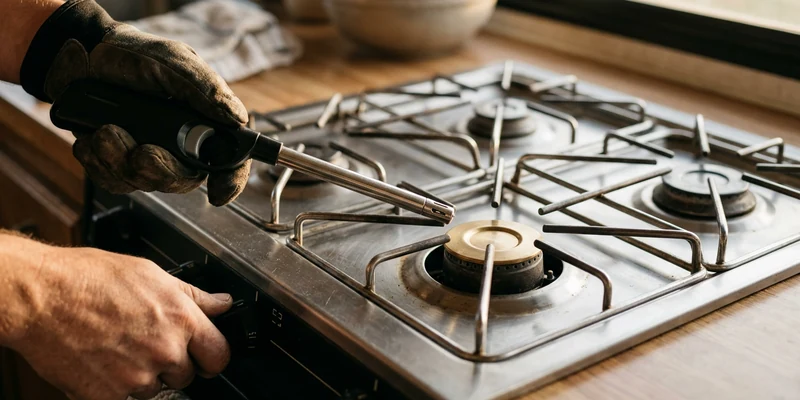
Some RV cooktop manuals include a hand lighting procedure, usually for use when the igniter has failed. If, and only if, your own manual describes it for your model, it is a legitimate diagnostic step: the flame source goes to the burner first, then the knob is turned on, exactly as printed. Never turn gas on and then go looking for a lighter.
What it proves is simple. If the burner lights and burns normally by hand but never lights on the igniter, propane delivery to that burner is fine and the ignition system is the fault, which is a cheap and largely owner friendly repair covered in RV stove igniter not clicking or sparking. If it will not light by hand either, gas is not getting there, and that points at supply or at the burner side.
When not to do it
Skip the match test entirely if your manual does not describe hand lighting, if you smell gas, if the burner has already been cycled several times without lighting, or if you are not able to reach the burner comfortably with a long lighter. And treat a stove that only ever lights by hand as a fault to fix, not a workaround to live with for a season.
🔥 If your manual permits hand lighting
A long reach refillable butane lighter with a flexible neck, which keeps your hand away from the burner and works at an angle. Use it only in the sequence your manual prints, and only on a burner that has not been flooded with gas from repeated attempts.

Lights, Then Goes Out When You Release the Knob
This specific symptom has a specific meaning, and it is worth recognizing because it saves you from chasing the wrong thing. The burner is getting gas and getting ignition, so both of those are proven. What is failing is the safety system that has to sense a flame and hold the gas valve open once you stop pressing.
On appliances that use a thermocouple or a flame sensing circuit, that component is part of the gas control assembly. Adjusting it, cleaning it, or replacing it is not owner work, and we do not publish instructions for it. Note exactly what happens, including how long the flame survives after you release the knob, and give that to a certified RV technician. It is a common failure with a routine fix in the right hands.
One Burner Versus All Burners
The pattern tells you where to look. If every burner refuses, the problem is shared, which means supply, the ignition module, or the appliance’s gas control. If one burner refuses while its neighbors are normal, the problem is local to that burner, and everything local to a burner sits behind the burner face.
That second case is where owners most often get into trouble, because the internet is full of advice about clearing burner ports with a pin or a wire. Do not. A burner that has been picked at burns differently afterward, and the change is not something you can see. If one burner is dead or weak while the others are healthy, that is a technician visit, and a short one.
Where This Job Stops Being Yours
We will not walk you through cleaning or clearing a burner tube, reaming an orifice, adjusting an air shutter or flame, adjusting or replacing a thermocouple, or touching gas lines, flare fittings, gas valves, or the regulator, and we would encourage you not to follow instructions that do. These are low pressure gas components inside a small living space. The failure mode when they are slightly wrong is not a dead stove, it is incomplete combustion that you cannot see, smell, or measure without the right instrument. A certified RV technician can set and verify that assembly with a manometer, and a cooktop call is one of the cheaper visits on the list.
Stop immediately if
Shut the knobs off, close the tank valve at the bottle, open windows and roof vents, and get everyone outside if you smell gas at any point, if a CO or propane alarm sounds, if you see soot or scorching around a burner, or if a flame burns yellow, lifts off the burner, or roars. Do not use the appliance again until a certified RV technician has inspected it, and never test for a leak with a flame.
🧯 The galley item people forget until they need it
A compact fire extinguisher rated for cooking and electrical fires, mounted where you can reach it without crossing in front of the stove. Check the gauge at the start of every season along with the CO alarm date.

When It Is Time to Replace the Stove
Most no light complaints end in a free fix or a cheap part, but a few point at an appliance that has reached the end. Rust through in the burner box, a technician finding the gas control leaking, or repeated combustion complaints after service all move the conversation from repair to replacement.
If that is where you are, the swap itself is in how to replace an RV stove, and what you replace it with depends on how you camp: propane RV stoves keep you cooking off grid, while electric cooktops and ranges take propane out of the galley if you have the power to support them. Any swap involving a gas connection finishes with a certified technician making and leak testing that connection.
Common Mistakes to Avoid
- Cycling the knob over and over. Every failed attempt puts unburned propane into a small space and diagnoses nothing.
- Assuming the igniter is dead because there is no flame. Spark and gas are separate systems. Watch for the spark before blaming it.
- Skipping the other appliances. The furnace or water heater is the fastest way to prove propane is reaching the coach.
- Opening the tank valve fast after a refill. That trips the excess flow protection and imitates a stove fault perfectly.
- Poking burner ports with a pin. It changes combustion invisibly, and it is technician work for a reason.
- Living with a stove that only lights by hand. That is a fault report, not a solution.
- No working CO alarm. Check the expiration date on the back of the housing before the next trip.
Frequently Asked Questions
Why will my RV stove not light but the igniter clicks? Ignition is working and gas is not reaching the burner. Confirm the tank valve and level, test another gas appliance, and if propane is clearly reaching the coach, the burner side needs a certified RV technician.
My stove stopped working right after I filled the propane tank. That is a classic excess flow trip or air in the line. Close the tank valve, wait a minute, reopen it slowly, and let a working burner run briefly to purge the line.
Can I light an RV stove burner with a lighter? Only where your own appliance manual describes hand lighting, and only in the printed order, flame first and then gas. Treat it as a diagnostic step rather than a permanent workaround.
Why does my burner go out when I let go of the knob? The flame is not being sensed, so the safety system closes the gas valve. That is a gas control fault and belongs to a certified RV technician.
Only one burner will not light. Is that different? Yes. A single dead burner points at something local to that burner, which sits behind the burner face. Do not clean or probe it, book a technician.
Does an RV stove need electricity to light? Piezo ignition does not. Electronic ignition needs a battery under the cooktop or a fused 12V feed, which is why some stoves quit when the house battery runs low.
The Bottom Line
An RV stove that will not light is failing at supply, at ignition, or at the valve that has to hold open, and ten minutes of free checks tells you which. Confirm propane, open the tank valve slowly, test another gas appliance, then watch for a spark to separate ignition from gas. Anything behind the burner face, meaning burner tubes, orifices, air shutters, thermocouples, gas valves, lines, and the regulator, is certified technician work and we do not publish steps for it. Shut down, close the tank valve, ventilate, and get out if you smell gas, hear a CO alarm, or see soot or a yellow flame.