Last updated: August 14, 2026
Most batteries that die over the winter are not killed by cold. They are killed by sitting at a low state of charge for months, and the cold only finishes the job. Successful RV battery winter storage comes down to one principle: keep the battery full, or as close to full as its chemistry likes, and stop anything from quietly draining it while you are not watching.
There are three workable ways to do that, and which one suits you depends entirely on whether your storage spot has power, sunlight, or neither. This guide covers all three, explains why a discharged lead acid battery can freeze while a full one will not, and covers the one rule that catches lithium owners out every single winter.
This article contains affiliate links. If you buy through them, we may earn a commission at no extra cost to you. Learn more.
Quick Answer
How do you keep RV batteries charged in winter storage?
- Charge the bank fully first, then either leave it on a smart maintainer, keep it topped up with a small solar panel, or disconnect it and recharge every month or so.
- A fully charged lead acid battery resists freezing down to very low temperatures. A deeply discharged one can freeze not far below the freezing point of water, and a frozen case is usually the end of the battery.
- Lithium is different: store it partially charged rather than full, and never charge it while the cells are below freezing unless the battery has a built in low temperature cutoff or heater.
Pick the Method That Matches Your Storage Spot
The right approach is decided by what is available where the rig sits, not by which method is theoretically best. Find your situation in the table and the plan follows.
| Your storage situation | What to do | What to watch out for |
|---|---|---|
| Shore power at home or in the barn | Leave the batteries in place on a smart maintainer, or on the converter if it has a proper float stage | Older single stage converters can boil a flooded battery dry over months |
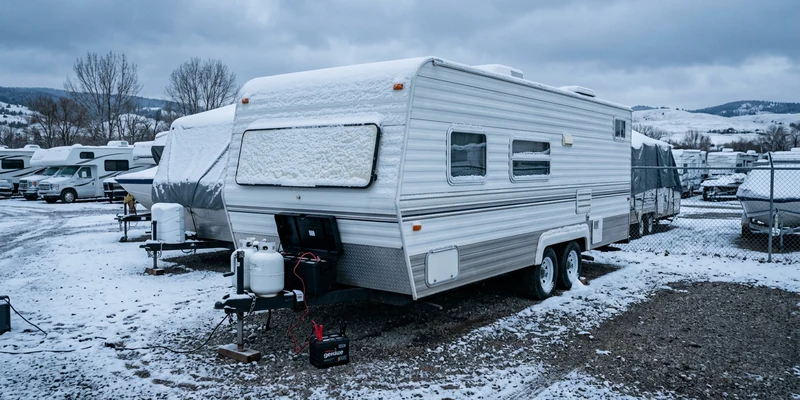
| Outdoor lot with sun, no power | Small solar panel with a controller, keeping the bank topped against background draw | Snow, a cover, or a shaded row makes the panel useless |
| Outdoor lot, no power, no sun | Remove the batteries, store them somewhere cool and dry, recharge monthly | Do not store them on a concrete floor without a board or tray underneath |
| Rig stays in place, batteries stay in | Open the battery disconnect, then check voltage every few weeks | Many disconnect switches leave the propane detector connected |
| Lithium bank, freezing climate | Store at a partial state of charge, isolate, and do not charge below freezing | A solar controller will happily try to charge a frozen bank |
| Mild climate, short storage | A full charge plus the disconnect is often enough | Background loads still drain the bank over two or three months |
If your battery goes flat faster than any of this explains, the problem is a load rather than storage. Work through finding a parasitic battery drain before buying a maintainer.
Why Batteries Die Over Winter
Three things happen at once when a rig sits. The battery self discharges, slowly losing charge with no load connected at all, and that rate is a real figure rather than a rounding error over four months. The coach’s background loads keep drawing, since propane and carbon monoxide detectors, control boards, and radio memory do not switch off when you lock the door. And cold reduces the chemistry’s ability to deliver current, which makes a partly discharged battery look far worse than it is.
For flooded and AGM lead acid batteries, the compounding problem is sulfation. A battery left partly discharged forms lead sulfate crystals on the plates, and the longer it sits the more of that becomes permanent. This is why a battery can survive one lazy winter and not the second one. It also explains a familiar spring pattern: the battery charges up, reads a normal voltage, and then collapses the first time the furnace fan runs.
The freezing point moves with state of charge
This is the part worth remembering. A fully charged lead acid battery has a strong electrolyte and stays liquid well below typical winter temperatures. As it discharges, the electrolyte becomes closer to plain water, and a deeply discharged battery can freeze not far below the freezing point of water. A frozen case cracks or buckles, and the battery is finished. Keeping it charged is therefore not just about convenience in spring, it is what stops the battery from freezing at all.
Method One: Leave It on a Maintainer
If the storage spot has power, this is the least effort and the most reliable option. A modern smart maintainer monitors the battery and delivers charge only when it is needed, holding it near full without cooking it. That is a different behavior from an old trickle charger, which pushes a constant small current whether or not the battery wants it and slowly boils off electrolyte in a flooded battery.
Two details make the difference. Choose a maintainer with a chemistry selector, because flooded, AGM, and lithium want different voltages and an AGM charged on a flooded profile ages faster. And place it somewhere ventilated and dry, since flooded batteries vent gas while charging and a sealed compartment is a poor place for that.

Leaving the rig plugged in and relying on the converter is a reasonable alternative if you know your converter has a genuine multi stage profile with a float stage. Progressive Dynamics and WFCO units built in the last couple of decades typically do. Older single stage units held one voltage indefinitely, and those are the ones that empty a flooded battery over a long winter. If you are unsure which you have, testing the converter with a multimeter will show you what it settles at.
Method Two: A Small Solar Panel
For a storage lot with no power, a modest solar panel and a charge controller will comfortably offset the background draw of detectors and memory circuits. This does not need to be a rooftop array. A panel in the tens of watts, aimed at the southern sky and connected through a controller, is usually enough to hold a bank against normal parasitic load.
The failure modes are all physical rather than electrical. Snow covering the panel, a fitted RV cover over the roof, a shaded row of the lot, or short winter days at northern latitudes all cut the output to something near nothing, and the bank quietly drains anyway. If your lot has any of those, treat solar as a supplement and check the battery voltage in person now and then.

If you are already planning a bigger array for actual camping rather than storage, the sizing question is a different one, and our guide to how much solar an RV actually needs answers it.
Method Three: Disconnect and Recharge Periodically
With no power and no sun, the honest answer is to remove the batteries or at least isolate them, and to recharge on a schedule. Work through it in this order.
- Charge the bank fully before storage. Starting from partial charge means the battery spends the entire winter in the condition that causes sulfation.
- Clean the terminals and the case. A film of dirt and electrolyte on top of a battery conducts, and that is a slow discharge path all by itself.
- Disconnect the negative cable first, then the positive. Or open the battery disconnect switch if the rig has one and it truly isolates the bank.
- Store somewhere cool and dry rather than warm. Cold slows self discharge on a full battery. Warm storage speeds it up.
- Check voltage every four to six weeks and recharge when it drops. A rested lead acid battery usually reads around 12.6 to 12.8 volts full, near 12.1 to 12.2 volts at roughly half, and anything approaching 12 volts is deeply discharged.
- Top up flooded batteries with distilled water before charging if the plates are exposed, and wear eye protection while you do it.
A permanently fitted disconnect switch makes this routine much less annoying, and it also protects against the accessory that someone forgot to switch off.

Lithium Changes the Rules
Lithium iron phosphate banks store differently, and following lead acid habits is how people damage expensive batteries. The single hard rule is charging temperature: most lithium batteries must not be charged when the cells are below freezing, and doing so causes permanent internal damage rather than a temporary loss of performance. Discharging in the cold is generally acceptable, charging is not.
Many current batteries include a built in low temperature cutoff in the battery management system, or an internal heater, and those handle it automatically. Older or budget units may not. Before you leave a lithium bank in a cold lot with a solar panel connected, confirm which one you have, because a charge controller has no idea how cold the cells are.
State of charge and isolation
Lithium prefers to be stored at a partial state of charge rather than sitting at 100 percent for months, commonly somewhere around half to two thirds. Self discharge is very low, so the bank will hold that for a long time as long as it is isolated from the coach’s background loads. Switch the battery off at its own disconnect if it has one, or open the main disconnect, and check it once during the winter rather than leaving it entirely alone. The wider picture, including what the converter has to do differently, is in our walkthrough on switching an RV to lithium batteries and the shortlist in best RV converters for lithium batteries.
Where This Stops Being a DIY Job
Battery work is 12 volt work and sits squarely in owner territory, with the normal precautions: negative cable off first, no rings or watches, eye protection around flooded batteries, and no smoking or open flame near a charging battery because they vent hydrogen. Lifting a group 27 or larger battery is a two hands and a straight back job rather than a one arm reach into a compartment.
Two things belong elsewhere. Any 120 volt work, including installing a hardwired charger, adding an outlet in a storage bay, or anything inside the distribution panel, is for a certified RV technician or a licensed electrician. And a battery that is swollen, leaking, cracked, or has visibly frozen should not be charged at all. Take it to a dealer or a recycling point rather than trying to revive it, and keep the propane and carbon monoxide detectors powered while the rig is occupied, since the furnace is exactly the appliance you will be leaning on when you take the rig back out in spring.
Common Mistakes to Avoid
- Storing a partly discharged battery. This is the single biggest cause of spring failures, and it is also what allows freezing.
- Relying on an old trickle charger. Constant current with no regulation boils flooded batteries dry over a long winter.
- Assuming the disconnect switch isolates everything. Detectors are often wired ahead of it, so a small draw usually remains.
- Leaving a solar panel under a cover. An RV cover or a layer of snow reduces output to nothing, and the bank drains anyway.
- Charging lithium in freezing conditions. Without a low temperature cutoff or a heater, this causes permanent damage.
- Waiting until spring to look. One voltage check in January costs five minutes and often saves the bank.
Frequently Asked Questions
Should I take the batteries out of the RV for winter? Only if there is no power and no usable sun where the rig is stored. If you can maintain them in place, leaving them fitted is simpler and avoids the lifting.
Can I just leave the RV plugged into shore power all winter? Yes, if the converter has a genuine multi stage profile with a float stage. Older single stage units can overcharge a flooded battery over months, so confirm what yours does first.
What voltage means a lead acid battery needs charging? Measured at rest, roughly 12.6 to 12.8 volts is full and around 12.1 to 12.2 volts is about half. Below that it is time to charge, and near 12 volts it is deeply discharged.
Do lithium batteries need a maintainer in storage? Usually not. Self discharge is very low, so isolating the bank at a partial state of charge is generally enough, and charging in freezing conditions is the thing to avoid.
Does storing a battery on concrete ruin it? Modern cases do not discharge through concrete, but a cold floor and a dirty case do not help. Put it on a board or a battery tray and keep the top clean.
The Bottom Line
Charge the bank fully before it sits, then keep it there with a smart maintainer if you have power, a small solar panel if you have sun, or a monthly recharge if you have neither. A full lead acid battery resists freezing while a discharged one does not, which makes state of charge the whole game. Lithium reverses two of those habits: store it partially charged and never charge it below freezing without a low temperature cutoff.