Last updated: August 14, 2026
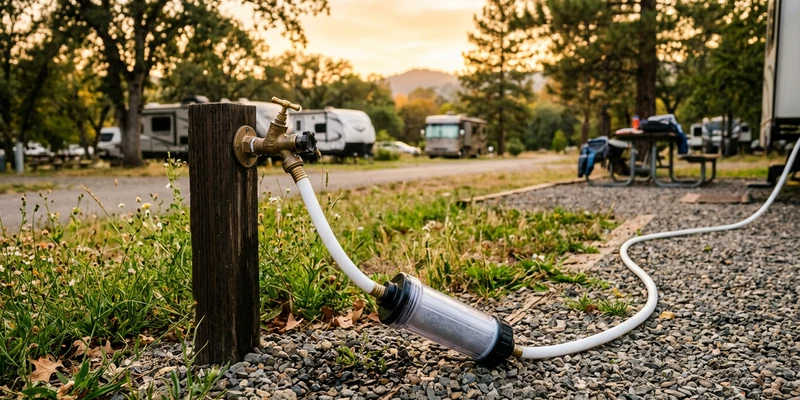
Walk any campground loop and you will see the same blue cylinder screwed onto three quarters of the hoses. It is the default because it works well enough, costs little, and needs no installation at all. Choosing the best RV water filter in this format is less about brand loyalty than about understanding what a carbon cylinder on a hose can realistically do, and what it quietly cannot.
An inline filter targets the two complaints owners have most often: chlorine taste and odor, and the grit that clouds a glass or ends up in the pump strainer. It is not a purifier, it does not control pressure, and it does not last the way the packaging implies once the water gets dirty. This guide covers what to look for, which versions suit which trips, and the two extras that matter far more than upgrading the filter itself.
This article contains affiliate links. If you buy through them, we may earn a commission at no extra cost to you. Learn more.
Quick Answer
Which inline RV water filter should you buy?
- A standard granular carbon inline filter with a flexible hose protector covers most weekend and seasonal camping, addressing chlorine taste, odor, and coarse sediment.
- If you camp for months at a time, a hose mounted cartridge filter costs less over a season because you replace the element instead of the whole unit.
- Buy a pressure regulator at the same time. It protects your plumbing in a way no filter can, and it is the cheaper of the two.
What to Check Before You Buy
Inline filters look almost identical on a shelf, and the differences that matter are printed in small type. These six points separate a good one from a frustrating one.
| What to check | Why it matters | What to look for |
|---|---|---|
| Media type | Granular carbon handles taste and odor; blocks capture finer particles | Granular for general use, a cartridge unit if you want a finer rating |
| Flow rate | Too much restriction shows up as a weak shower | A rating comfortably above what your pump delivers |
| Hose protector | The filter’s weight bends the hose right at the fitting | A flexible protector included, or bought separately |
| Fitting quality | Cheap plastic threads strip and weep at the spigot | Reinforced or brass fittings, and hand tight only |
| Rated capacity | Stated gallons assume clean water, not campground reality | Treat the number as a ceiling, not a promise |
| Storage and freezing | A wet filter left out in a freeze is a cracked filter | Something you can drain, bag, and store indoors easily |
Notice what is absent from that list: pressure. Filters do nothing about it, and campground pedestals vary far more than most owners assume, which is the subject of our guide on how much RV water pressure is too much.
What an Inline Filter Does, and What It Does Not
Carbon media adsorbs the compounds behind chlorine taste and odor, and the housing catches sediment down to whatever the media is rated for, typically a coarse rating in the standard disposable format. In practice that means water that tastes neutral, a shower head that stops collecting grit, and a pump strainer that stays cleaner.
What it is not is a purifier. A basic inline carbon filter is not designed or rated for biological treatment, and no filter substitutes for a known good source. Fill from potable supplies, respect any advisory posted at a park, and treat the filter as taste, odor, and equipment protection. If you want a finer rating on drinking water specifically, that job belongs to a cartridge system or an under sink filter, as covered in our comparison of RV water filter systems.
It also does not clean the tank
A filter on the hose treats water on the way in. Anything already living in a fresh tank that sat over the winter stays exactly where it is, which is why seasonal sanitizing is a separate task, described in our guide to sanitizing an RV fresh water tank.
Our Top Picks at a Glance
How we chose: we compared widely available inline RV filters on media type, flow restriction, fitting durability, realistic service life, and the complaints and compliments that repeat across owner feedback. Our assessment is based on published specifications and that feedback rather than any trial of our own, and the right pick depends mostly on how many weeks a year you are hooked up.
🏆 Best Overall
The standard granular carbon inline filter with a flexible hose protector, the format that became the default for good reason. It screws on in seconds, addresses chlorine taste and coarse sediment, and stores in a drawer. The hose protector is not optional in practice, since without it the filter’s weight puts a permanent kink right at the spigot fitting. Our Camco TastePURE review looks at this one in detail.

🔁 Best for Long Trips
A hose mounted cartridge filter, where the housing stays and only the element is replaced. Over a full season it usually works out cheaper than a string of disposables, the media is generally finer, and there is less to throw away. It is bulkier and needs a spot in the bay, so it suits people who stay hooked up for weeks rather than weekends.

🪨 Best for Sediment Heavy Water
An inline sediment prefilter fitted ahead of your carbon filter. On water that leaves grit in a strainer or discolors a housing within days, the prefilter takes the load and the carbon filter stops choking early. Two cylinders on a hose looks like overkill until you see how much longer the expensive one lasts.

How Long They Actually Last
Rated capacities on inline filters assume reasonably clean water. Campground water frequently is not, and owners consistently report shorter real world life than the packaging suggests, particularly where sediment is heavy or the park is on a well. Judge by symptoms rather than the calendar.
Three signs say the filter is finished: flow drops noticeably at the shower with no other explanation, taste or chlorine odor comes back, or the housing has been sitting warm and unused for weeks. That last one matters, because a damp carbon filter left in the sun between trips is not a filter you want back on the hose. Most owners land on one filter per season for weekend use, and considerably more often when full timing.
When it is not the filter
A weak shower gets blamed on a clogged filter more often than it deserves. Before replacing anything, check the pump, its strainer, and the plumbing, since a failing pump produces the same symptom; common RV water pump issues walks through telling them apart.
Two More Things Worth Buying With It
These two do more for your rig than any filter upgrade, and both are things people buy after learning the hard way.
🛡️ Buy This First
An adjustable brass water pressure regulator with a gauge, fitted at the spigot ahead of the filter. RV plumbing tolerates far less than some campground pedestals deliver, and a split fitting behind a wall is a very expensive way to learn that. The gauge also tells you when a park’s low pressure, not your filter, is the reason the shower is disappointing.

🚿 The Hose Matters Too
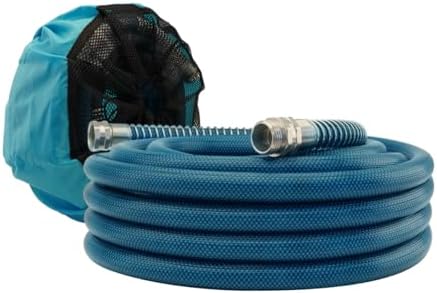
A hose rated for drinking water, kept exclusively for the fresh side. Garden hoses are not made for potable use and give water a distinct plastic taste that no carbon filter fully removes. Keep a second, clearly different hose for tank rinsing and anything on the waste side, and never let the two touch.
Setting It Up and Keeping It Working
Order at the spigot is regulator first, then a sediment prefilter if you use one, then the carbon filter, then the drinking water hose to the rig. That way nothing downstream of the spigot ever sees full pedestal pressure, and the coarse stage protects the fine one.
Hand tighten every fitting; a wrench on plastic threads is how they split. Support the filter so it is not hanging on the spigot, use the hose protector, and flush a new filter for a minute or two before drinking, since carbon fines give the first water a gray tint. That is normal and clears quickly.
Off season handling
Drain the filter, bag it, and store it indoors when the rig sits. A filter full of water in a freeze cracks, and one left damp and warm for months is not worth reusing. The same logic applies to the rest of the plumbing, which is covered in how to keep RV pipes from freezing.
Common Mistakes to Avoid
- Skipping the pressure regulator. The filter protects your taste buds; the regulator protects your plumbing.
- Hanging the filter off the spigot. Without a hose protector, the weight kinks the hose and stresses the fitting.
- Using a garden hose. Not intended for potable use, and it adds a plastic taste the filter is then blamed for.
- Reusing last season’s filter. Cheap to replace, and a damp filter stored warm for months is not a bargain.
- Expecting it to fix tank odor. Smells from a stored fresh tank or the water heater need their own treatment.
- Cranking fittings with a wrench. Hand tight is the spec. Plastic threads split, and then you have a fountain.
Where to Go From Here
If you find yourself replacing disposables every few weeks, you have outgrown the format. A two stage canister setup gives you replaceable cartridges, a finer carbon stage, and better flow over time, and our comparison of RV water filter systems covers what that step up involves.
If the complaint is odor rather than taste, and it is only on the hot side, no filter will touch it. That is a water heater issue and it has its own fix, described in our guide to RV hot water that smells like sulfur.
Frequently Asked Questions
Do inline RV water filters make campground water drinkable? They improve taste, odor, and sediment, but a basic carbon filter is not a purifier and is not rated for biological treatment. Fill from potable sources and follow any advisory posted at the park.
How long does an inline RV water filter last? Rated capacities assume clean water. In practice, judge by flow and taste, and expect roughly a season of weekend use or considerably less when you are hooked up full time.
Which end does the filter go on? At the spigot, after the pressure regulator, with your drinking water hose running from the filter to the rig. That keeps the hose full of filtered water rather than the other way round.
Why is my water gray when I first use a new filter? Carbon fines from a fresh cartridge. Run it for a minute or two before drinking and it clears on its own.
Do I still need a filter if I fill my fresh tank instead of using city water? Yes, and arguably more so. Filtering at the fill point keeps sediment out of the tank and the pump, though it does not clean a tank that is already dirty.
Can I leave the filter connected all winter? No. Drain it and store it indoors. Water left inside cracks the housing in a freeze, and a damp filter stored for months should be replaced anyway.
The Bottom Line
For weekend and seasonal camping, a standard granular carbon inline filter with a hose protector is genuinely enough, and it is the format most owners should start with. Step up to a hose mounted cartridge filter if you stay hooked up for weeks, and add a sediment prefilter where the water is rough. Then spend the rest on a pressure regulator and a proper drinking water hose, because those two protect the rig in ways no filter can.