Last updated: August 14, 2026
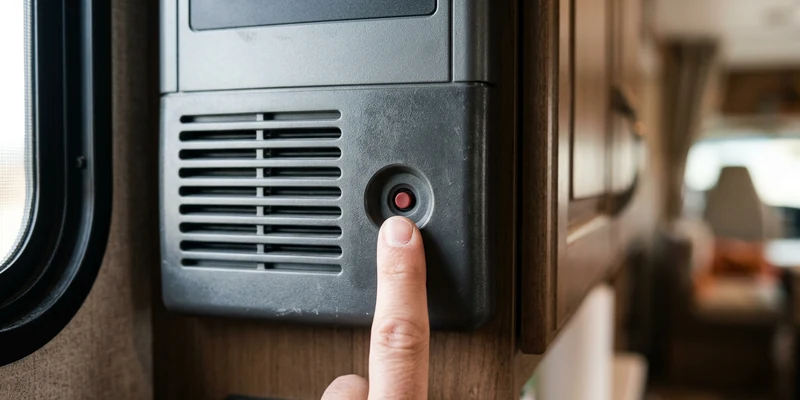
Here is the honest answer up front: most RVs do not have an RV converter reset button at all. Converters are not designed with a reset switch the way a GFCI outlet or a household appliance is. What owners are almost always looking for is one of four other things, and every one of them is easy to find once you know it exists.
Those four are the 120V breaker that feeds the converter, the pair of DC fuses on the converter itself, the battery disconnect switch, and a full power cycle of the whole system. This article shows where each one lives, how to use it, and why a converter that needs resetting twice is telling you something you should not ignore.
This article contains affiliate links. If you buy through them, we may earn a commission at no extra cost to you. Learn more.
Quick Answer
Where is the reset button on an RV converter?
- Most RV converters have no reset button. The closest equivalent is the 120V breaker labeled converter or power center in your distribution panel.
- The other things people mistake for a reset are the pair of DC blade fuses on the converter and the house battery disconnect switch.
- To power cycle properly: unplug shore power, open the battery disconnect, wait a few minutes, then restore the battery first and shore power second.
What People Call a Reset, and Where It Actually Is
Match what you are hoping to find on the left with what your RV actually has. Every item here is accessible without opening anything electrical.
| What you are looking for | Where it actually is | How to use it |
|---|---|---|
| Converter reset button | Does not exist on most units | Use the breaker and fuse checks below instead |
| 120V converter breaker | In the distribution panel, labeled converter or power center | Flip fully off, pause, flip back on, at the handle only |
| DC reverse polarity fuses | On the converter face, a pair of blade fuses | Inspect both, replace only at the rating printed on the unit |
| Battery disconnect switch | Battery compartment, entry step, or a cabinet | Close it, then recheck charging |
| Charge mode button | On some units, a small remote pendant or panel button | Changes charge mode, it does not reset anything |
| Thermal shutdown | Internal, self resetting | Clear the vents and let the unit cool down |
| Full system power cycle | Shore cord plus battery disconnect | Remove both sources, wait, restore battery first |
If none of these restores charging, the diagnosis continues in our hub on RV converter repair.
The 120V Breaker Is the Real Reset
Your RV distribution panel has both AC breakers and DC fuses, usually side by side in the same power center. One of the AC breakers feeds the converter, and it is normally labeled converter, power center, or something similar. That breaker is what people mean when they say they reset the converter.
Flip it fully to off, pause for a moment, then flip it back on. This matters because a tripped breaker frequently sits in a middle position that looks like on, and a half hearted flick does not actually reset it. Do this at the breaker handle only. Removing the panel cover to look behind it is not owner work, and there is nothing behind it you need to see.
The Fuses People Mistake for a Reset
The second thing owners find when they go hunting is a pair of automotive blade fuses mounted on the converter itself. These are reverse polarity protection on the 12V side, commonly rated somewhere in the 30 to 40 amp range depending on the model, with the correct rating printed on the unit.
They do not reset. When they blow, charging stops completely, and they usually go as a pair with no visible drama. A blown fuse can look intact at a glance, so pull each one and inspect the element in good light, or check continuity with a meter. Replace only with the rating on the label, never higher, because that fuse is protecting wiring a larger fuse would happily let overheat. Which fuse does what is covered in the RV converter fuse guide.
Keeping a fuse assortment in the rig turns this from a lost afternoon into a two minute job, and the same fuses cover the water pump, lighting, and slide circuits.

How to Power Cycle the Whole System Properly
Some converters and their charge controllers do behave better after a genuine power cycle, particularly after a surge, a brownout at a busy campground, or a battery swap. The trick is removing both power sources, because leaving either connected means nothing actually resets.
- Unplug the shore cord at the pedestal and switch off the generator if one is running.
- Turn off the inverter if you have one, so it is not backfeeding anything.
- Open the battery disconnect switch, or disconnect the negative cable at the house battery if there is no switch.
- Wait several minutes. This lets capacitors discharge and the control electronics fully drop out.
- Reconnect the battery first, then plug in shore power. Restoring in this order avoids an unnecessary inrush.
- Recheck charging by measuring at the battery terminals, where a working converter usually pushes the reading into roughly the 13.2 to 14.4 volt band.
The measurement side of that last step is spelled out in how to test an RV converter with a multimeter.
Thermal Shutdown Resets Itself
If your converter works, then quits after a while, then works again once the rig cools down, you are seeing thermal protection rather than a fault that needs resetting. Converters shed real heat and depend on a cooling fan with clear airflow, and they are usually mounted somewhere that invites storage.
The fix is space, not a button. Clear anything stacked against or in front of the unit, vacuum dust out of the vents and fan grille, and confirm the fan spins when the converter is working hard. A converter that keeps overheating in a clear, ventilated space has a fan or a control problem worth investigating, and that pattern shows up in our list of RV converter problems.
When a Reset Is the Wrong Answer
Resetting is diagnosis, not repair. Once is reasonable, twice is informative, and beyond that it becomes a habit that hides a real fault. A breaker that trips again straight after you reset it is reporting a problem in that circuit, and the next reset does not fix anything.
Stop entirely and call a certified RV technician or a licensed electrician if the breaker trips repeatedly, if you smell hot plastic, if you see discolored or melted insulation or scorch marks near the unit, or if the converter is too hot to touch. Unplug the shore cord first. And keep the boundary clear on the work itself: replacing DC fuses, closing a disconnect switch, and flipping a breaker at the handle are owner tasks, while anything inside the distribution panel, any AC wiring, breaker replacement, and converter installation is technician work. Repeated trips are covered further in why RV breakers trip at the pedestal.
If Nothing Resets It
When the breaker holds, the fuses are good, the disconnect is closed, the vents are clear, and a full power cycle changes nothing, the converter has most likely failed. These units are replaced rather than repaired, since the internals are not user serviceable and board level diagnosis is rarely worth the labor.
Before ordering, note the output amperage from the existing label, measure the opening if yours is a deck that slides into a power center, and confirm whether your batteries need a lead acid or lithium charge profile. Progressive Dynamics and WFCO are the brands most commonly fitted in North American RVs, and both offer multi stage replacements in the amperage ranges factories typically install.

Common Mistakes to Avoid
- Flicking the breaker halfway. A tripped breaker needs to go fully off before it will reset.
- Judging a fuse by looking at it. Pull it and inspect the element, or check continuity.
- Leaving shore power connected during a power cycle. Both sources have to come off or nothing resets.
- Repeated resets as a routine. A circuit that keeps tripping is a fault report, not an inconvenience.
- Confusing a charge mode button with a reset. Some units have a pendant that selects charge modes, which does not clear anything.
- Opening the AC panel to look for a hidden button. There is not one, and the risk is real.
Frequently Asked Questions
Does an RV converter have a reset button? Most do not. The practical equivalent is the 120V breaker labeled converter in your distribution panel, along with the pair of DC fuses mounted on the converter itself.
Where is the RV converter located? Usually in or beside the distribution panel, often under a dinette bench, in a bottom cabinet, or in an exterior bay. Follow the 12V fuse panel and you will normally find it in the same assembly.
How do I reset my RV electrical system? Unplug shore power, switch off the generator and inverter, open the battery disconnect, wait several minutes, then reconnect the battery first and shore power second.
Why does my converter breaker keep tripping? Repeated tripping means a fault on that circuit, such as a short, an overload, or a failing converter. It is a signal to stop resetting and get it inspected rather than to keep flipping the handle.
Can I reset the converter to fix a battery that will not charge? Sometimes a power cycle clears a stuck charge controller, but if charging does not return, the cause is elsewhere. Work through the not charging checklist instead.
The Bottom Line
There is usually no reset button to find. Use the 120V breaker labeled converter, inspect the pair of DC fuses on the unit, confirm the battery disconnect is closed, and if you want a genuine reset, remove both shore power and battery for a few minutes before restoring the battery first. One reset is diagnosis, repeated resets hide a fault, and anything involving the AC panel or a burning smell belongs to a certified RV technician.