Last updated: August 14, 2026
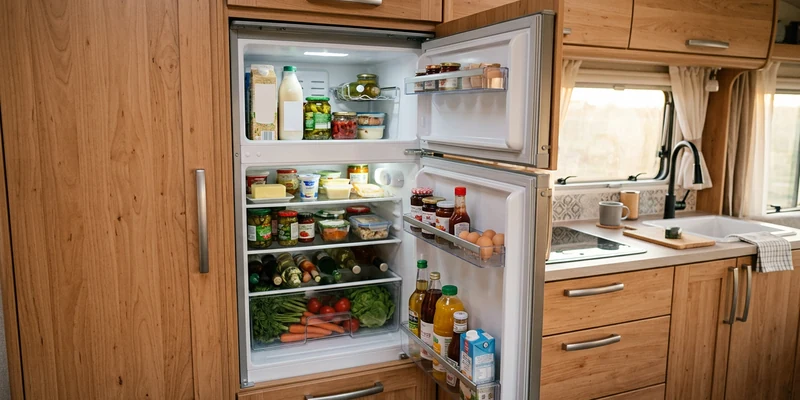
The RV 12V refrigerator has quietly become the default in new trailers, and owners of older rigs are following. A DC compressor fridge behaves like the one in your kitchen: it cools fast, it holds temperature in hot weather, it does not care whether you parked on a slope, and it takes propane out of the equation entirely. For anyone who has spent a summer nursing an absorption unit through hot afternoons, that alone sells it.
The catch is that you are trading a propane problem for a power problem. A 12V fridge runs on the house battery around the clock, so the appliance is only half the purchase. This guide covers what actually separates one 12V refrigerator from another, how much battery and solar you realistically need behind it, and which format fits a full replacement, a retrofit into an old absorption cutout, or a portable setup.
This article contains affiliate links. If you buy through them, we may earn a commission at no extra cost to you. Learn more.
Quick Answer
Which 12V RV refrigerator should you buy?
- For a full replacement, a two door 12V compressor upright sized to your existing cutout is the straightforward choice, since it cools properly in heat and tolerates off level parking.
- Measure the cutout opening, the door swing, and the vent path before you shop. Capacity in cubic feet is the last thing to worry about, not the first.
- Budget for the power side at the same time. Most owners find a 12V fridge needs meaningful battery capacity plus solar or a decent charging setup before it works off grid.
What to Check Before You Buy
These six points decide whether the refrigerator fits your rig and your power system. Every one of them causes returns when it gets skipped.
| What to check | Why it matters | What to look for |
|---|---|---|
| Cutout dimensions | A retrofit has to drop into the old absorption opening | Measure height, width, and depth of the cabinet opening, not the old fridge |
| Daily power use | This is the real cost of a 12V fridge | A published daily amp hour figure, and treat it as a best case in mild weather |
| Voltage support | Some run DC only, others accept 120V as well | Dual voltage if you spend time on shore power without a large inverter |
| Door configuration | Swing direction and latches matter in a narrow aisle | Reversible doors and a travel latch that actually holds on rough roads |
| Ventilation | A compressor still rejects heat and needs air behind it | Clearance per the manual, and a plan for the old absorption vents |
| Low voltage cutoff | Protects the battery, but can shut the fridge off overnight | An adjustable cutoff so you can match it to lithium or lead acid |
Capacity is deliberately absent from that list. Almost every rig ends up with whatever fits the opening, and a fridge that is two cubic feet larger is no use if the door will not clear the dinette.
How a 12V Fridge Differs From an Absorption Unit
An absorption refrigerator boils a fluid mixture using a propane flame or an electric element, with no moving parts in the cooling circuit. It is quiet and it runs on gas off grid, but it wants level parking, it needs a working vent stack, and it loses ground on hot afternoons because it can only reject heat by convection.
A 12V compressor fridge uses a DC motor and a sealed refrigerant loop, exactly like a household unit. It pulls down quickly, holds temperature when it is hot outside, works at any reasonable parking angle, and takes a combustion appliance out of your coach. In exchange it draws current continuously, and it stops working when the house battery gets low, which is a failure mode absorption owners never had to think about. The full comparison of both types sits in our guide to an RV refrigerator not cooling.
What it actually draws
Consumption varies with ambient temperature, how often the doors open, and how well the compartment is vented, so treat any single number with suspicion. Owners of full size 12V RV refrigerators commonly report daily consumption in the range of roughly 40 to 70 amp hours in warm weather, less in mild conditions. That is the figure to plan your battery bank around, not the compressor rating.
Our Top Picks at a Glance
How we chose: we compared widely available 12V RV refrigerators on cutout compatibility, published daily consumption, voltage support, door and latch design, and the complaints and compliments that repeat across owner feedback. Our assessment is based on published specifications and that feedback rather than any trial of our own, so verify the exact dimensions against your own cabinet before ordering.
🏆 Best Overall
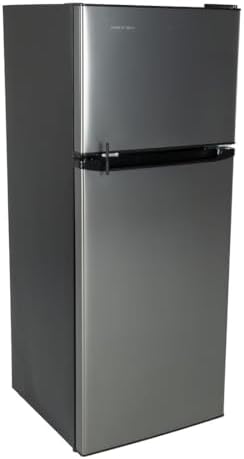
A two door 12V compressor upright in the roughly 10 to 12 cubic foot class, the format most new trailers now ship with. It cools quickly, holds temperature through hot afternoons, and needs no leveling discipline at all. Confirm the cutout dimensions and the door swing against your cabinet before you commit.
🔁 Best for Replacing an Absorption Fridge
A 12V compressor model sized specifically to drop into a standard absorption cutout, which saves you rebuilding the cabinet. Owners doing this swap usually keep the old exterior vents for airflow and add a fused DC feed sized to the run. Good travel latches matter here, since these get loaded and driven hard.

🧊 Best Portable Option
A portable 12V compressor cooler for van builds, truck campers, and anyone who wants a second cold box for drinks and overflow. It runs from a socket, moves between vehicles, and doubles as a freezer, which makes it the flexible choice rather than a permanent install.

The Power System Is Half the Purchase
This is where 12V refrigerator projects go wrong. A single group 24 lead acid battery does not comfortably run a full size 12V fridge overnight, because usable capacity on lead acid is roughly half of the rated capacity before you start damaging it. Owners who add a compressor fridge to an unchanged stock electrical system tend to discover this on the second night out.
The combination that works for most people is lithium capacity plus enough solar to replace what the fridge takes each day, or regular driving with a decent DC to DC charger. Our walkthrough on switching an RV to lithium batteries covers the converter and charging side, and how much solar an RV actually needs puts the daily numbers together.
🔋 Buy This With It
A 100 amp hour lithium iron phosphate house battery, or a second one if you already have capacity, since usable capacity rather than rated capacity is what keeps a compressor fridge running overnight. Check your converter or charger is lithium compatible before adding one.

📟 Stop Guessing at State of Charge
A shunt based battery monitor, which shows actual amps in and out and real state of charge rather than the vague idiot light on the wall panel. It is the single most useful instrument for anyone running a 12V fridge off grid.

Installing It Without Regret
The mechanical side is manageable for a competent owner and the electrical side has rules worth respecting. A full size 12V fridge is a continuous load at meaningful current, so it needs its own appropriately sized and fused feed, wire gauge chosen for the length of the run rather than whatever was already there, and clean, tight terminations. Disconnect the battery before you start and keep the circuit fused close to the source.
Mechanically, secure the cabinet properly for travel, keep the manufacturer’s clearances at the back and sides, and think about the old absorption vents. Most owners leave them in place, since the compressor and condenser still shed heat and that stack is already there. Do not seal the compartment up tight.
Where a technician earns their fee
If your swap involves removing a propane fed appliance, have the gas line to the old refrigerator capped and leak tested by a certified RV technician. That is not a fitting to leave dangling behind a cabinet, and it is not owner work. Any 120V wiring for a dual voltage model or an inverter circuit is technician territory as well, while 12V accessory wiring is reasonable to do yourself with the battery disconnected.
Who Should Skip the Swap
A 12V refrigerator is not automatically the right answer. If you camp almost entirely with shore power hookups and your absorption fridge is working, the upgrade buys you convenience rather than capability, and the money is often better spent elsewhere.
It also gets awkward if you boondock in cold, dark conditions where solar barely produces, since the fridge keeps drawing regardless of the weather. And if your current fridge only misbehaves in hot weather or after an off level night, you may be looking at an airflow or leveling issue rather than a failed appliance, as covered in a fridge that cools on electric but not propane and in our summer heat guide.
Common Mistakes to Avoid
- Measuring the old fridge instead of the opening. The cabinet cutout is what has to accept the new unit.
- Adding a compressor fridge to a stock lead acid setup. Usable capacity, not rated capacity, decides whether it survives the night.
- Undersizing the wire and fuse. This is a continuous load on a long run, and voltage drop shows up as nuisance shutdowns.
- Sealing up the old vents. A compressor still rejects heat and the compartment needs airflow.
- Leaving a capped propane line to chance. Have it capped and leak tested by a certified RV technician.
- Ignoring the low voltage cutoff setting. Set for lead acid on a lithium bank, it can shut the fridge off long before the battery is actually low.
Frequently Asked Questions
How much power does a 12V RV refrigerator use? It depends heavily on outside temperature and door openings, but owners of full size units commonly report roughly 40 to 70 amp hours per day in warm weather. Plan your battery bank around the daily figure rather than the compressor rating.
Can I run a 12V fridge on a single lead acid battery? Not comfortably overnight. Usable capacity on lead acid is roughly half the rated figure, which is why most owners pair a compressor fridge with lithium capacity and solar.
Will a 12V fridge fit where my absorption fridge was? Often yes, since several models are sized for standard cutouts, but measure the opening height, width, and depth yourself before ordering.
Do 12V refrigerators need to be level? No, and that freedom is one of the main reasons owners switch. Compressor units tolerate the kind of parking that stalls an absorption fridge.
Are they noisy? There is a compressor, so there is sound, usually described as similar to a household fridge cycling. Absorption units are silent by comparison, which is the one comfort trade you make.
What happens to the propane line? It should be capped and leak tested by a certified RV technician as part of the swap. Do not leave it capped by improvisation behind the cabinet.
The Bottom Line
A two door 12V compressor upright sized to your existing cutout is the right pick for most owners replacing an aging absorption fridge, with a portable compressor cooler as the flexible option for vans and truck campers. Measure the cabinet opening, the door swing, and the vent path before capacity ever enters the conversation. Then budget for the power system in the same breath, because a compressor fridge lives on the house battery and usually needs lithium capacity plus solar to work off grid.