Last updated: August 14, 2026
The RV water heater anode rod is a bar of reactive metal that corrodes on purpose so your tank does not. It is finished when it has thinned to roughly a quarter of its original diameter, when the steel core wire is exposed along any part of its length, or when it has broken into segments. Most owners get somewhere between one and three years out of a rod, and the honest answer to how often you should look at it is once a year, at the same time you flush the tank.
This guide is about the why and the when: what the rod does, how far gone it is allowed to be, what shortens its life, and how magnesium and aluminum zinc rods differ once they are in the water. The physical swap is covered separately in how to replace an RV water heater anode rod, and thread and length questions live in our guide to Suburban anode rod size and fit.
This article contains affiliate links. If you buy through them, we may earn a commission at no extra cost to you. Learn more.
Quick Answer
When should you replace an RV water heater anode rod?
- Pull and inspect it once a season. Replace it once it is down to about a quarter of its original thickness, once the bare steel core wire shows, or once it has snapped into pieces.
- Magnesium rods protect harder and wear faster. Aluminum zinc rods usually last longer and are the common choice where sulfur smell keeps coming back.
- Only steel tanks such as Suburban have a rod at all. An aluminum Atwood or Dometic tank is built without one and should never have one fitted.
- Never open a water heater that is hot or still under pressure. Switch it off, let it cool, open a hot faucet, and lift the relief valve lever first.
Reading a Used Anode Rod at a Glance
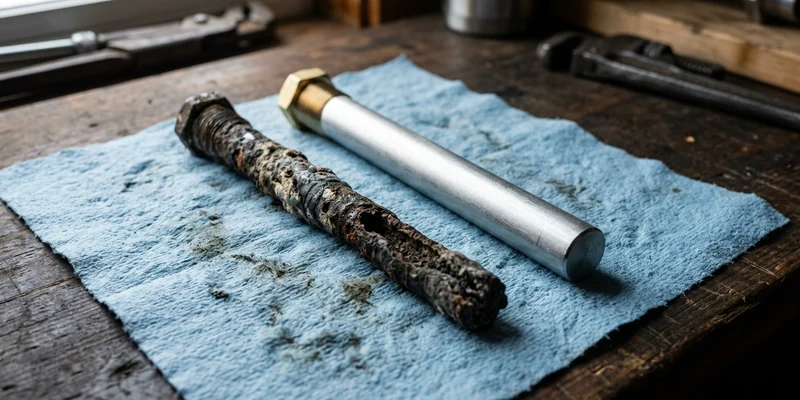
Pull the rod out, wipe it off, and compare it to a new one. The condition tells you everything about timing, and it also tells you something about your water. Find the description that matches what you are holding.
| What the rod looks like | What it means | What to do |
|---|---|---|
| Full diameter, lightly dulled surface | Barely used, the tank is well protected | Clean the threads, refit with fresh tape, check again next season |
| Evenly reduced, still well over half its original thickness | Normal wear for a season or two of use | Refit and plan to replace it at the next inspection |
| Pitted and lumpy, roughly half gone | Working hard, often a sign of aggressive water | Replace it now rather than gambling on another season |
| Down to about a quarter of its diameter | End of useful life, protection is dropping fast | Replace it, and shorten your inspection interval |
| Thin steel core wire visible anywhere | Spent, the tank is now unprotected at that point | Replace immediately and inspect the tank interior while it is open |
| Broken into chunks or came out in pieces | It was left in far too long | Fish the loose pieces out during the flush, then fit a new rod |
| Coated in a hard white crust | Heavy scale, common with hard water | Flush thoroughly, then consider filtering your fill water |
| Nearly untouched but the water smells of sulfur | Magnesium reacting with bacteria in the water | Sanitize the system, then consider an aluminum zinc rod |
| Rod is missing entirely | Either a previous owner left it out, or you have an aluminum tank | Identify the tank before buying anything |
If sulfur odor is what brought you here rather than maintenance, the chemistry and the fix are covered in why your RV hot water smells like sulfur.
What the Anode Rod Actually Does
It corrodes instead of the tank. In a steel tank full of water, the more reactive metal gives up its electrons first, so a rod of magnesium or aluminum alloy takes the corrosion that would otherwise attack the tank wall wherever the protective lining is thin or chipped. That is why it is called a sacrificial anode, and why a rod that looks ruined has been doing its job perfectly.
In a Suburban style RV water heater the rod does double duty: it threads into the low port on the side of the tank and also serves as the drain plug. That is convenient, because it means every tank flush already involves removing the rod, and inspecting it costs you nothing extra.
Why a spent rod matters more in an RV than at home
A residential tank sits in a basement where a slow weep gets noticed. An RV tank sits behind an exterior access door, above a floor and next to wall cavities, and it travels. Once the tank starts to leak there is no repair, only replacement of the appliance, and the water usually finds the structure before it finds the ground. A rod is one of the cheapest parts on the rig and it is the only thing standing between hard water and a steel tank.
How Often to Check It
Once a year is the baseline that technicians commonly recommend, usually as part of spring commissioning or fall winterizing, since the tank has to be drained for both. Twice a year is the sensible interval for full timers, for anyone whose rod came out badly worn last time, or for anyone who fills from a lot of different sources.
Tie the inspection to something you already do. Draining the water heater is a required step before storage in freezing weather anyway, so the rod is already in your hand at that point. Owners who never build the habit tend to discover the rod at the moment the tank starts weeping, which is the expensive version of the same information.
What Eats a Rod Faster Than Normal
Rod life is mostly about water, not about the rod. Four factors explain nearly all of the variation between one owner getting three years and another getting eight months out of the same part.
- Water chemistry. High mineral content, high chloride content, and softened water all accelerate the reaction. Owners who camp mainly in hard water regions consistently report shorter rod life.
- How much you actually use it. A weekend rig that heats water twenty days a year will not consume a rod the way a full time coach does.
- Temperature. Hotter water speeds up every electrochemical reaction in the tank, the sacrificial one included.
- Sediment. A layer of scale and grit in the bottom of the tank holds water against the steel and gives corrosion somewhere to concentrate, which is a large part of why flushing matters as much as the rod does.
None of that is a reason to skip the rod. It is a reason to look at yours rather than to trust a calendar interval you read somewhere.
Magnesium vs Aluminum Zinc Anode Rods
Both protect the tank. They differ in how aggressively they do it, how long they last, and what they do to the smell of your hot water. Neither one is wrong, and plenty of owners switch back and forth over the life of a rig.
| Consideration | Magnesium | Aluminum zinc |
|---|---|---|
| Protection strength | Strongest, most reactive | Slightly less aggressive but adequate |
| Typical service life | Shorter, wears visibly faster | Longer in the same water |
| Sulfur odor | Most associated with the rotten egg smell | Owners frequently report the smell easing after switching |
| Hard water performance | Consumed quickly | Usually the better match |
| Soft or softened water | Can be consumed very fast | Generally holds up better |
| What it is usually made of | Magnesium alloy on a steel core wire | Aluminum with a small zinc content on a steel core |
The practical rule most owners land on: start with magnesium because it is the default and it protects hardest, and switch to aluminum zinc if the rod keeps disappearing in under a year or if hot water smells of sulfur no matter how often you sanitize. Whichever you buy, the thread and the length have to match your heater, which is the part people get wrong.
🔩 The default replacement rod
A magnesium anode rod with the 3/4 inch NPT thread used on Suburban style steel tanks. This is the standard choice for owners who want maximum tank protection and are willing to inspect it every season. Confirm the length against your old rod before ordering.

🧪 When the smell keeps coming back
An aluminum zinc anode rod in the same 3/4 inch NPT thread. It is the rod owners switch to when magnesium keeps producing sulfur odor or vanishes in a single season of hard water.

📦 If you would rather not do this twice
A two pack or a rod supplied with thread sealing tape, so the spare is already in the rig when next season’s inspection goes the wrong way. Cheap insurance for anyone who travels far from an RV parts counter.

Only Steel Tanks Have a Rod at All
Before you buy anything, find out which tank you own. Suburban water heaters use a porcelain lined steel tank and need a sacrificial rod. Atwood units, now sold under the Dometic name, use an aluminum tank clad in steel and are designed without one; they drain through a plastic plug instead.
Fitting a rod into an aluminum tank is not an upgrade. The tank is not the metal the rod is designed to protect, and manufacturers do not specify one. Check the label inside the exterior access door or the model number in your manual, and if you are still unsure, our Suburban anode rod fitment guide walks through telling the two apart and matching thread and length.
What Happens If You Never Replace It
Nothing, for a while, and then something permanent. Once the rod is consumed, the corrosion that was attacking it moves to the next available steel, which is the tank itself, concentrating at any spot where the porcelain lining is chipped or thin.
The progression is usually quiet. Owners notice rusty flecks in the hot water, then a damp patch inside the compartment, then a steady drip that only appears when the system is pressurized. By then the tank is compromised, and RV water heater tanks are not repairable. A patched or sealed tank fails again under pressure, so the appliance gets replaced instead. That is the whole argument for a part you can inspect in fifteen minutes.
Where This Stops Being a DIY Job
Inspecting and replacing a rod is owner territory. The rest of this appliance is not, and the boundary is worth stating plainly.
- Never open a hot or pressurized tank. Switch the heater off on both gas and electric, let it cool for several hours, shut off the water supply, open a hot faucet inside until it stops flowing, and lift the pressure relief valve lever. Water at operating temperature will scald you the instant the plug moves.
- Anything on the propane side. We do not publish instructions for gas lines, regulators, gas valves, burner tubes, orifices, or burner adjustment, because those are the components where a mistake becomes a fire or a carbon monoxide problem rather than a leak. Describe the symptom to a certified RV technician and let them work on it.
- Anything on the 120 volt side. Heating elements, thermostats, wiring, and breaker work belong to a certified technician in most rigs.
- A weeping tank body. Water coming from the tank rather than a fitting means the tank is finished. Replacement of the appliance is the only real option.
- A relief valve that drips constantly. That points at pressure or thermostat behavior rather than a bad valve, and it should be diagnosed rather than capped.
Stop immediately and call for help if you smell gas, if a carbon monoxide alarm sounds, or if you see soot, scorch marks, or a yellow or lifting flame at the burner. Shut the appliance off, close the valve at the propane cylinder, ventilate, get everyone outside, and have a certified RV technician inspect it. Every coach with a combustion appliance should carry a working carbon monoxide alarm, and the expiration date is printed on the back of the unit, so check it at the start of each season.
Common Mistakes to Avoid
- Buying a rod before identifying the tank. Aluminum Atwood and Dometic tanks take a drain plug, not an anode.
- Judging the rod through the drain opening. It has to come out to be assessed. The part that wears most is not the part you can see.
- Replacing the rod without flushing. Sediment in the bottom of the tank is half the problem, and a rinse wand removes what gravity leaves behind.
- Reusing old thread tape. Fresh tape on clean threads is the difference between a dry compartment and a slow drip you find in a month.
- Overtightening to stop a leak. The port is easier to damage than most people expect. Leaks at the rod are almost always a sealing problem, not a torque problem.
- Powering an electric element on an empty tank. A dry element burns out in seconds. Refill and purge the air before you restore heat.
Where to Go From Here
If you have decided the rod needs to come out, the full procedure with draining, socket size, and refilling is in how to replace an RV water heater anode rod. If you are not certain which rod fits, start with Suburban anode rod size and fit.
If you are weighing whether to keep maintaining a tank at all, our comparison of tankless and tank water heaters lays out what changes, including the fact that a tankless unit trades the anode rod for a descaling routine. And since the tank has to be drained for winter anyway, pair this job with keeping RV pipes from freezing.
Frequently Asked Questions
How often should an RV water heater anode rod be replaced? Inspect it once a season and replace it when it is down to roughly a quarter of its original diameter or the core wire is exposed. Owners commonly report one to three years of life, with water chemistry making most of the difference.
How worn is too worn? If you can see the thin steel core wire anywhere along the rod, or the rod has broken into segments, it has stopped protecting the tank at that point and should be replaced right away.
Is magnesium or aluminum zinc better for an RV? Magnesium protects most strongly but wears faster and is most associated with sulfur odor. Aluminum zinc usually lasts longer and is the common switch for owners fighting recurring smell or very hard water.
Does every RV water heater have an anode rod? No. Steel tanks such as Suburban do. Aluminum Atwood and Dometic tanks are built without one and use a plastic drain plug, and a rod should not be fitted to them.
What happens if I leave the old rod in too long? Once the rod is consumed, corrosion attacks the steel tank instead. That shows up as rusty water and eventually a leaking tank, and RV water heater tanks are replaced rather than repaired.
Can I check the anode rod without draining the tank? No. On a Suburban style heater the rod is the drain plug, so removing it drains the tank by definition. Always let the heater cool and release the pressure first.
The Bottom Line
The anode rod is the cheapest insurance policy on your rig, and the only way to use it is to look at it. Pull it once a season while you flush the tank, replace it once it is down to about a quarter of its original thickness or the core wire shows, and choose aluminum zinc instead of magnesium if the rod keeps vanishing or the hot water smells of sulfur. Confirm you have a steel tank before you buy, never open the heater while it is hot or pressurized, and leave everything on the gas and 120 volt side to a certified RV technician.
Check your rod against the table