Last updated: August 14, 2026
An inverter that beeps at you during a movie, clicks off when the coffee maker kicks on, or refuses to power the same outlet it powered yesterday feels like a failed component. It usually is not. Most RV inverter problems trace back to the battery bank and the heavy cables between the battery and the inverter, and the beeping is the unit telling you so in the only language it has.
That is good news, because the checks that solve the majority of these faults cost nothing. This guide works through the symptoms in the order a technician would: read the alarm, find out what the battery is really doing under load, rule out heat and overload, and only then decide whether the inverter itself is finished. It also marks the point where the job crosses onto the 120 volt side, which belongs to a certified RV technician rather than a weekend in the driveway.
This article contains affiliate links. If you buy through them, we may earn a commission at no extra cost to you. Learn more.
Quick Answer
Why does an RV inverter beep and shut down?
- Most beeping is a low battery voltage alarm. Typical 12 volt units warn somewhere in the 10.5 to 11 volt range and shut down shortly below that to protect the bank.
- If the battery reads healthy at rest but the alarm still fires the moment a load starts, suspect voltage drop in undersized, overlong, loose, or corroded DC cables rather than a bad inverter.
- A sudden shutdown with no warning beep under a heavy load usually means overload or an over temperature trip. Both clear on their own once the cause is removed.
Symptoms, Likely Causes, and What to Check First
Inverters communicate through a small vocabulary of beeps, blinks, and shutdowns, and each pattern points at a different part of the system. Read your symptom in this table before you touch anything, because the wrong first move (usually ordering a replacement) is also the most expensive one.
| What the inverter does | What it usually means | What to check first |
|---|---|---|
| Slow intermittent beep, still running | Low voltage warning, bank is getting low | State of charge, then whether anything is actually charging |
| Steady beep, then shutdown | Low voltage cutoff reached | Resting battery voltage, cable size, terminal corrosion |
| Quits only when the microwave or kettle starts | Surge demand above the unit’s rating | Continuous and surge watt ratings against the appliance |
| Runs fine, then quits after roughly half an hour | Over temperature trip | Cooling fan, clearance around the case, bay temperature |
| Powered on and fan running, no output | Remote switch off, GFCI on the inverter tripped, transfer relay not switching | Inverter’s own GFCI outlet, remote panel, output breaker |
| Completely dead, no display | Blown main DC fuse or open battery disconnect | Inverter fuse, disconnect switch, battery terminals |
| Appliances buzz, sensitive gear misbehaves | Modified sine wave output | Waveform type on the unit’s label |
| Trips the shore power breaker when you plug in | A fault on the 120 volt side | Stop and call a certified RV technician |
Start With the Checks That Cost Nothing
Before any parts get involved, spend ten minutes on the free diagnostics. In practice these resolve a large share of the complaints that reach RV forums, and they cost only a multimeter and a wrench.
Measure resting battery voltage with everything off. A healthy 12 volt lead acid bank usually reads around 12.6 to 12.8 volts at rest, sits near 12.0 to 12.2 volts at roughly half discharged, and is deeply drawn down below about 11.9 volts. A lithium iron phosphate bank behaves differently, holding somewhere near 13.2 to 13.4 volts across most of its usable range and then dropping quickly at the end. Then check the obvious mechanical items: battery terminals clean and tight, the main inverter fuse intact, the battery disconnect closed, and the inverter’s own on/off switch or remote panel actually on. Loose terminals and a corroded ground are the two findings technicians mention most often, and both mimic a failing inverter perfectly.
Low Voltage Alarms on a Battery That Reads Fine
This is the classic. The battery shows healthy voltage at rest, then the inverter alarms within seconds of a real load. The inverter is not lying, it simply measures voltage at its own terminals rather than at the battery.
Why the voltage collapses at the inverter
Inverters draw enormous current on the DC side. A rough working figure is watts divided by roughly ten to twelve to get amps at 12 volts, so a 1000 watt load pulls something in the region of 85 to 100 amps. Push that through cable that is too thin, too long, or joined by a corroded lug, and a meaningful part of the battery voltage disappears as heat in the wire before it ever reaches the inverter. The unit sees ten and a half volts, alarms, and shuts down while the battery itself is still half full.
How to confirm it in two minutes
Put the meter on the battery posts and have someone start the load, then move the meter to the inverter’s own DC terminals under the same load. A small difference is normal. A gap of several tenths of a volt, or worse, means the cabling is the problem. Warm or discolored cable ends confirm it. The fix is shorter, thicker cable with properly crimped lugs, kept as close to the battery as the layout allows.
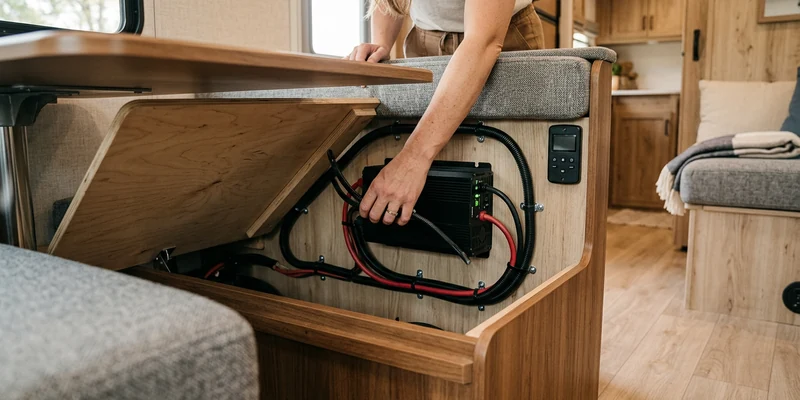
If your cable run is the weak link, a matched cable set sized for your inverter, with the correct lug size and an inline fuse holder, is the part that solves it.

Overload and Over Temperature Shutdowns
These two look identical from the couch, and the difference is timing. Overload trips instantly when a big appliance starts. Over temperature trips after the unit has been working for a while.
Overload
Inverters carry two numbers, continuous watts and surge watts. Motors and compressors, meaning air conditioners, residential refrigerators, and power tools, draw several times their running wattage for the first fraction of a second. A microwave rated at a certain cooking wattage draws considerably more from the wall than its cooking figure suggests, which surprises a lot of owners. Add up what is genuinely running at once, compare it to the continuous rating, and remember that running near the ceiling all evening is what cooks an inverter over a season. Running rooftop air conditioning off an inverter is a separate project with its own battery math, covered in our guide to running an RV air conditioner on batteries and solar.
Over temperature
Inverters lose roughly ten to fifteen percent of the energy passing through them as heat, and that heat has to go somewhere. Units bolted into a sealed cabinet, buried behind storage bins, or mounted in a bay that bakes in afternoon sun will trip their thermal protection long before they reach their rated output. Check that the fan spins freely and is not choked with dust, clear the manufacturer’s recommended air space on all sides, and treat a hot bay as a real design problem rather than bad luck.
Powered On, But No Power at the Outlet
When the display lights up and the fan runs but nothing works, the fault is almost always downstream of the inverter rather than inside it. Work through the chain in order.
- The inverter’s own GFCI. Many units have a GFCI receptacle on the case. If it tripped, everything fed from it is dead. Press reset.
- The remote panel. A remote switch left off, or a damaged remote cable, keeps the output side asleep even though the unit is powered.
- The output breaker. Hardwired installations feed a small subpanel or a group of outlets through a breaker that can trip like any other.
- The transfer switch or relay. On inverter/charger units, a relay decides whether outlets get shore power or inverter power. A stuck relay leaves the outlets connected to a shore cord that is not plugged in.
- The wrong outlets. In many coaches only a few receptacles are wired to the inverter. The rest stay dead by design.
Modified sine wave output causes a different class of complaint: appliances that technically run but buzz, motors that hum louder, and some electronics, chargers, and medical devices that refuse to cooperate. That is not a fault, it is the waveform. Our explainer on what an RV inverter actually does covers the difference between waveform types in plain terms.
When the Inverter Really Has Failed
Genuine inverter failure does exist, and it has a recognizable signature: no output with confirmed good battery voltage at the inverter terminals, a burnt electrical smell, visible scorching, a fan that never spins, or an error code the manual maps to an internal fault. Repeated shutdowns that persist after cabling, load, and cooling have all been ruled out point the same way.
Repair beyond fuses and connections is rarely practical on consumer units. Boards are potted, parts are unlabeled, and the high capacitance inside holds a charge after disconnection. If your unit is under warranty, that path is the sensible one. Beyond it, replacement is the normal answer, and it is the moment to correct the original sizing rather than repeat it: match the continuous rating to what you actually run at the same time, and choose pure sine wave if anything sensitive lives in the coach.
Owners upgrading at this point typically move to a pure sine wave unit in the 1000 to 2000 watt range, which covers laptops, televisions, coffee makers, and small kitchen appliances without living at the edge of its rating.

If you are still deciding between capacities, our roundup of the best RV inverters for everyday off-grid power breaks the sizes down by what people actually run, and there is a dedicated look at the 2000 watt class for bigger loads.
Where This Stops Being a DIY Job
The dividing line is voltage, and it is not a soft line. The 12 volt side is normal owner territory as long as you take the standard precautions: open the battery disconnect, pull the main inverter fuse before touching cable ends, remove rings and watches, and use insulated tools around battery posts.
The 120 volt side is not. Hardwiring an inverter into the coach’s AC distribution, adding or moving a transfer switch, changing neutral to ground bonding, and any work at the breaker panel or the shore power inlet belongs to a certified RV technician. Two symptoms in particular mean you stop immediately and call one: a breaker at the campground pedestal that trips when you plug in, and any tingle felt when touching the coach body. Both suggest a fault that can injure someone, and neither is a wiring puzzle to solve by trial and error.
Common Mistakes to Avoid
- Replacing the inverter before measuring under load. A voltage reading taken with everything switched off tells you almost nothing about why the unit alarms.
- Blaming the battery for a cable problem. New batteries fitted to old, undersized cable produce exactly the same low voltage alarm.
- Sizing by peak demand. An inverter chosen to just barely survive the microwave will spend its life near its limit and fail early.
- Mounting it where it cannot breathe. A sealed cabinet or a sun-facing bay guarantees thermal shutdowns in summer.
- Installing the inverter in a compartment with vented flooded batteries. Flooded lead acid batteries release hydrogen, and inverters contain relays that spark.
- Leaving it switched on all the time. Idle draw is small but constant, and over a week in storage it will flatten a bank by itself.
Frequently Asked Questions
Why does my RV inverter beep when the battery is charged? Because it measures voltage at its own terminals, not at the battery. Undersized or corroded DC cable drops enough voltage under load to trigger the alarm while the battery is still well charged.
At what voltage does an RV inverter shut off? Most 12 volt units warn somewhere around 10.5 to 11 volts and cut off shortly below that. Your manual gives the exact figures, and some units let you adjust them.
Can I fix an RV inverter myself? You can fix the things that cause most faults: fuses, cable ends, terminals, cooling, and load management. Internal board repair is not a home job, and any hardwired 120 volt work belongs to a certified RV technician.
Does an inverter drain the battery when nothing is plugged in? Yes. Switched on with no load, an inverter still consumes a small amount continuously, which adds up over days. Switch it off when you are not using it, especially in storage.
Why does my inverter shut down when the microwave starts? Startup surge. Microwaves and motor-driven appliances briefly demand far more than their running wattage, and if that exceeds the surge rating the inverter protects itself by shutting down.
Is my problem the inverter or the converter? If the complaint is about outlets going dead off shore power, it is the inverter. If the battery is not charging while plugged in, it is the converter. Our comparison of the inverter versus the converter sorts out which one owns which symptom.
The Bottom Line
Beeping and shutdowns are almost always a voltage message rather than a death notice, so measure at the inverter terminals under real load before you buy anything. Cable size, terminal corrosion, cooling, and honest load math resolve most complaints, and only a confirmed no-output condition with good voltage at the terminals justifies replacement. Keep the 120 volt side, hardwiring and transfer switches included, in the hands of a certified RV technician.