Last updated: August 14, 2026
The 2000 watt RV inverter is the size most owners end up at, and for good reason. It is the first class that comfortably covers a microwave or a drip coffee maker, and it is the last class that installs without rethinking the entire electrical system. Above it, the cable gauge, the fuse rating, and the battery bank all take a step up in cost and complexity. Below it, the kitchen stays off limits.
That makes this a size worth understanding rather than simply buying. Two thousand watts at 12 volts is a serious current draw, and the inverter is only as useful as the battery bank feeding it. This guide covers what the class genuinely runs, what it will not, how much battery and cable it wants, and which configurations suit which rigs, followed by picks that span the plain, the affordable, and the inverter charger route.
This article contains affiliate links. If you buy through them, we may earn a commission at no extra cost to you. Learn more.
Quick Answer
What should you look for in a 2000 watt RV inverter?
- Pure sine wave, a surge rating around double the continuous figure, and a remote switch so it is not quietly draining the bank all week.
- Plan the battery bank first. At 12 volts a full 2000 watt load pulls roughly 170 to 200 amps, which realistically means lithium or a large lead acid bank.
- Decide between a plain inverter and an inverter charger. The charger version adds a transfer switch, so shore power and battery power swap over automatically.
What a 2000 Watt Inverter Will and Will Not Run
This table is the heart of the decision. Note that appliances draw more from the wall than their nameplate output suggests, particularly microwaves, and that anything with a motor asks for a surge on startup.
| Appliance | How it behaves on a 2000 watt inverter | Verdict |
|---|---|---|
| Microwave, compact to mid size | Draws well above its cooking wattage, but within range for short bursts | Yes, in minutes rather than half hours |
| Drip coffee maker | A heavy but brief load while brewing | Yes, one appliance at a time |
| Toaster, kettle, air fryer | Straight resistive heat, near the top of the range | Usually yes alone, never alongside the microwave |
| Residential refrigerator | Modest running draw with a compressor surge at each start | Yes, and it is the classic reason to install one |
| Laptops, TV, chargers, CPAP | Trivial loads for this class | Yes, all day if the bank allows |
| Hair dryer on high | Often at or above the continuous rating on its own | Low setting only, if at all |
| Rooftop air conditioner | Starting surge exceeds what this class delivers in most cases | No, that is a 3000 watt and big bank conversation |
| Induction cooktop | Sustained high draw that empties a bank quickly | Technically possible, rarely practical |
The pattern is simple: 2000 watts is a burst appliance budget, not a sustained one. Owners who understand that are happy with the class, and owners who expected household behavior are not. If you are still weighing sizes, the wider comparison lives in our RV inverter buying guide.
The Battery Bank Is the Real Purchase
At 12 volts, output watts translate into a lot of input amps. Once conversion losses are included, every 1000 watts of output pulls roughly 85 to 100 amps from the bank, so a full 2000 watt load sits somewhere around 170 to 200 amps. That number explains almost everything about how this class is installed.
A single lead acid battery cannot hold that up. Its voltage sags under the load, the inverter’s low voltage alarm sounds, and the unit shuts down before the microwave finishes. Two or more lead acid batteries in parallel manage short bursts. A lithium bank of roughly 200 amp hours handles it comfortably, which is why the 2000 watt inverter and the lithium conversion tend to happen in the same season. Our walkthrough on switching an RV to lithium batteries covers the charging side of that project.
Cable, fuse, and distance
Because current is high, the DC cable between battery and inverter is thick, short, and fused. Manufacturers typically call for heavy welding style cable in the 2/0 AWG range for this class at normal mounting distances, with a fuse or breaker sized to the cable and mounted within roughly a foot and a half of the positive terminal. Longer runs need thicker cable, not the same cable stretched further, and a marginal cable shows up as heat and voltage drop rather than as a clean failure. The gauge tables and the layout are in our guide on how to wire an RV inverter.
Our Top Picks at a Glance
How we chose: we compared 2000 watt class inverters on waveform, continuous and surge output, standby draw, terminal and mounting design, remote and monitoring options, and the reliability themes that repeat across owner feedback and technician recommendations. Our assessment rests on published specifications and that feedback rather than any hands on trial of our own.
🏆 Best Overall
A 2000 watt 12V pure sine wave inverter with hardwire terminals, a wired remote switch, and roughly double surge headroom. This is the configuration technicians most often suggest for a permanent RV install, because the remote means it can live in a compartment near the batteries while you switch it from inside. Renogy and Xantrex both build this class for RV use.

💰 Best Budget Pick
A 2000 watt pure sine unit with its own AC outlets rather than a hardwire block, for owners who want to plug appliances straight into the inverter. It keeps the install simpler, since no coach wiring is involved, and it suits a van or a trailer where the inverter can be mounted somewhere reachable.

⚡ Upgrade Pick
A 2000 watt class inverter charger with an integrated transfer switch. Off grid it inverts from the battery; plugged in it charges the bank and passes shore power through, switching automatically fast enough that a residential refrigerator never notices. Xantrex and Victron are the names that come up most often for this role.

High Frequency or Low Frequency?
Most 2000 watt inverters sold for RV use are high frequency designs: light, compact, efficient, and inexpensive to build. Low frequency inverters use a heavy transformer, weigh several times as much, and tolerate large surges and sustained overloads far better. For an RV, high frequency is usually the right trade, since weight and space are at a premium and the loads are short.
The exception is a rig with a big motor load that starts often, or an owner who wants the inverter to survive years of being pushed to its limits. There, the extra weight buys durability. If your existing inverter keeps shutting down or beeping under load, that is often a surge or voltage problem rather than a broken unit, and RV inverter problems covers the diagnosis before you go shopping.
Two More Things to Buy at the Same Time
The inverter is rarely a standalone purchase. These two items are what turn it from a box in a compartment into a system that works.
🔋 The Bank Behind It
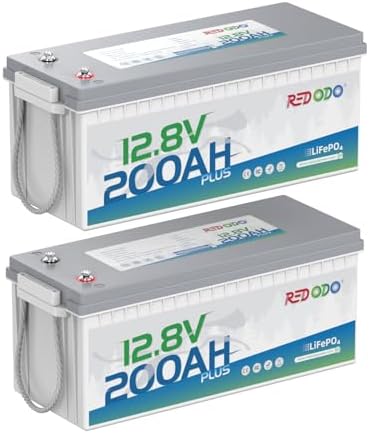
Around 200 amp hours of 12V LiFePO4, either one large battery or two standard cases wired in parallel, with a battery management system rated for the continuous current this inverter can pull. Lead acid works for occasional short bursts, but it sags under a 2000 watt load in a way lithium does not.
🧰 The Cable and Fuse Kit
Heavy gauge battery cable with proper crimped lugs, plus a fuse holder and fuse mounted close to the positive terminal. Sized for a 2000 watt inverter this typically means cable in the 2/0 AWG range and a fuse rated to protect it, not to match the inverter’s output.

Installing a 2000 Watt Inverter Safely
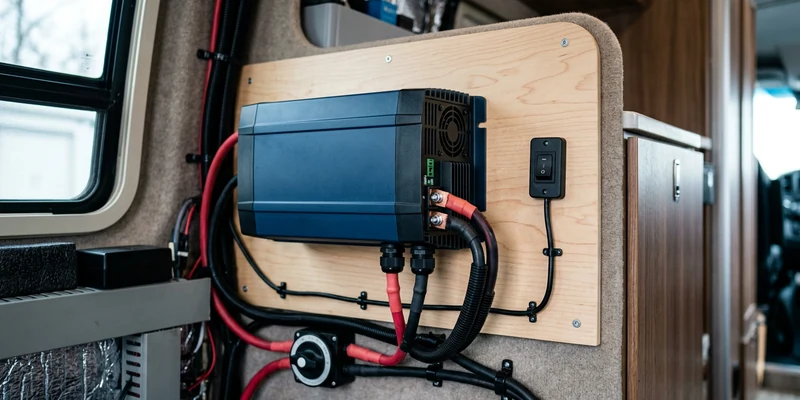
Mount it close to the battery bank, in a ventilated space, with the cooling fan unobstructed. Keep the DC cable run as short as the layout allows and support it so it cannot chafe against metal. Fuse the positive side near the battery, since that fuse protects the cable in a short circuit and nothing else in the rig will do that job.
Standard 12V precautions apply while you work: disconnect the negative cable first, pull the main fuse, remove rings and watches, and tighten terminal hardware properly, because a loose connection carrying two hundred amps generates real heat. Turn the inverter off at the remote when you leave the rig, since standby draw is small per hour and noticeable over a week.
Where the line is
Connecting the inverter output into the coach’s 120V distribution panel is not owner work. Subpanels, transfer switches, and neutral to ground bonding are governed by rules that exist for good reasons, and mistakes there are not visible until something goes badly wrong. Plugging appliances into the inverter’s own outlets is fine; rewiring the AC side of the rig belongs to a certified RV technician or a licensed electrician. If the unit already installed is failing, our guide to RV inverter repair separates what an owner can address from what cannot be fixed.
Common Mistakes to Avoid
- Pairing it with one battery. The inverter will not be the component that disappoints you; the sagging bank will.
- Buying modified sine to save a little. Compressors, chargers, and anything with a circuit board object, and the savings vanish on the first replacement.
- Running two heat producing appliances at once. Microwave and coffee maker together is above the class, every time.
- Using cable that fits rather than cable that is rated. Gauge follows amps and distance, not terminal size.
- Leaving it powered on continuously. Standby draw over a week of storage is how batteries get found flat.
- Expecting it to run the air conditioner. The starting surge alone rules it out in almost every rig.
Where to Go From Here
If you are still deciding whether this is the right class at all, our full RV inverter comparison lays the sizes out side by side, and what an RV inverter actually does is the place to start if the terminology is still slippery. To avoid the single most common misunderstanding in RV electrical, read inverter vs converter.
If the real goal is running larger loads for longer, the honest answer is often a second power source rather than a bigger inverter. Our roundup of RV inverter generators covers the quiet models that pair well with a modest battery bank.
Frequently Asked Questions
What can a 2000 watt inverter run in an RV? A microwave, a coffee maker, a residential refrigerator, and all the small electronics, one large appliance at a time. Rooftop air conditioning and sustained induction cooking are outside the class.
How many batteries do I need for a 2000 watt inverter? Plan on roughly 200 amp hours of lithium, or a large multi battery lead acid bank. A single battery sags under the current and triggers a low voltage shutdown.
What size cable does a 2000 watt inverter need? Typically heavy cable in the 2/0 AWG range at normal mounting distances, with a fuse near the battery sized to protect the cable. Longer runs require thicker cable rather than a longer thin one.
Is a 2000 watt inverter charger better than a plain inverter? It is better if you want automatic switching between shore power and battery power and one less charger in the rig. It costs more and takes more room, so a plain inverter is fine for occasional use.
Will a 2000 watt inverter run a microwave? Usually yes, in short bursts, keeping in mind that a microwave draws considerably more than its cooking wattage. Nothing else large should be running at the same time.
Can I install one myself? The 12V side is standard owner work with the battery disconnected and the fuse pulled. Tying the output into the coach’s 120V panel should be done by a certified RV technician or licensed electrician.
The Bottom Line
Two thousand watts is the practical middle of RV inverters: enough for the kitchen appliances people actually miss, still installable without rebuilding the rig. Buy pure sine, add a remote switch, and spend as much attention on the battery bank and the cable and fuse as on the inverter itself, because that is where this size succeeds or disappoints.