Last updated: August 14, 2026
Effective trailer security storage is not one strong lock, it is several ordinary obstacles stacked on top of each other. A thief towing away a trailer from a storage lot is working against the clock and in full view, so the goal is not to make theft impossible, it is to make your trailer the slowest and most conspicuous one in the row.
That is why owners who take this seriously use layers: something at the coupler, something at a wheel, something that makes the trailer awkward to move, and something that tells them where it went if all of that fails. None of it is expensive relative to what sits inside, and most of it takes a few minutes on the day you drop the rig off.
This article contains affiliate links. If you buy through them, we may earn a commission at no extra cost to you. Learn more.
Quick Answer
How do you secure a trailer at a storage lot?
- Layer it: a coupler lock so the ball cannot be attached, a wheel lock or boot so it cannot roll, and a hidden GPS tracker so a stolen trailer can be found.
- Choose the lot as carefully as the locks. Fencing, gate access records, lighting, and camera coverage do more than any single device on the trailer.
- Document everything before you leave: VIN, photos from every angle, serial numbers of what is inside, and confirmation that your insurance covers the trailer where it is stored.
The Layers, and What Each One Actually Stops
Every device on this list has a limit, and knowing the limit is what stops you from relying on one item. Stack three or four and the trailer stops being a quick target.
| Layer | What it stops | Where it falls short |
|---|---|---|
| Coupler lock | Anyone dropping a ball under the coupler and driving off | Does not stop a recovery style lift or a strap tow |
| Wheel lock or boot | Rolling the trailer, and it is highly visible from a distance | Can be defeated with time and tools; use on more than one wheel if you can |
| Hitch pin lock | Removing a receiver mount, and secures a hitch left in place | Only protects the hardware, not the trailer itself |
| GPS tracker | Nothing, but it turns a theft into a recovery | Needs power and cellular coverage, and needs testing before you rely on it |
| Removing a wheel | Casual towing entirely, for long term storage | Needs proper support under the axle and is not for short stays |
| Lot choice | Opportunists, since fencing, gates, and cameras deter before anything else does | Costs more, and camera coverage is often less complete than advertised |
| Documentation | Nothing at the lot, but it decides how the insurance claim goes | Useless if the photos live only on a phone that goes missing too |
Note the pattern. The devices buy time and attention, the tracker buys recovery, and the paperwork buys a settlement. Skipping any one of the three leaves an obvious gap.
Start at the Coupler
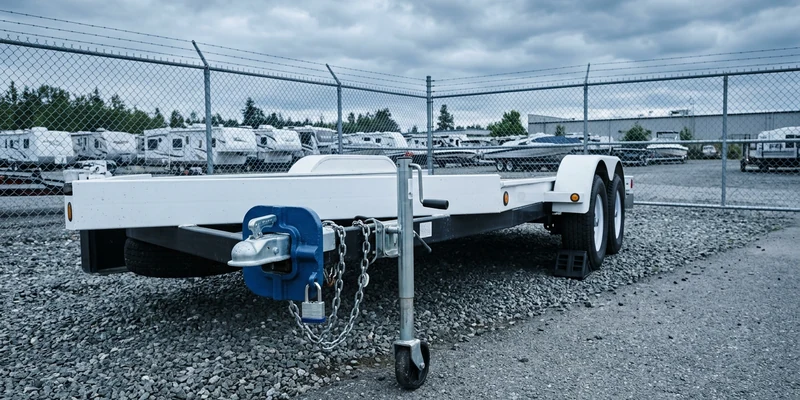
A coupler lock fills or covers the ball socket so no hitch ball can be inserted, and it is the single most useful item in the list because it addresses the fastest method of theft. The pin style lock that fits through the coupler latch is the minimum, while the shroud style that encloses the whole coupler is harder to work around.
Two details matter more than the brand. First, fit: coupler sizes vary, and a lock that does not seat correctly against your coupler leaves the gap someone needs. Second, weather: a lock that lives outdoors through a winter will seize if the cylinder never sees lubricant, so pick something weather rated and treat the cylinder before storage. A lock you cannot open in March is its own kind of problem.

Stop the Wheels From Turning
A wheel lock, sometimes sold as a boot or clamp, does two jobs at once. It physically prevents the wheel from rotating, and because it is brightly colored and obvious from across a lot, it moves attention to the trailer parked next to yours.
Fit is again the deciding factor. Check the tire width and rim diameter the lock is designed for, and be aware that some designs interfere with wheel covers or with duals. Owners who store long term often use two, one on each side, and combine them with chocks so nothing moves during the season. If you are also fitting chocks for the season, that is a good moment to look at the tires themselves, since long parked tires are exactly the ones that later cause an RV tire blowout.

The Long Term Option
For storage measured in months rather than weeks, removing one wheel entirely is the most effective deterrent available, since nothing rolls anywhere. It only makes sense if the axle is properly supported on rated jack stands on firm ground, never on leveling blocks or stabilizer jacks, and it is worth asking the lot whether they permit it before planning around it.
Choose the Lot Like It Is Part of the Security
The lot does more work than anything you bolt on. Ask specific questions rather than accepting a general assurance: is the perimeter fenced and in good condition, is the gate coded with individual access records or a shared code that everyone knows, is there lighting through the night, are the cameras recording and for how long, and is there any staffed presence.
Ask about access patterns too. A lot where anyone can follow a car through an open gate is a different proposition from one where each entry is logged. Position matters as well, since a trailer parked deep in a lot with others around it is harder to extract than one sitting near the fence line with a clear pull out. And read the storage agreement for what it says about liability, because most lots explicitly do not insure your rig.
Tracking and Documentation
A GPS tracker will not prevent anything, and that is fine, because its job starts after the trailer leaves. Hidden trackers that report position on movement give law enforcement something to work with in the window where recovery is realistic. Pick one that suits how your trailer sits: hardwired units need a power source that survives storage, and battery units need a charging schedule and a check before each layup.
Test it before you rely on it. Verify the app alerts you when the trailer moves, confirm coverage at the actual lot rather than at home, and make sure someone else knows how to access the account. Then do the paperwork: photograph the trailer from all four corners and the interior, record the VIN and where it is stamped, note serial numbers of anything valuable inside, and store all of it somewhere other than the phone in your pocket.

Confirm the Insurance Before, Not After
Call your insurer and confirm that the trailer is covered while in storage at that address, that contents are covered and to what limit, and whether they require specific security measures. Some policies distinguish between covered and uncovered storage or between fenced and unfenced lots. That conversation takes ten minutes and decides everything about how a bad day ends.
The Rest of the Layup
Security is one part of leaving a trailer somewhere for months. While you are there, deal with the things that quietly cause damage in the meantime.
Cover the tires against ultraviolet exposure and park on boards rather than directly on damp ground or hot asphalt. Deal with the water system before freezing weather, covered in how to keep RV pipes from freezing. Decide what happens to the batteries, since a battery left to slowly discharge through a winter often does not come back, which is the subject of keeping RV batteries charged in winter storage. And close off entry points before rodents find them, since a stored trailer is exactly the quiet, sheltered space they are looking for, as covered in how to keep mice out of an RV.
Common Mistakes to Avoid
- Relying on one lock. Any single device can be defeated with time. Layers are what make a trailer a poor target.
- Buying a coupler lock without checking fit. A lock that does not seat correctly on your coupler size leaves the gap that matters.
- Leaving valuables aboard. Tools, electronics, and generators are what turn a trailer into a target in the first place.
- Never testing the tracker. An untested tracker is a subscription, not a security measure.
- Assuming the lot insures your rig. Most storage agreements say the opposite in plain language.
- Supporting an axle on leveling blocks. If a wheel comes off, the axle belongs on properly rated jack stands on firm ground.
Frequently Asked Questions
What is the best lock for a travel trailer? There is no single answer, which is why layering works. A coupler lock addresses the fastest theft method, a wheel lock stops the trailer rolling and is visible from a distance, and using both is far stronger than either alone.
Do GPS trackers actually help? They do not prevent theft, but they give you and law enforcement a location during the short window when recovery is realistic. Test alerts and coverage at the storage lot before you depend on it.
Should I remove a wheel for long term storage? It is highly effective for storage measured in months, provided the axle is supported on properly rated jack stands on firm ground and the lot allows it. It is not practical for short stays.
Does my insurance cover a trailer in storage? Ask your insurer directly, since coverage often depends on the storage address, whether the lot is fenced or covered, and what limits apply to contents. Do not assume the storage facility carries any liability.
What should I photograph before storing? All four exterior corners, the interior, the VIN and where it is stamped, and serial numbers of anything valuable aboard. Keep copies somewhere other than the phone you carry.
What else should I do before a long layup? Cover the tires, protect the water system from freezing, plan for the batteries, and seal rodent entry points. See keeping RV batteries charged in winter storage for that side of it.
The Bottom Line
Stack layers rather than trusting one device: a correctly fitted coupler lock, a visible wheel lock, and a tested GPS tracker cover prevention, deterrence, and recovery in turn. The lot itself matters as much as the hardware, so ask about fencing, gate access records, lighting, and camera retention before you sign anything. Then document the VIN, photograph the rig inside and out, confirm with your insurer what is actually covered in storage, and finish the layup with tires, plumbing, batteries, and rodent proofing.