Last updated: August 14, 2026
Before any of the practical detail, the part that decides everything: whether you can dump RV tanks at home depends entirely on local law and on the system your house is connected to, and there is no national answer. In some places a homeowner may discharge holding tanks into their own sanitary sewer cleanout without a second thought. In others it requires a permit, is restricted to gray water only, or is not allowed at all. On a septic system there is a further question about capacity and about what your county health department permits. Find out what applies at your address before you connect anything.
What is not in doubt is the other side of it. Emptying holding tanks onto the ground, into a ditch, into a street gutter, or into a storm drain is illegal essentially everywhere in the United States, and storm drains in particular usually run straight to a creek or a river without any treatment at all. This guide covers how to find out what your own rules are, and then how to do the job properly if the answer turns out to be yes.
This article contains affiliate links. If you buy through them, we may earn a commission at no extra cost to you. Learn more.
Quick Answer
Can you dump RV holding tanks at home?
- Only where it is legally permitted, and only into a sanitary sewer or an approved septic connection. Check with your local sewer utility, county health department, or building department first, and check any HOA rules as well.
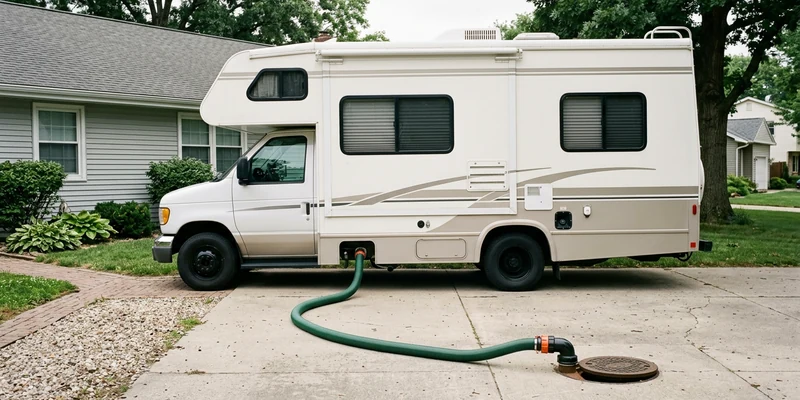
- Where it is allowed, the accepted route is a proper connection to a house sewer cleanout or an approved RV dump connection, with the black tank emptied first and the gray tank used to rinse the hose.
- Never discharge to the ground, a ditch, a gutter, or a storm drain. That is illegal in practice everywhere and storm drains typically flow untreated to local waterways.
Which Routes Are Acceptable, and What to Confirm
Use this table to work out which conversation you need to have before you buy any equipment. The right hand column is what to ask, and the answer you get is the one that governs, not anything you read online.
| Route | Generally viable? | What to confirm first |
|---|---|---|
| House sanitary sewer cleanout | Often, where local rules permit it | Ask your city or county sewer utility whether RV discharge to a private cleanout is allowed, and under what conditions |
| Purpose built RV sewer connection | Yes where one was permitted and installed | Whether it was permitted, and whether it needs a backflow device |
| Septic system, via cleanout or approved point | Sometimes, with real caveats | County health department rules, tank capacity, and the effect of a large slug of water on the drain field |
| Toilet inside the house | Slow but sometimes used with a macerator | Whether local rules treat this differently, and whether your drain can take the volume |
| Portable waste tote to a dump station | Yes, and it sidesteps the question entirely | Nothing beyond where the nearest dump station is |
| Onto the lawn or gravel | No | Not a legal option. Do not do it |
| Ditch, gutter, or storm drain | No | Illegal and usually discharges untreated to a waterway |
| Neighbor’s or business cleanout | No, unless explicitly authorized | Written permission plus the same local rules that apply to your own |
If any of those conversations ends with a no, the portable waste tote route is the straightforward answer. It is what a lot of owners in restrictive areas use, and it turns the problem into a short trip rather than a legal risk.
How to Find Out What Applies Where You Live
This takes two phone calls and an afternoon, and it is the only part of this job you genuinely cannot skip. Start at the top of the list and stop when you have a clear answer in writing or from a named person.
- Your sewer utility or public works department. They own the rules about what may enter the sanitary sewer and they are used to the question. Ask specifically about discharging RV holding tanks to a private cleanout on your own property.
- The county health department, if you are on septic. Septic rules are usually theirs rather than the city’s, and they will also tell you whether tank additives are a problem for your system.
- The building or permitting department. If you are thinking about installing a dedicated RV sewer connection rather than using an existing cleanout, that is almost always permitted work.
- Your HOA or landlord. Even where the law allows it, a covenant or a lease may not, and this is the one people discover last.
- Write down who told you what. A name and a date is worth having if a neighbor ever raises the question.
Rules also differ between black and gray water in many jurisdictions, and gray is sometimes treated more permissively. Do not assume that, though. In plenty of places gray water from an RV is regulated exactly like black water, precisely because it carries food waste, grease, and soap.
Doing It Properly Where It Is Allowed
Assuming you have a clear yes and a suitable connection, the procedure is the same one you would use at a dump station, with a little more care because you are working next to your own house.
- Gear up first. Disposable gloves, a hose you use for nothing else, and a bucket of clean water and soap set up before you start. Keep the fresh water hose out of this entirely, and never let the two touch.
- Connect the sewer hose at both ends before opening anything. Seat it on the rig’s bayonet fitting and secure it into the cleanout with a proper adapter so it cannot lift out under flow. A hose that jumps out of a cleanout is the failure everyone remembers.
- Black tank first, and only when it is reasonably full. Volume is what carries solids out. Dumping a quarter full black tank is how you end up with a pyramid clog, which is a separate and much less enjoyable job covered in clearing a clogged RV black tank.
- Then the gray tank. Gray water rinses the sewer hose on its way out, which is the whole reason for the order. Leave enough gray in reserve to do that properly.
- Rinse the black tank if you have a flush connection. Use the built in tank rinse or a wand, and watch what comes out through a clear elbow so you know when to stop.
- Close the valves, then disconnect. Black valve first, gray second, then break the connection with the hose still tilted to drain. Cap both ends.
- Rinse the area and wash up. Flush the cleanout with clean water, replace its cap, and wash thoroughly. Store the sewer hose somewhere it never contacts fresh water gear.
🧰 The connection that makes it safe rather than improvised
A sewer hose kit with a clear elbow and a set of adapters, including a threaded fitting that locks into a standard cleanout. The clear section is not a gimmick, it is how you tell when a rinse is finished, and a locking adapter is what stops a hose lifting out under pressure. Match the fittings to the cleanout size at your house before ordering.

🔩 For getting a proper seal at the cleanout
A threaded sewer hose to cleanout adapter in the size that matches your house connection, typically three or four inches. A firm mechanical connection beats a hose wedged into a pipe every single time, and it is the difference between a routine job and a genuinely bad afternoon.

When the Cleanout Is Uphill or Far Away
Gravity dumping needs a downhill run, and plenty of driveways do not provide one. That is what macerator pumps are for. A macerator grinds the discharge and pumps it through a small diameter hose, which means it can push uphill and over a longer distance than a gravity hose ever will, and it makes a garden hose sized line practical.
The tradeoffs are real. Macerators are slower than a gravity dump, they add an electrical component that can fail, and they are unforgiving about anything that should not have gone in the toilet in the first place. Owners who use them consistently also report that they are much less messy overall, which is why full timers on tight sites tend to like them.
⚙️ For a cleanout that gravity cannot reach
A 12V RV macerator pump with a garden hose sized discharge line, either a portable clamp on unit or a permanently mounted one at the outlet. Check the amp draw against the circuit you plan to feed it from, and be honest with yourself about what has been going down the toilet, since a macerator is far less tolerant of wipes and heavy paper than a three inch gravity hose.

Or skip the plumbing question entirely
A portable waste tote on wheels is the option people forget. You fill it from the rig, tow it behind a vehicle or wheel it, and empty it at a dump station. It sidesteps every question about your home connection, it works for renters and HOA neighborhoods, and it costs nothing to permit.
🛞 The option that avoids the whole legal question
A wheeled portable waste tote sized to your tanks, with a tow handle and a proper vent. Buy larger than you think you need if you can store it, since the whole point is emptying the rig in one trip rather than three. Check tire type against how far you will actually be towing it.

Where This Stops Being a DIY Job
The dumping itself, done into an approved connection, is routine. These four are not, and two of them are legal rather than technical.
- Installing a new sewer connection. Cutting into house drain lines, adding a dedicated RV connection, or fitting a backflow device is licensed plumber work and it is usually permitted work as well. Do not improvise a permanent connection.
- Anything on a septic system you are unsure about. Septic capacity, drain field loading, and the effect of tank chemicals are questions for a septic professional or your county health department. A large discharge into a marginal system is an expensive mistake.
- Backflow and cross connection concerns. Any arrangement where waste water could be pushed back toward a potable supply is a serious matter and belongs to a licensed plumber, not to a hose and hope.
- Uncertainty about the rules. If you cannot get a clear answer that dumping is permitted at your address, use a dump station or a tote. An enforcement action, a fine, or a contaminated waterway is not worth the convenience.
Common Mistakes to Avoid
- Assuming a cleanout in the yard means permission. The pipe being there is not the same as being allowed to use it that way. Ask first.
- Dumping the black tank when it is barely full. Volume carries solids. A partial dump is how clogs start.
- Leaving the black valve open on a full hookup at home. Liquid drains away and solids stay behind. Keep it closed and dump in batches.
- Dumping gray before black. Gray water is your hose rinse. Use it in the right order and the cleanup takes a minute.
- Wedging the hose into the cleanout. Use a threaded adapter. A hose that lifts out under flow makes a mess you will remember.
- Mixing fresh and waste gear. Different hoses, different storage, no exceptions, ever.
Where to Go From Here
If the reason you are dumping at home is that something already went wrong, deal with that first. Clearing a clogged RV black tank covers the pyramid clog, and a black tank clogged with toilet paper covers the version caused by the wrong paper and not enough water.
If the smell is what brought you here rather than the volume, the gray tank is usually the culprit and it has its own fix, covered in why your RV gray tank smells. And once the waste side is sorted, the fresh side deserves the same attention in how to sanitize an RV fresh water tank.
Frequently Asked Questions
Is it legal to dump RV tanks at home? It depends entirely on where you live and what your house is connected to. Some jurisdictions permit discharge into a private sanitary sewer cleanout, others restrict or prohibit it. Ask your sewer utility, county health department, and HOA before you connect anything.
Can I dump into a septic system? Sometimes, but treat it as a question for your county health department and a septic professional. Capacity, drain field loading, and tank additives all matter, and a large slug of water can cause real problems.
Can I dump gray water on the lawn since it is just sink water? No. Gray water carries food waste, grease, and soap, and many jurisdictions regulate it exactly like black water. Ground discharge is not a legal option.
Which tank do I empty first? Black first, then gray. The gray water rinses the sewer hose on its way out, which is the entire reason for the order.
Do I need a macerator pump? Only if gravity will not do the job, meaning the cleanout is uphill or too far for a standard sewer hose. Where gravity works, it is faster and there is nothing to fail.
What if dumping at home is not allowed where I live? Use a dump station, or move the waste with a wheeled portable tote. That is what most owners in restrictive areas do and it works fine.
The Bottom Line
Start with the rules, not the hose: ask your sewer utility, your county health department if you are on septic, and your HOA whether discharging RV holding tanks at your address is permitted. Where it is, use a proper threaded connection into a sanitary sewer cleanout, dump black first and gray second, and keep waste and fresh water gear completely separate. Where it is not, use a dump station or a wheeled tote, and never put holding tank contents on the ground or into a storm drain.